Those who survived a suicide attempt on what drove them to the brink – and what helped them hold on
The path of recovering after once thinking of ending one's life is rarely straightforward. But for those who have lived through such a crisis, and the caregivers who walked beside them, they hope no one has to face it alone.
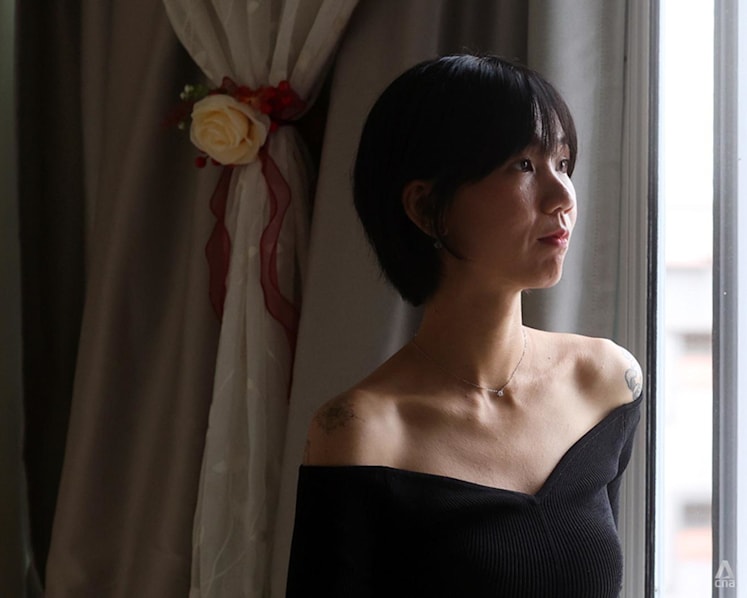
Ms Adoncia Ng, 30, struggled with depression and thoughts of suicide as a teenager. (Photo: CNA/Ooi Boon Keong)

This audio is generated by an AI tool.


Warning: This article contains references to suicide, self-harm and domestic abuse.
The first time she attempted suicide, Ms Sandy (not her real name) was in Secondary 3 and had tried to end her life by swallowing a household cleaning product.
At 15, she was reeling from a family conflict that had spilled into her school life, leaving her feeling "really humiliated" and with nowhere to turn.
"I felt like I wanted to have some place to dig a hole and just hide and not come out anymore," said Ms Sandy, now a 51-year-old freelance educator.
"After drinking (the cleaner), I was sick and vomited, and my parents thought I was sick because of food poisoning."
She continued to experience suicide ideation every now and then – and then in her 30s, she fell to new depths of depression while dealing with a divorce and financial stresses from her family. She hit rock bottom when a colleague of hers died in a workplace accident.
After noticing her irregular sleeping and binge eating patterns, it was her sister who "verbally slapped" her out of it.
"My sister came to me one day and said: 'What are you trying to do with your life? Is this really what you want to do?' When she asked that, I just broke down and cried," said Ms Sandy, visibly choking up as she recalled the incident.
"I felt during that period of time (that) life was a blur. Everything was misty and foggy to me."
She spoke on condition of anonymity given that stigma surrounding suicide still exists today. While awareness around mental health has grown in recent years, many who have struggled with suicidal ideation said the silence and shame are still daunting.
Last September, a first-of-its-kind study in Singapore released by the Institute of Mental Health (IMH) found that suicide is rarely the result of a single cause. Instead, it's often a convergence of factors including mental illness, physical health issues and relationship breakdown.
The study, titled Seeking Answers: A Psychological Autopsy of Exploring and Analysing Risk Factors (SPEARS), also found that on average, four warning signs emerged in the week before a person died by suicide.
In response to CNA TODAY's queries, Associate Professor Mythily Subramaniam, principal investigator of the study and assistant chairman of the institute's Medical Board for Research, said the study provided insights into the complexity of suicide in Singapore, particularly the role of interpersonal, social and clinical factors.
The study also underscored gaps in recognition both at the individual and caregiver level. For example, suicide loss survivors – individuals who had lost loved ones to suicide – said they were unaware of warning signs or unsure how to respond when a loved one expressed suicidal thoughts.
Survivors of both suicide attempts and suicide loss told CNA TODAY that while those warning signs were familiar, they were only part of the picture of how overwhelming everyday situations can escalate to a point of an individual wanting to end their life.
The journey back from crisis was rarely linear, said those who had lived it and the caregivers and mental health professionals who have worked with persons dealing with suicidal ideation. More importantly, it's a process that they hope no one has to face alone.
LIVING WITH WANTING TO DIE
Individuals who have considered ending their life told CNA TODAY that rather than singular triggers, it was an accumulation of pain over time that made it hard to imagine any other way out – much of it rooted in circumstances beyond their control.
The imprints of the mental, emotional and physical abuse from Ms Adoncia Ng's now-estranged mother led her to struggle with suicidal thoughts as early as 14 years old.
At her lowest points, when she felt life was meaningless, she would self-harm by hitting her head against the wall or scratching her arms whenever she argued with her mother.
"It seemed almost like my vision had a grey tint. Everything was in greyscale, everything was so gloomy," said Ms Ng, now 30 and a business development and strategy manager.
"I was very sad all the time. I would be crying and not know why I'm crying. My heart would ache."

A fear of heights kept her from acting on a plan she had formed at the time. At 15, she found some grounding in a best friend who related to her struggles at home.
But three years later, a new wave of anxiety hit, causing her to struggle with even simple everyday tasks such as leaving the house or ordering food. For her, this period dredged up the trauma of her childhood and, with it, fresh thoughts of suicide.
"I didn't dare to seek professional help at the time," said Ms Ng. "My parents were not very well-to-do and psychological help just felt very expensive, and we were not very educated about (mental health)."
Those around her noticed some warning signs, but actual help was scarce. Her father saw the self-harm but stayed silent, later admitting he feared that raising it might make things worse.
On one occasion, Ms Ng recalled her mother walking into her room after finding her staring out the window of their 8th-storey flat.
"She said: 'Why, do you feel like you want to commit suicide? I also feel like I want to commit suicide.' And then she left the room," said Ms Ng.
For mental health social worker and counsellor Muhamad Haikel Mohamed, suicidal thoughts first surfaced when he was 14 years old, following multiple sexual assault incidents that left him in what he described as "dark, bleak and lonely" period.
"There was a deep pain and heaviness in my heart," he recalled.
"Negative thoughts kept screaming in my head, thoughts like: 'You are better off dead', 'No one loves you', and 'Life is so much better for others without you'."
The pain and sense of self-loathing he felt led him to feel suicide was a viable option at 18 years old. He later made multiple attempts over the years.
"We can't choose or decide to have suicidal thoughts or not. It can happen to you and me," said Mr Haikel, now 38.
Even as their inner lives were in tumult, some told CNA TODAY that those around them were none the wiser as they often "masked" signs of self-harm or suicidal intent.
It was a workplace conflict about 23 years ago that first led Mr Sam Roberts, 55, to feel a deep emotional exhaustion and sense of being trapped even as everything appeared normal on the outside.
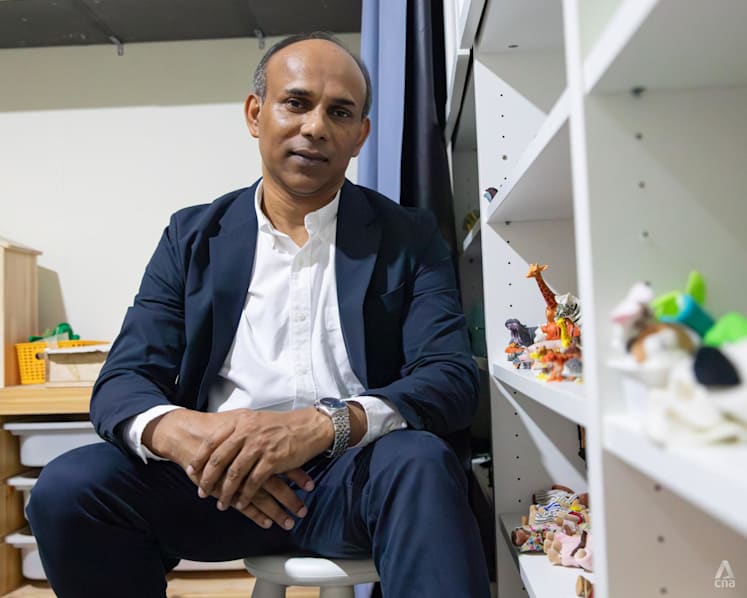
Mr Roberts, now the founder and executive director of Olive Branch Psychology, said: "Over time, that turned into a feeling of being stuck, and there was no clear way of moving forward."
"Looking back, it was not that I wanted to die. It was more that I couldn't see how to keep this going or living this way."
THE JOURNEY TO RECOVERY
Just as the journey towards wanting to end one's life is often not straightforward, the path to recovery can also be long and winding.
Where he would have once described his mental health as a "rollercoaster ride", Mr Haikel compared it now to a Ferris wheel ride, with more measured ups and downs.
Looking at a list of suicide risk warning signs identified in the IMH SPEARS study, such as lack of purpose, hopelessness, withdrawal and mood changes, he recognised some of them surfacing in himself in the weeks before his previous attempts.
However, he noted that certain signs such as suicidal ideation and feeling trapped are harder for others to spot, unless clearly expressed by the individual experiencing them.
"For me, I wished those around me would have noticed how withdrawn and hopeless I've become as compared to my baseline. These are observable signs," he said, adding that a few people close to him did recognise such warning flags in him and reached out to check on him.
Besides practical intervention close to a mental health crisis, he stressed that understanding signs of distress and deterioration of mental health, which can be precursors to manifesting suicidal thoughts, would also be helpful in supporting a loved one.
We can't choose or decide to have suicidal thoughts or not. It can happen to you and me.
For Ms Ng, encountering an overseas YouTuber who posted about her depression and troubles at home helped her stay positive, giving her ideas and inspiration for self-care techniques she could adopt to look after her own mental health.
"I wouldn't say I'm fully recovered – it's still an ongoing journey for me," said Ms Ng, who said that she is considering seeking professional help now as an adult to better understand the circumstances of her childhood.
"Along with a lot of people around me, I feel like we are still struggling, but we are going on the right path to want to recover."
A volatile childhood where he became an "unwitting collector of abuse" caused Mr Edwin Chaw to have panic attacks, insomnia, nightmares and flashbacks to the abuse in his 20s.
At his most isolated, he hit a depressive low while attending university abroad at around 25 years old, exacerbated by a breakup and academic and job stress, which led him to feel like every single pillar in his life "skewed towards the bad".
He began to realise the gravity of the situation only when he saw a doctor for his anxiety and panic attacks. The doctor suspected that he might have post-traumatic stress disorder and referred him to a psychologist.
"(The doctor) looked me square in the eye and very directly and bluntly asked me: 'Have you had thoughts of harming yourself? Have you been thinking of suicide?'"
This was the first time Mr Chaw had admitted to both himself and another person that he had been harbouring thoughts of ending his life.

Mr Chaw said disclosing his plans for suicide also enabled him seek help from a housemate, who would help to dispense his medications to make sure he took them as per his prescription.
With the disruptions to his studies, he also slowly came to terms with the understanding that the "traditional Singaporean dream" he had always envisioned for himself may never become reality, and allowed himself to search for other forms of success and fulfilment.
He also thought of the things he would miss about living, such as listening to music, so he would listen to music for hours at a time.
"It's a combination of the small things (you enjoy) and trying to reimagine what the future can be instead," said Mr Chaw, who is today a compliance officer and ambassador for Beyond the Label, a nationwide movement to address mental health stigma in society.
HOW TO HELP SOMEONE IN CRISIS
Whether a person struggling with suicidal thoughts is willing to seek help – or whether others offer it – remains underpinned by a stigma that experts say still runs deep in Singapore.
While discussions of mental health have become less taboo, perceptions persist of self-harm and suicide being "attention-seeking" behaviour or morally unacceptable, said survivors.
Some people, particularly from older generations, may still be under the impression that attempting suicide is a crime. Attempted suicide has been decriminalised in Singapore since January 2020.
For those who have lived through a mental health crisis, speaking openly about their personal experiences with suicide ideation and attempts is, in itself, an effort in suicide prevention – to reach others who may be struggling in silence.
"Talking about suicide should be as acceptable as talking about any other health concern," said IMH's Assoc Prof Mythily.
"Suicide prevention isn’t just about services or professionals – it’s about all of us playing a role in supporting friends, families, colleagues and the larger community, and having the courage to reach out when we notice something is wrong."
When a close friend began experiencing suicidal thoughts while grieving her mother's death from cancer, Mr Darren Tan was just a teenager and initially felt lost about how to help.
"What she needed was not solutions, but a listening ear and (people to validate) her feelings. She just lost her mother – we cannot just say that we understand her situation and how she's feeling," said Mr Tan, now 25.
"It's (important) to just to be present and genuine, even if you don't know how to de-escalate the situation."
Mr Tan, now a final-year psychology student at the National University of Singapore, went on to train as a volunteer at suicide prevention charity Caring for Life. Today, he runs training sessions for others who want to help but do not know where to start.
He acknowledged that in attempts to offer support, it may not be practical or sustainable to spend every waking moment with a loved one in crisis.
However, in his training sessions, he has observed that some hesitate to address the issue directly with their loved one because they have never been in such a situation before.
By far, though, the top misconception he encounters is the fear that simply raising the topic of suicide will make things worse.
"We encourage them to ask the question: 'Are you thinking about ending your life?' That is important because it opens up this platform for (their loved one) to share their feelings," he said.
"(Because) you have asked me this question, (I know) you're not going to judge me."
Assoc Prof Mythily said that in Singapore, many individuals hesitate to seek help because of concerns about being judged or labelled, or because they worry about the impact on their family, education, or career.
To this end, Mr Tan said adopting sensitive language is also important. He pointed to a common Chinese colloquial expression for one considering suicide – "做傻事" – which means "doing a foolish or silly thing". Such loaded phrases may cause individuals struggling with such thoughts to choose silence instead, to avoid being the target of negative judgment.
"If a person finally opens up to you and tells you they are thinking about ending their life, and the very next moment you shut them down and tell them they shouldn't do this – that would just ruin the whole conversation from the get-go," said Mr Tan.
Mr Alex Yeo, executive director at Caring for Life, said that the layman may feel like they are ill-equipped to support someone struggling with suicide ideation, but urged against underestimating the impact we can have on our loved ones despite not being professionals or experts.
Crucially, that support should not end once an immediate crisis seems to have passed.
"We are not saying that you need to go all out. Even the simple text of a check-in – 10 seconds – can be quite powerful," said Mr Yeo.
However, he noted that even with simple gestures, barriers may remain. For instance, the struggling individual may not respond well or be "emotionally aggressive" with the intention of chasing away those around them.
Ultimately, experts stressed that caregivers supporting someone at risk of suicide can often feel exhausted and isolated themselves in carrying this emotional burden, and are in need of consistent support themselves.
Ms Andrea Chan, a representative from Beyond the Label, said that there is also a burden that comes with having the knowledge of how critical the situation may be, as the caregivers often believe they're responsible for the life of their loved one, which can lead to chronic stress and emotional exhaustion.
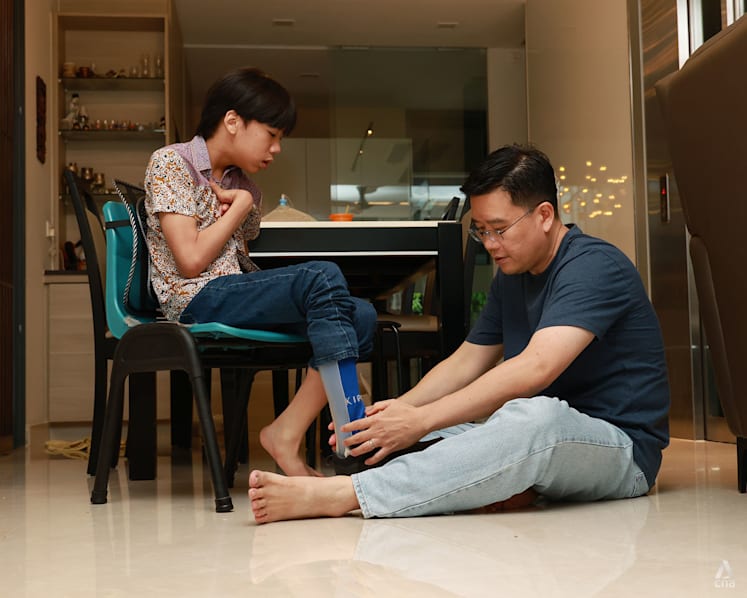
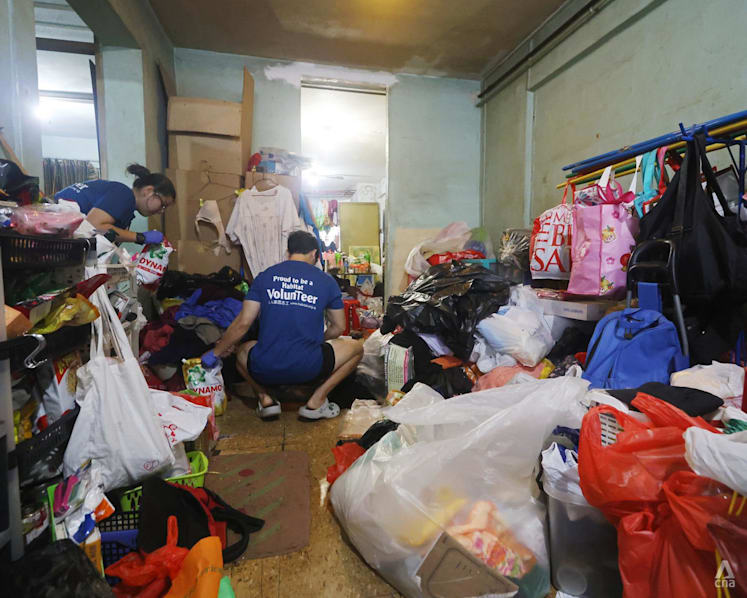
Before Ms Cheryl's (not her real name) spouse died by suicide after falling into depression just two weeks after their honeymoon in 2024, she tried to provide a listening ear, be present and encouraged him to seek professional help.
However, she said her new husband was becoming emotionally abusive towards her. Towards the end of his life, that abuse almost turned physical.
"It was a really difficult period for me. I wanted to help him, yet I kept getting hurt by him," said Ms Cheryl. "It slowly but surely eroded me."
She encouraged others who may be facing similar situations to share the circumstances with trusted people and seek professional help from certified sources.
"As a caregiver, there are many difficult choices that need to be made. Sometimes it feels like no matter what choice you make, every option is wrong," said Ms Cheryl.
"There are many things that do not go by the book, and not everything can be justified or understood through logic alone. Compassion and trying to understand go a long way."
Looking back, she saw how her late husband's pain had consumed his ability to see beyond it – and she wanted others who are struggling to know that seeking help is never an overreaction.
Mr Roberts' personal journey with suicidality sparked a career pivot to the mental health sector, one that later brought him to an unexpected point 4,130m above sea level.
He started a Climb for Life, an initiative where he and a team, including his two teenage sons, embarked on an expedition to Annapurna Base Camp in Nepal. The group reached the goal on Sep 10, 2025, on World Suicide Prevention Day.
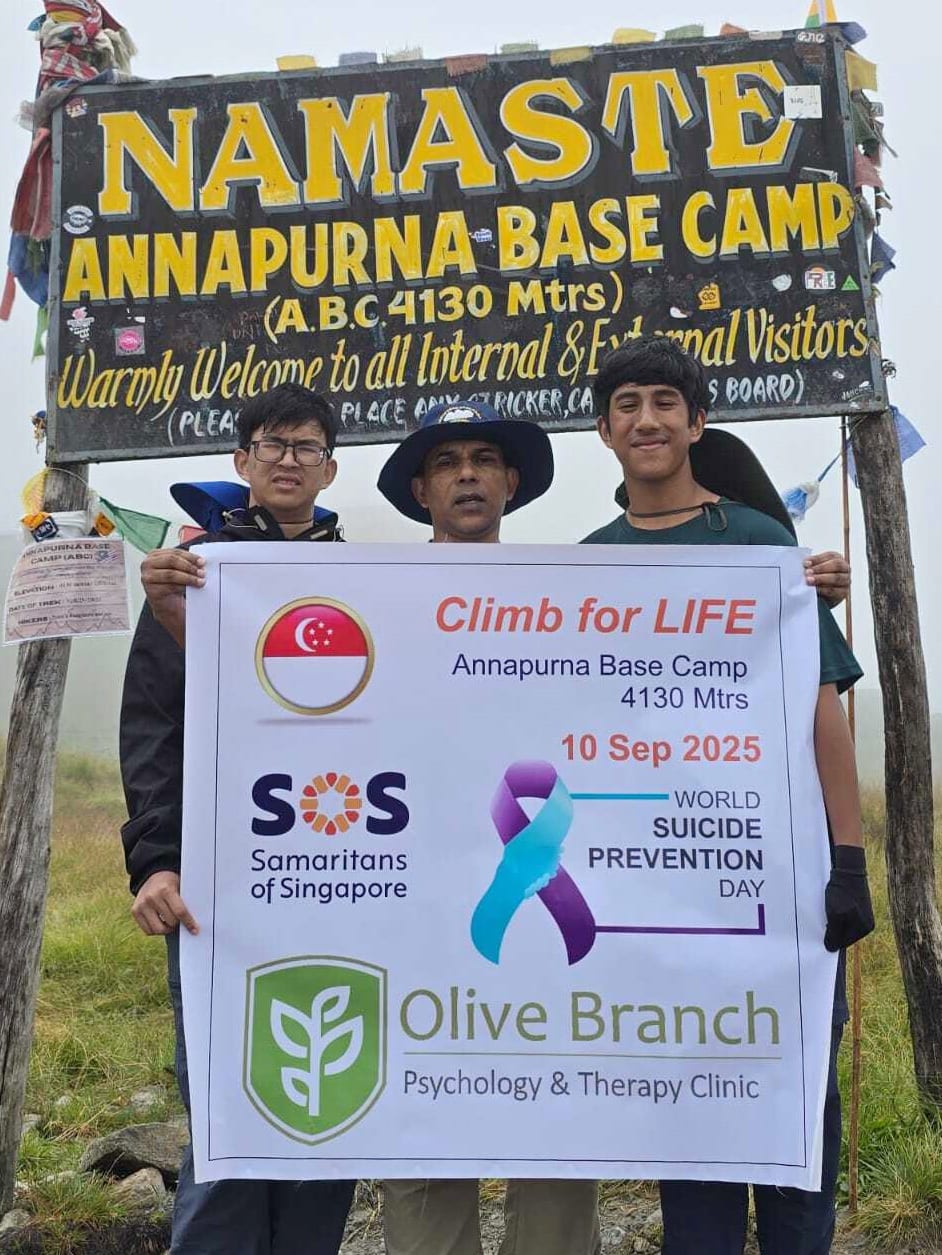
The trip was not without bumps – the family ended up stranded in the Himalayan range after protests swept across Nepal and Mr Roberts injured his left leg on the hike down – but he was proud that the effort raised around S$5,000 for Samaritans of Singapore (SOS).
Back home, he makes it a point to speak openly about his past experience with suicidal ideation and winding journey with mental health with his children and with clients at his counselling centre.
"Now my hope is I want to live to 100 years (old). People ask me: 'Are you crazy?' But life is so meaningful now," he said.
"I don't see any challenge stronger than living a happy life."
WHERE TO SEEK HELP
If you, or anyone you know might want to talk to someone, you can reach out to one of the helplines below.
- Samaritans of Singapore: 1767 (24-hour Hotline), 9151 1767 (24-hour CareText, WhatsApp)
- National Mental Health Helpline: 1771
- Touchline by Touch Community Services: 1800 377 2252
- Tinkle Friend (for primary school-aged children): 1800-2744-788
- You can also find a list of international helplines here. If someone you know is at immediate risk, call 24-hour emergency medical services.
Editor's note: An earlier version of this article misspelled Edwin Chaw's name. We are sorry for the error.