Taking children to festive gatherings is exhausting, but skipping them would be worse
The year-end holidays and festive occasions can be a crash course on social norms and behaviours for young children, says this mum of five. It helps to prepare them to avoid meltdowns.
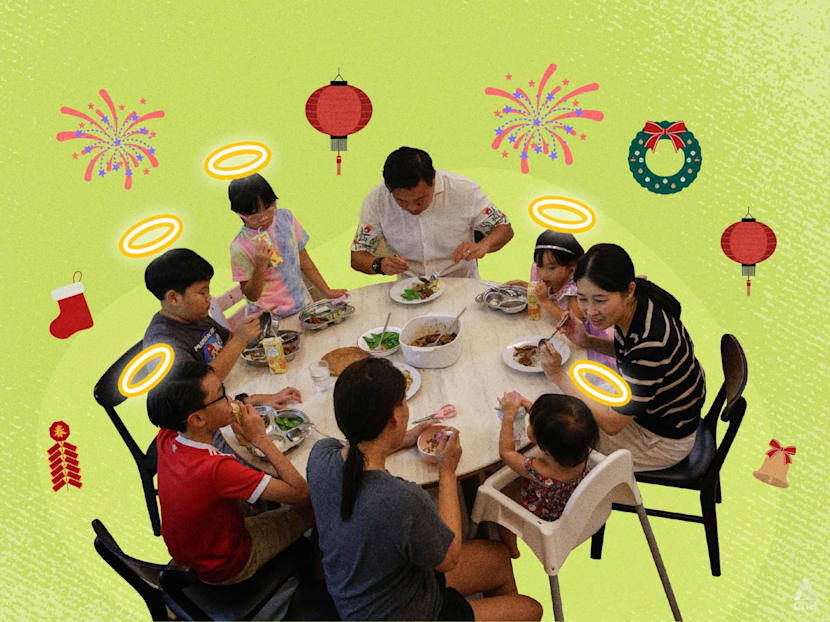
Ms Kelly Ang is constantly torn between wanting to catch up with loved ones at festive gatherings and worrying about her children's behaviour and possible meltdowns. (Illustration: CNA/Nurjannah Suhaimi and TODAY file photo)

This audio is generated by an AI tool.


Festive seasons have always been occasions I truly look forward to attending.
Christmas and Chinese New Year, in particular, usually meant endless gatherings with friends and family that stretched late into the night, with unrestrained conversations and genuine laughter. No one would be concerned about work or school the following day, and enjoyment was the only thing on the agenda.
Now that I've become a parent, such festive seasons give me mixed feelings instead.
Celebrating these occasions with kids in tow has made it impossible to be completely unadulterated in my enjoyment of the gatherings.
It is stressful for me, even after 12 years of parenting. As much as I want to enjoy the company of my friends and family, I'm also constantly worried about how my kids would behave and react – worse, if they accidentally made someone upset.
Back when I was a new mum, I cherished the idea of creating joyful memories with my firstborn, especially during the festive seasons like Christmas, New Year and Chinese New Year.
I truly wanted him – and later on, my younger ones, too – to experience the magic of Christmas, savour every moment and grasp the true meaning behind these celebrations.
As they grew older, and I had more children, I also felt the need to teach them how to behave properly at social gatherings.
These days, though, my older kids are definitely not that little anymore. It's far from cute when they interrupt conversations, try to end gatherings early with proclamations of "I'm bored!", hog their favourite food, or fail to acknowledge or greet other guests.
I would often feel compelled to leave early, so that my children wouldn't disrupt the gathering.
WHY GOOD BEHAVIOUR AT GATHERINGS MATTERS
In recent years, it has become increasingly clear that social skills among young people are under strain. Across many countries, more young people are struggling with social anxiety and finding it harder to navigate everyday interactions.


Researchers point to several reasons: the blip in social conventions during the COVID-19 years, the increased time children now spend online, intense academic and social pressures, and even concerns that overprotective parenting may play a role.
Whatever the cause, I see it as well and it worries me.
I want my children to be able to socialise effectively and adeptly in a wide variety of situations. And year-end parties with friends and family are the perfect places for them to learn and practise the basics of social life.
These are mostly low-stakes environments filled with people who care about them, where it's perfect for learning how to interact, take turns, read the room and simply enjoy each other's company.
However, it seems that what constitutes good behaviour at parties is subjective, depending on who you ask.
Some children can barely manage simple greetings or play with acquaintances. Others may swing to the opposite end of the spectrum – being too excited or too loud and hogging conversations.
Being good company is definitely a life skill, one that I believe is gradually fading over time.

Too many young people have grown up prioritising their wants and needs, leading to what I like to call "main character syndrome" – a mindset where their own desires take precedence over everyone else's.
Picture a room filled with such individuals. It would be hard for any genuine connection to happen. Living in a society made up of people like that would feel like a nightmare.
Children cannot help but put their own needs and wants first, so as parents, we need to help them look beyond themselves.
It is not some vague ideal that is separate from what we expect at parties. To me, it is absolutely linked.
HOW I DO IT
Before every party, I give my children a heads-up well before we leave. I'll tell them where we're going, what's likely to be on the menu, how long we'll be there and who we're meeting.
If it's been a while since the children of the different families have met, I may also suggest common interests that they may bond over or show them old photos of things they used to do together, to help my kids settle back into the friendship.
Sometimes, I give them a pre-emptive boost with activities they enjoy, such as taking them for a swim or playing a favourite board game with them in the morning before the gathering.
Other times, I reward them with activities they enjoy afterwards, or even issue warnings that come with an "or else" if none of these work.
During the gathering, I mainly want to sit and enjoy time with my loved ones, but I also watch the children closely.
When I notice that they are getting restless, I try to involve them in activities or shift the conversation so they can be a part of it.
"Hey, my son loves playing football, too. Son, tell uncles and aunties about the time last week you played in the heavy rain. It was really memorable, right?"
Friends and family also often try to involve their children in the conversations, because we care about them and understand that they are learning to converse with adults.


For the littler ones, I ensure they are well-rested before the gathering, helping them nap and eat a light meal if the food is served later than their usual dinner time.
During the event, I introduce them gradually to my friends' kids by sitting with them in the play area before joining the adults when they're ready.
If they become over-stimulated, I take a short, quiet walk outside and take them back when they are calmer.
Of course, it is easier on my extroverted kids than on my introverted ones. Knowing how introverted or extroverted each of my kids are helps me keep track of the kind of guidance or support they need at gatherings.
If it feels like a lot of effort just to take the children to those joyful gatherings, believe me, it really is.
However, I truly believe it's so rewarding because it gives us a wonderful chance to deepen our connections with loved ones, and we also pick up priceless social and emotional skills along the way.
CELEBRATING WITHOUT BURNING OUT
Having celebrated 12 wonderful festive seasons with my children, I've always wanted to keep our calendar more flexible each year as the year-end party rush starts, but I often find myself unable to do so.
As a serial people pleaser, I just find it too hard to say "no" to a hearty celebration.
But with back-to-back gatherings this past December, I was feeling truly burnt out.
It didn't help that my kids' sleep schedules were completely out of whack, with bedtimes stretching past midnight. That made it hard to wake up on time the next morning, leaving them generally fatigued at the gatherings that followed.
Next year, to help everyone in the family enjoy the festivities more sustainably, I’m hoping to flex my boundary-drawing muscle and space out our gatherings a tad more, with a little more breathing room and time for the littler ones to unwind and decompress, too.
Will I do better for this coming Chinese New Year? I suppose we'll find out soon enough.