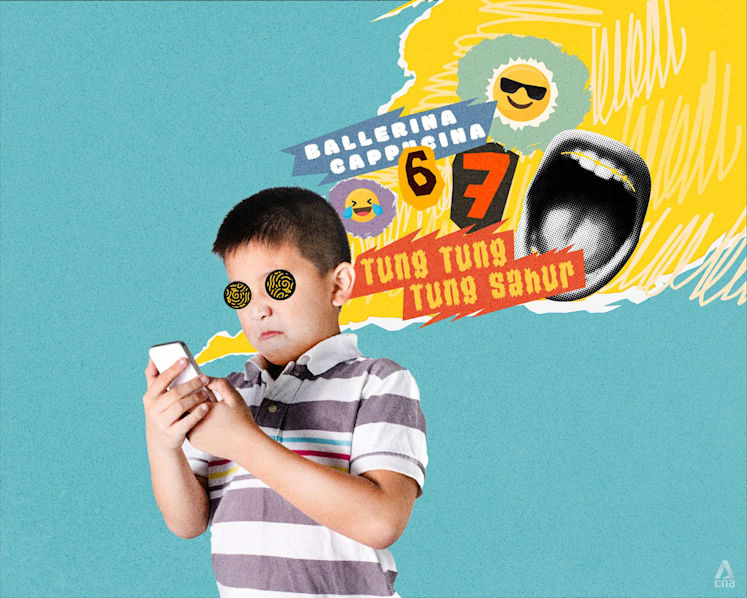
Slang and informal digital language are seeping into essays and class discussions. Here's how I deal with it as an educator
"Fr", "IJBOL", "it's giving" are just some of the internet slang that university lecturer Kennedy Albar hears increasingly often in his classroom, but the use of such words is not necessarily bad. He explains why.

Mr Kennedy Albar, a lecturer in communication and ethics, has noticed how quickly digital language spreads, but says that the real issue is not the slang or informal lingo itself. (Photo: CNA/Justin Tan)

This audio is generated by an AI tool.


These days, it's getting increasingly common in classes to hear a student discuss a philosophical argument with careful reasoning, then moments later remark that an idea is "lowkey problematic" or that someone's well-made point "slaps".
Online, expressions such as "fr" ("for real"), "ngl" ("not gonna lie") or "it's giving" ("it seems" or "it suggests") circulate widely across TikTok, Instagram and messaging applications. Occasionally, these expressions also surface in class discussion boards.
Being an educator, I've always advocated that students speak "properly". However, what I'm seeing appears to be much more complex than a simple decline in language standards.
Are young people forgetting how to speak good English? That is a question that has long been a subject of national debate, well before the advent of social media and internet slang.
For now, good English isn't "disappearing" exactly. Instead, it's more about the changing environments in which certain types of language are used.
Seeing slang and abbreviations such as "rizz" ("charisma") and "IJBOL" ("I just burst out laughing") increasingly seep into situations where more formal language is typically used and expected, it raises a new concern: Are young Singaporeans losing the ability to shift between informal digital language and the kind of English required in academic, professional and public settings?
And, perhaps more importantly – does the distinction even matter anymore?
WHY MUST WE SPEAK WELL?
Singapore has long recognised the importance of linguistic competence.
Since 2000, the Speak Good English Movement has encouraged Singaporeans to communicate in clear and grammatically sound English.
The goal was to ensure that Singaporeans could engage confidently in global conversations across business and diplomacy.






At the same time, Singapore's linguistic identity has always been layered.
Singlish remains an important marker of cultural identity and social belonging and many of us, myself included, can move effortlessly between Singlish with friends and Standard English in formal contexts.
For decades, this ability to switch registers has been one of Singapore's quiet strengths. But now, the rise of digital communication is reshaping how language is learned and practised.
Messages tend to be short and heavily shaped by trends. Memes and abbreviations spread rapidly, creating a digital slang that young people adopt almost instinctively and indiscriminately, across traditional borders and boundaries such as country lines and ethnic cultures.
In many such instances, brevity replaces precision as the goal for effective communication.
This isn't necessarily a bad thing. Slang and informal language have always been part of humanity's linguistic evolution.
Every generation develops its own expressions, many of which eventually fade.
What is different today is the sheer scale and intensity of digital exposure.
Young people encounter and produce written language constantly through messaging apps, comment threads and social media posts. Much of this language is conversational and abbreviated.
This is in contrast to myself and my fellow millennials, who acquired most of our linguistic "base" for English through books and other formal texts before venturing into online spaces.
The result is that informal English now occupies a far larger share of everyday communication than before.

For educators, the consequences sometimes appear in subtle ways.
Having taught for more than 20 years – first teaching English to speakers of other languages and later at the university level – I've been noticing that the changes have grown starker in recent years.
I get more essays handed in to me that read more like spoken conversation than structured argument. Sentences are shorter and less precise. Connective phrases that guide readers through complex reasoning are used less frequently.
These patterns do not necessarily indicate a lack of intelligence or effort. Rather, they reflect habits shaped by digital communication.
Clear writing requires clarity of reasoning.
To construct a persuasive argument, one must sequence ideas, anticipate counter-arguments and guide readers logically through a claim.
Some may argue against the notion of formal language skills still being a requirement in an age where so much of our lives and work take place online. What does it really matter as long as others can – more or less – understand you?
However, what many fail to understand is that grammar and structure are not merely technical rules. They're essential tools that help make complex ideas understandable to others.
In professional contexts, this ability still matters greatly.
Whether drafting reports, presenting proposals or collaborating across cultures, the ability to articulate ideas clearly can significantly shape both credibility and opportunity.
Good English, in this sense, is not about sounding "posh" or adopting a particular accent. It is about communicating ideas with precision.
NOT JUST ABOUT APTITUDE, BUT ADAPTABILITY
Singapore's challenge today is therefore not to eliminate slang or digital language, as that would be neither realistic nor desirable.
Informal language can be creative, expressive and culturally meaningful.
The real challenge is ensuring that younger generations develop context awareness. It is essential to recognise when different forms of language are appropriate.
A message to a friend does not need the same level of formality as an academic essay. A TikTok caption does not follow the conventions of a professional report.
But when contexts change, language must adapt accordingly.
If students become overly comfortable only with informal expression, that flexibility may weaken.


This is where education plays an important role.
Language instruction should not simply emphasise grammatical correctness in isolation. Instead, it can help students understand why different contexts demand different forms of communication.
Teaching students how to move between conversational and formal registers equips them with a valuable social skill.
It allows them to retain the cultural richness of everyday speech while still mastering the clarity required in professional and academic environments.
In many ways, Singapore's linguistic diversity has always required this kind of adaptability.
The ability to shift between languages and registers is already part of the national experience.
The rise of digital slang does not necessarily threaten that tradition. But it does remind us that language habits are shaped by the environments in which people communicate.

In my own classes, I often prompt students to discuss how language shifts across contexts, and practise expressing the same idea in both informal and formal ways – whether in class discussions, presentations or argumentative writing.
Perhaps this may seem like a bane to some, rather than a boon. However, if we want young Singaporeans to continue speaking good English, the answer is not to dismiss the language of the internet.
It is to ensure that alongside it, students continue to practise the careful, structured communication that allows ideas to travel clearly across classrooms, workplaces and societies.
After all, language is more than a set of words. It is the medium through which thought becomes visible.
And in a knowledge-driven society, that clarity remains one of Singapore's most valuable skills.
Kennedy Albar is a lecturer in communication and ethics at a Singapore university.
If you have an experience to share or know someone who wishes to contribute to this series, write to voices [at] mediacorp.com.sg (voices[at]mediacorp[dot]com[dot]sg) with your full name, address and phone number.