

Stop waiting for the perfect match – I found mine by accident in a hotel buffet line
Mr KB Ryan Joshua Mahindapala had found no success with dating apps when a chance encounter in Vietnam in a hotel buffet line led to an unexpected and unlikely marriage.
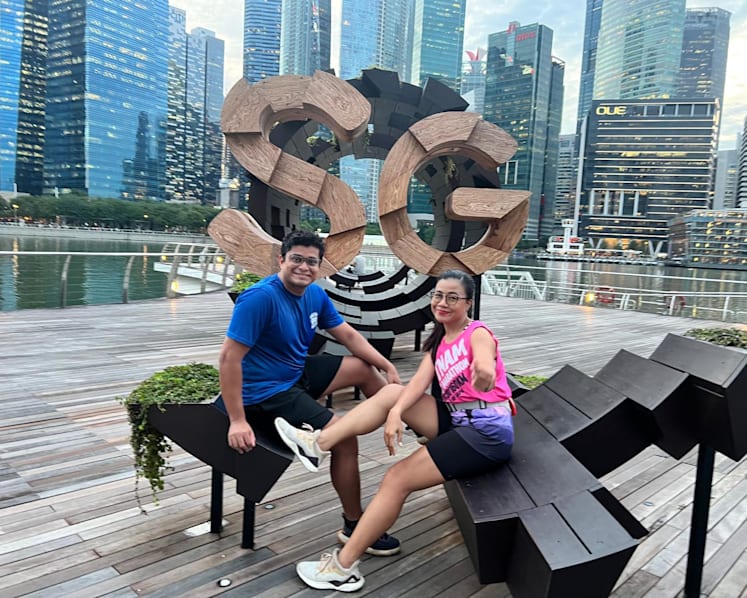
Mr K B Ryan Joshua Mahindapala and his wife, Ms Hoang Thi Hoang Anh – also called Anh Hoang – in a 2022 photo, from the first trip she made to Singapore after they became a couple. (Photo: Anh Hoang)

This audio is generated by an AI tool.


Her name is Anh Hoang. She is Vietnamese, a free-thinker, and she lives over 3,150km away from where I grew up.
I could not have imagined a less likely match – at least, not by the conventional checklists we Singaporeans tend to carry around in our heads.
But now here we are, husband and wife.
For about a year before I met Anh Hoang, I was on a couple of dating apps. I swiped, I matched, I participated in message exchanges that invariably fizzled out.





On the rare occasion a conversation did lead to a date, it never led to a second one. I would leave wondering if I had been on a date at all, or simply an interview where both of us were checking boxes neither of us could name.
I was approaching dating the same way I approached everything else in my life at the time: with a checklist, a set of criteria, and a growing anxiety that the right person was not showing up on cue – as I’d believed they were supposed to.
AN AIRPORT MEETING AND A BUFFET LINE CONVERSATION
In May 2022, at the age of 30, I was on my way to Hanoi, Vietnam, as part of a delegation of international technical officials for the 31st SEA Games.
Having volunteered as a technical official with the Triathlon Association of Singapore since 2017, giving up weekends to officiate at races, being assigned to the SEA Games was a great privilege to me.
When our delegation landed at Noi Bai International Airport, a group of local volunteers was there to receive us.
Among them, Anh Hoang stepped forward to introduce herself as the liaison officer for the international officials. She would help us navigate the city, the schedules, and the inevitable chaos of a multi-sport games.
We did not speak at the airport. There were too many people, there was too much to organise.


The first real conversation happened a few days later, at the hotel restaurant. I was in the buffet line, deciding between options, when Anh Hoang appeared beside me.
We said hello. We talked about the games, about Hanoi, about nothing in particular.
It was ordinary. Unremarkable. The kind of exchange you forget about by the time you reach your table.
Except that I didn't forget.
DISTANCE, DIFFERENCES AND DOUBTS
Over the course of the games, we spoke more. By the time I flew home to Singapore, I knew I wanted to stay in touch.
We exchanged contacts – tentatively, the way you do when you are not entirely sure what you are hoping for.
What followed were months of late-night video calls, messages sent across the one-hour time difference, and a slowly dawning realisation that something real was developing between us.
I want to be honest here: it was not all sentimental warmth and clear-headed certainty.
We lived in different countries. We held different passports. She was a free-thinker; I am Christian. We were brought up in different cultures, with different values.
There were nights when I stared at the ceiling and asked myself some very practical, very sobering questions. How were we actually going to build a life together? Where would we live? How would we navigate the differences that society and, if I am honest, my own anxious mind, kept flagging as problems?
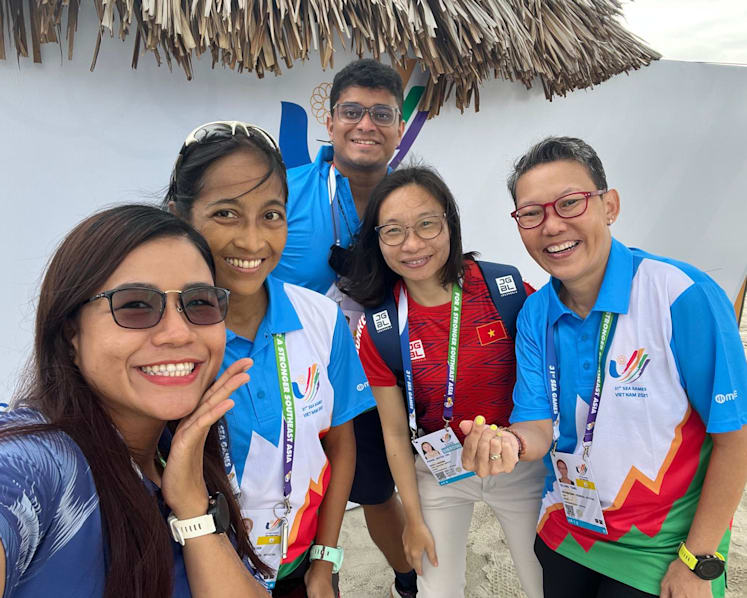
Eventually, I made a choice. I decided to stop treating our differences as a liability, and start seeing them as part of what made this relationship worth pursuing.
For instance, we realised how deeply grateful we were to have the wholehearted support of both our families from the start. Not every couple navigating cultural and religious differences is afforded the same generosity.
The warmth with which her family welcomed me, and mine welcomed her, turned what might have been a tense, complicated negotiation into something that felt more like a joyous expansion of love.
We didn’t lose anything of our individual families. Instead, we both gained a new, bigger family.
We dated for exactly three years, three months, three weeks and three days.
On Nov 30, 2025, after dating long-distance and flying back and forth, Anh Hoang and I got married.
FINDING LOVE IN SINGAPORE, AND THE CHECKLISTS WE CARRY
In 2025, Singapore saw 24,687 marriages – a 6.2 per cent drop from 2024, marking the third consecutive year of decline.
When I tell people here that my wife is Vietnamese, a free-thinker, and that we met at a sporting event in a foreign country, it’s not unusual to see surprise flicker on their faces – a furrow of the brow, a widening of the eyes, a downturned mouth. The unspoken question of how two people so different on paper ended up together.
We live in a society that is extraordinarily open in many ways. And yet, when it comes to love and marriage, we can be remarkably cautious.
I watch my peers in the dating pool filter potential partners by race, by religion, by educational background, by income bracket. We wait for the perfect mix of the perfect conditions: stable career, sorted finances, the “right” timing, whatever that means.
We are so careful that sometimes, I suspect, we filter out the very things that could surprise us.
I was doing the same because I, like so many young adults, thought that’s what I was supposed to do – follow the recipe for perfect results. Then I went to Vietnam for a triathlon event, stood in a buffet line, and had a conversation with a stranger.
No algorithm. No profile picture. No carefully curated list of interests. Just two people reaching for food at the same time.
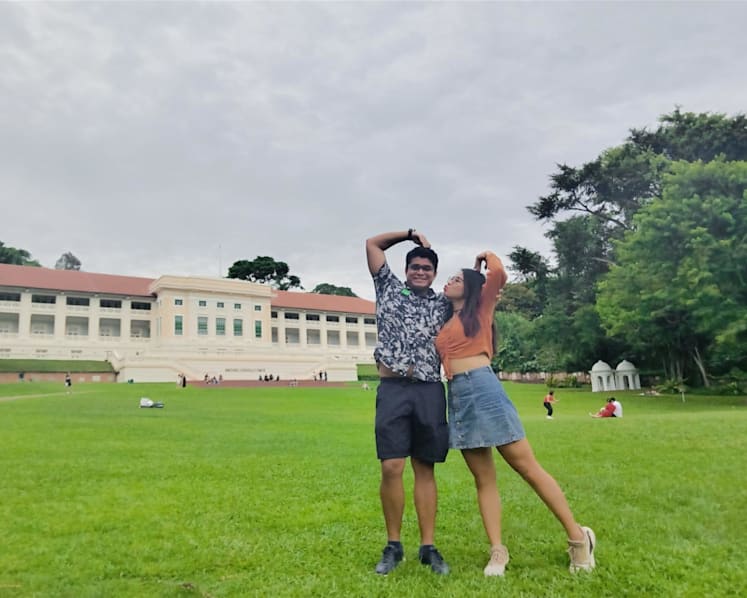
Anh Hoang and I do not share a nationality, a faith or a mother tongue. What we share is harder to put into a matchmaking form or a dating profile: a genuine curiosity about each other's worlds, a respect for where the other person has come from and what they’ve been through, and a willingness to figure things out as we go.
Singapore was built, after all, on the idea that difference could be made to work. That people from vastly different places and traditions could build something together.
Why can't this same spirit apply to a marriage?
DON’T LET LIFE PLANS STOP YOU FROM LIVING LIFE
Anh Hoang has since obtained a long-term visit pass from the Immigration and Checkpoints Authority and moved in with my parents and me. Singapore is home now, though she toggles between the two countries because her career still takes her back to Vietnam.
Eventually, we intend to purchase a home and start a family in Singapore. But for the time being, we are building our life across two countries and two time zones.
It is not the conventional picture of a newlywed life. But then, very little about our story has been conventional.
I think about that version of myself sometimes. The one with the five-year plan, the target age for milestones like marriage, the carefully constructed idea of what a successful life was supposed to look like.
He would not have predicted any of this – not the SEA Games, not Hanoi, and certainly not Anh Hoang.
That’s the thing about plans. We make them because uncertainty is uncomfortable, because having a destination – even if only the idea of one – feels safer than drifting.
I did not go to Vietnam looking for a wife. But I ended up meeting what has now become the most important person in my life – precisely because I had stopped white-knuckling the steering wheel long enough for them to find me.
What happened at a hotel buffet line in Vietnam was never in my best laid plans.
But then again, plans aren’t what make life worth living. What matters is actually living life.
K B Ryan Joshua Mahindapala is a Singaporean lawyer turned writer and educator. He frequently writes on topics related to heritage, culture and identity.
If you have an experience to share or know someone who wishes to contribute to this series, write to voices [at] mediacorp.com.sg (voices[at]mediacorp[dot]com[dot]sg) with your full name, address and phone number.




