







Artemis II: What to know about NASA's first crewed mission towards the Moon since 1972
The mission, years in the making, will see four astronauts embark on a 10-day mission covering 2.25 million km.
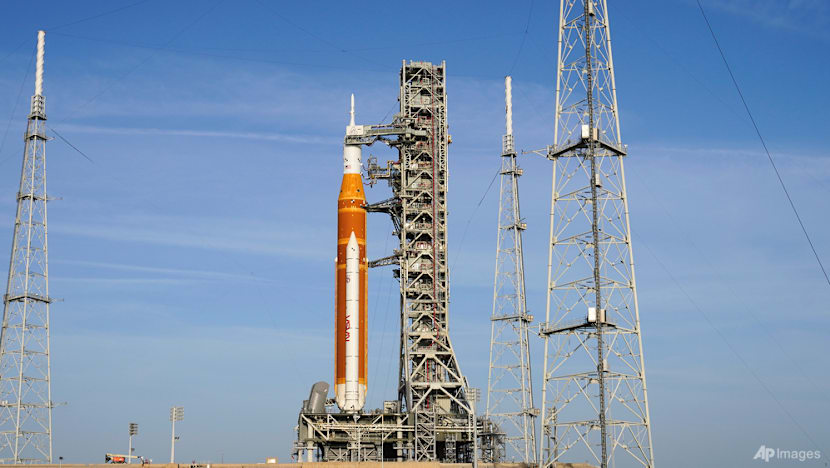
The NASA Artemis II SLS (Space Launch System) rocket with the Orion spacecraft is seen at Launch Complex 39B at the Kennedy Space Center, Mar 31, 2026, in Cape Canaveral, Florida (Photo: AP/John Raoux)


SINGAPORE: NASA's first fully crewed rocket headed back to the Moon in more than 50 years is scheduled to blast off on Wednesday (Apr 1).
All going well, Artemis II with three American and one Canadian astronauts on board is headed on a 10-day mission covering 2.25 million km that will orbit the Moon while not touching down on the lunar surface.
The first crewed mission of its type since 1972 has reignited hints of the "moon fever" that gripped America, and much of the wider world, during the Apollo missions half a century ago.
It will also be the first crewed flight of the Space Launch System (SLS) rocket developed by NASA for lunar missions. The uncrewed Artemis I mission in 2022 used an SLS rocket.
The Artemis programme eventually aims to establish a base on the Moon, and to provide a platform for missions to Mars.
The current target for take-off by Artemis II is a two-hour window that starts at 6.24pm local time (6.24am, Thursday, Singapore time) from the Kennedy Space Center in Cape Canaveral, Florida.
Here are five things to know about Artemis II, and why it matters.
WHO ARE THE ASTRONAUTS?
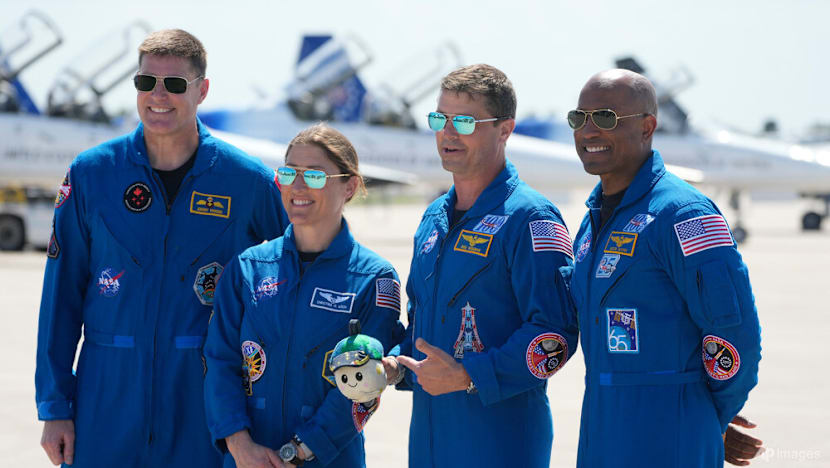
The crew of Artemis II consists of three men and one woman: Americans Reid Wiseman, Victor Glover and Christina Koch, along with Canadian Jeremy Hansen.
History will be made on several fronts as Glover, the mission's pilot, will become the first Black astronaut to travel near to the Moon while Koch is set to be the first woman to do so.
Hansen will be the first non-American astronaut to go beyond low Earth orbit.
Wiseman will be the commander of the Artemis II mission.





WHAT EXACTLY WILL THE MISSION DO?
The Artemis II mission is not a Moon landing, but is described as a "crewed lunar flyby" by NASA.
The crew will fly aboard the Orion spacecraft, perched atop NASA's powerful orange-and-white SLS rocket.
After launch, the Orion capsule will orbit Earth while the astronauts conduct various checks to ensure the reliability and safety of the spacecraft. They will also test its manual piloting capabilities during docking simulations.
If all trials are successful, Orion will then head to the Moon, travelling about 393,000km. The spacecraft will loop around the Moon and venture thousands of kilometres beyond it before returning to Earth in a “free-return” trajectory.
This free-return trajectory made famous in Apollo 13 relies on the Moon's gravity to send it back towards Earth without propulsion, minimising the need for fuel.
The mission will end with a splashdown in the Pacific Ocean off the California coast.
NASA said the Artemis II mission will confirm the systems necessary to support astronauts in “deep space exploration and prepare to establish a sustained presence on the Moon”.
WHY IS IT CALLED ARTEMIS AND WHAT COMES NEXT?
The Artemis programme is named after the twin sister of Apollo in Greek mythology, signalling NASA’s return to the Moon following the Apollo missions.
Artemis II follows Artemis I, an uncrewed test flight that orbited the Moon in 2022.
Future missions are expected to build on this foundation, eventually paving the way for missions to Mars.
Artemis III is planned for 2027 and will involve the Orion capsule docking in Earth's orbit with NASA's two lunar landers.
The two lunar landers are the Blue Moon system from Jeff Bezos' Blue Origin and Starship from Elon Musk's SpaceX.
Artemis IV will then see an attempt at a lunar landing, which is scheduled for 2028. Observations from the Artemis II mission should help NASA choose a landing site for Artemis IV, which will venture to the Moon's south pole, where no human has ever been.
The last mission, Artemis V, is aimed at further expanding long-term lunar infrastructure, including a possible moon base, NASA has said.
Senior fellow at the Brookings Institution’s Center for Technology Innovation of the Governance Studies programme, Darrell West, sees much economic potential both on the Moon and Mars.
“You can mine minerals in each of those places,” he told CNA.
“Each will probably end up being major tourist sites, maybe more for the ultra wealthy than for average people.”
HOW IS ARTEMIS DIFFERENT FROM APOLLO?
While Apollo was driven by Cold War rivalry and the race to land the first humans on the Moon, Artemis is focused on long-term exploration.
NASA now aims to establish a sustained presence on the Moon, rather than short-term visits. The programme also involves collaboration with international partners and private companies, including SpaceX and Blue Origin.
Another key difference is pace.
It took NASA just eight years to go from putting its first astronaut in space to putting Apollo 11’s Neil Armstrong and Buzz Aldrin on the moon in 1969.
Artemis, by contrast, has progressed more slowly amid shifting priorities between the Moon and Mars, as well as technical and funding challenges.
Geopolitics remains a factor, however.
While the US once raced the Soviet Union, it now faces growing competition from China, which has already landed robotic missions on the Moon’s far side.
WHAT RISKS DOES THE ARTEMIS MISSION FACE?
As NASA’s first crewed deep space mission in decades, Artemis II carries significant technical and operational risks.
One key concern is the SLS rocket itself. While it successfully completed an uncrewed test flight in 2022, it has faced issues, including hydrogen fuel leaks during pre-launch tests – problems that previously delayed the mission.
Another critical area is the Orion spacecraft’s heat shield, which protects the capsule during re-entry into Earth’s atmosphere. During Artemis I, the shield eroded in unexpected ways, prompting NASA to adjust the spacecraft’s re-entry trajectory for this mission.
In addition, the crew will experience a communications blackout as the spacecraft passes behind the Moon, temporarily cutting off contact with mission control.
The world is watching as the Artemis crew prepares for a mission of a lifetime.
“I'm all behind them and cheering them on,” said Charlie Duke, who was on the Apollo 16 mission.
“It's going to be an exciting, exciting flight. Going out 6,000 miles beyond the moon and looking back and you'll see they'll be able to see the whole backside of the moon."
It’s also a chance to introduce American space exploration to a new generation.
“You know, half the world's population weren't even born when we were Apollo,” Duke said.
“And to refresh them and to show them the excitement of deep space exploration and moon landings and stuff is going be I think a very outstanding motivational tool for the young people to challenge them, say, 'well, let's go do that, that's what I want to do'."




