Countries must shift from climate talks to action, says World Energy Council chairman ahead of COP30
While a previous climate summit produced a landmark agreement to transition away from fossil fuels, many countries have yet to follow through on their updated national climate pledges.
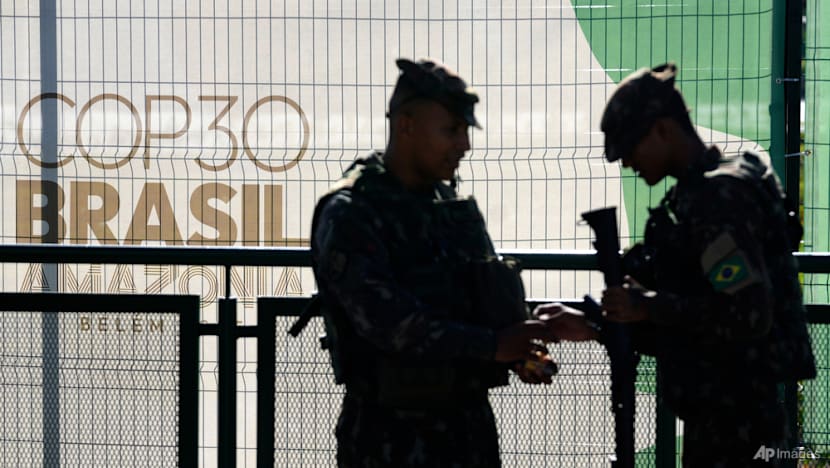
Soldiers patrol in City Park, the site of the COP30 UN Climate Summit, in Belem, Brazil, Nov 4, 2025. (Photo: AP/Eraldo Peres)

This audio is generated by an AI tool.


The world must move from climate negotiations to concrete action if it hopes to deliver on global climate goals, said World Energy Council chairman Adnan Amin, urging countries to use the upcoming COP30 climate summit in Belem, Brazil to accelerate implementation efforts.
The planet is entering “a very different juncture” in the climate process, said the sustainable development economist, who served as CEO of the 28th United Nations Climate Change Conference of the Parties (COP28) in 2023.
“The challenge, in my view, is going to be how do we transform COP from negotiations into an international cooperation platform for implementation that can really give a sense of direction, create partnerships and allow for the flow of capital at greater scale,” he told CNA on Tuesday (Nov 4).
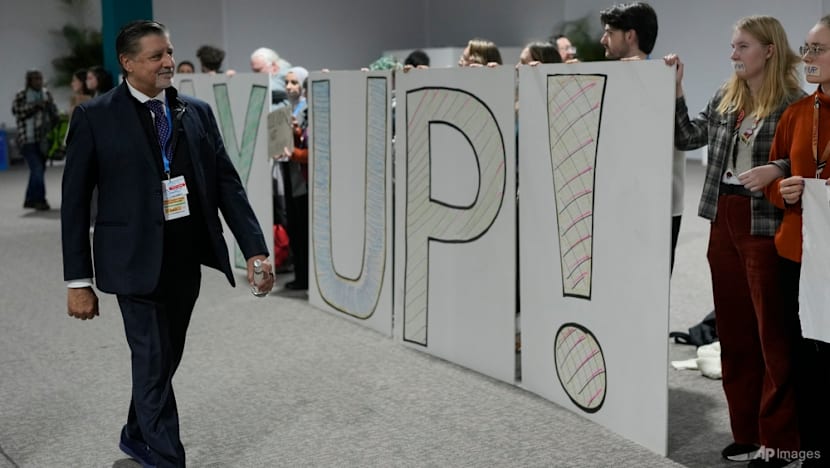
PROGRESS ON CLIMATE ACTION
COP28 concluded with the UAE Consensus – a landmark deal to transition away from fossil fuels – and 133 nations committed to tripling global renewable energy capacity and doubling energy efficiency by 2030.





Amin, who previously served as director-general of the International Renewable Energy Agency (IRENA), said the world is making strong – though uneven – progress towards the targets agreed in Dubai.
But he pointed out that many countries have not delivered on their updated national climate pledges two years later.
“The response to the Nationally Determined Contributions (NDCs) has been somewhat disappointing,” he said, adding that some major emitting countries and blocs have yet to take action.
“So, I think the test will be whether we are able to switch the mode of climate discussions internationally into ones of implementation and partnership.”
His comments come amid growing doubts over whether this year’s conference will deliver tangible progress on climate action.
GROWING MOMENTUM
According to IRENA data, global renewable capacity grew by a record 585 gigawatts in 2024 – a 15.1 per cent increase.
But this remains well below the pace needed to reach the 2030 goal of tripling installed renewable energy generation capacity to at least 11,000 gigawatts.
“We're expecting a higher growth this year of over 600 gigawatts,” said Amin. “But (with) 2030 only five years away, to meet that target, we are going to have to add close to a thousand gigawatts a year.”
Still, he believes the world is on track to come close, if not fully meet, the target by the end of the decade.
“What's important in all of this is that the direction of travel is clear,” he said. “More and more renewables are being added to the global power systems.”
While the shift towards renewables is accelerating, Amin cautioned that much of the progress remains concentrated in developed markets rather than developing economies.
He identified grid infrastructure and financing as key barriers to scaling up clean energy.
“We can add capacity very easily,” he said. “But the question of integration into the system, management of a grid infrastructure and distribution of power is going to be an important issue.”
Amin was speaking to CNA on the sidelines of the ongoing ADIPEC summit in Abu Dhabi, which gathers global leaders, investors and innovators to shape the future of energy.
POWERING THE FUTURE
This year’s conference has spotlighted digital technologies, including artificial intelligence.
“It's undoubtable that the advent of AI is going to create much more efficient energy systems across the board,” said Amin.
AI is seen as a powerful tool for accelerating decarbonisation by optimising energy use, managing complex systems and driving innovation in clean technologies.
However, UN Under-Secretary-General Amandeep Singh Gill, who is also attending ADIPEC, warned that the rapid growth of AI could deepen global inequalities.
He said technological power is becoming concentrated in a few regions, leaving much of the world excluded from AI’s benefits while shouldering its risks.
The UN special envoy for digital and emerging technologies also highlighted AI’s soaring energy demands, noting that power consumption from data centres is projected to quadruple by 2040.
This surge could strain power supplies and raise costs, he told CNA.
“The world needs to generate more power (and) more energy … then there comes a choice – are we going to use carbon-free energy, or are we going to rely on fossil fuels and then reverse some of the progress we've made in addressing climate change issues?”