







Iran's choice of Mojtaba Khamenei appears to close path to swift end to war
The appointment of Khamenei, 56, has been declared unacceptable by US President Donald Trump, who has demanded Iran's unconditional surrender.
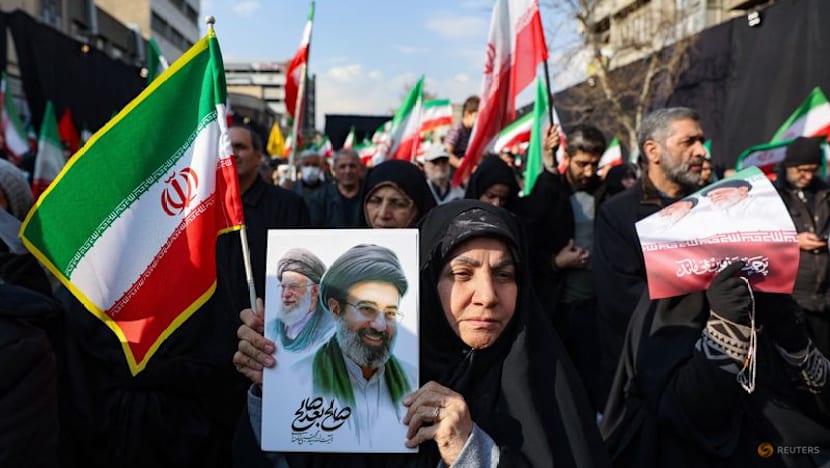
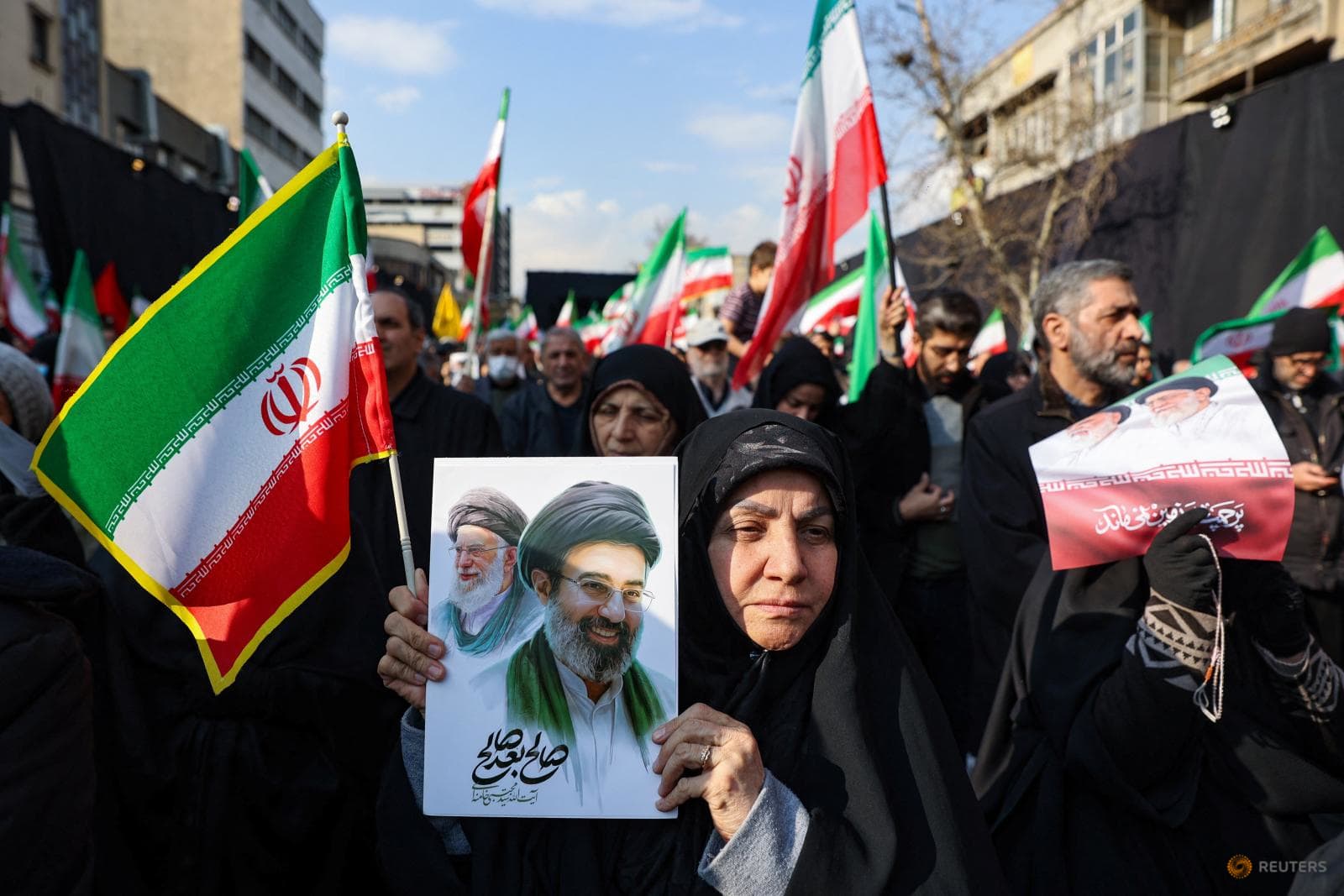
A woman holds a placard with an image of Iran's new supreme leader Mojtaba Khamenei alongside late Iranian Supreme Leader Ayatollah Ali Khamenei in Tehran, Iran, Mar 9, 2026. Majid Asgaripour/WANA (West Asia News Agency) via REUTERS
DUBAI/JERUSALEM: Iran named Mojtaba Khamenei to succeed his slain father as supreme leader on Monday (Mar 9), signalling that hardliners remain firmly in charge and appearing to close off any path to a swift end to war in the Middle East.
The prospect that the disruption to global energy supplies - already one of the most severe in history - could last longer than previously expected sent oil prices surging in record leaps, and global stock markets went into a nosedive.
Khamenei, 56, a Shiite cleric with a power base among the security forces and their vast business empire, has been declared unacceptable by US President Donald Trump, who has demanded Iran's unconditional surrender.
Despite Trump's warnings, Tehran remains defiant. Ankara said on Monday that NATO air defences had shot down a ballistic missile that was fired from Iran and entered Turkish airspace, the second such incident of the war.
Iranian state media showed large crowds in the streets of several cities showing support for the new leader, carrying Iranian flags and portraits of his father Ali Khamenei, killed by strikes on the war's first day.
In Isfahan, state TV reported the sound of nearby explosions from apparent airstrikes as loyalists gathered in the historic Imam Square, chanting "God is the Greatest" below a stage with portraits of Ali and Mojtaba Khamenei. In Tehran, a eulogist could be heard singing: "Either death or Khamenei, our blood leads to paradise."
IRAN'S POLITICAL SYSTEM RALLIES BEHIND MOJTABA
Politicians and institutions issued pledges of loyalty to the new supreme leader, whose wife, son and mother also died at the start of the US-Israeli air onslaught according to Iranian state media.
"We will obey the commander-in-chief until the last drop of our blood," a defence council statement said.
Iranians reached by telephone were divided, with supporters of the authorities hailing the choice as a declaration of defiance and opponents fearful it would dash their hopes for change.
"I am so happy that he is our new leader. It was a slap in the face to our enemies that thought the system will collapse with the killing of his father. Our late leader's path will continue," said university student Zahra Mirbagheri, 21, from Tehran.
Related:
Many Iranians had celebrated the elder Khamenei's death, weeks after his security forces killed thousands of anti-government protesters in the worst domestic unrest since the era of Iran's 1979 revolution. But there has since been little sign of anti-government activity, with activists fearful of taking to the streets while Iran is under attack.
"The (elite Revolutionary) Guards and the system are still powerful. They have tens of thousands of forces ready to fight to keep this regime in place. We, the people, have nothing," said Babak, 34, a businessman in the central city of Arak who asked to keep his family name confidential.
Israel says its war aim is to overthrow Iran's system of clerical rule. Washington initially said its aim was to destroy Iran's missile capabilities and nuclear programme, but Trump later said the war could end only with a compliant Iranian government.
Israel had said it would kill whoever succeeded the elder Khamenei unless Iran ended its hostile policies. Trump on Sunday again demanded Washington have a say in the selection of the supreme leader.
"If he doesn't get approval from us, he's not going to last long," he told ABC News. In an interview with the Times of Israel after the new supreme leader was named, Trump declined to respond, saying only "We'll see what happens", according to the newspaper.
OIL SURGES PAST US$100 A BARREL
The war has effectively shut the Strait of Hormuz, where a fifth of global oil and seaborne liquefied gas is shipped near the Iranian coast. With tankers unable to sail for over a week, producers have run out of storage and are being forced to halt pumping.
Brent crude futures were up nearly 7.00 per cent at US$99.25 per barrel at 16.10pm GMT, having earlier shot as high as US$119.50 in what would have been the biggest one-day rise on record. Since the war started, Brent has surged by as much as 65 per cent.
The prospect of a prolonged energy crisis - reviving memories of the Middle East oil shock of the 1970s - sent global share markets into a tailspin. Bond yields surged as investors bet that central banks would have to cancel rate cuts or impose hikes to fight inflation.
The price of gasoline has particular political resonance in the United States, where Trump's Republicans hope to keep control of Congress in midterm elections in November.
The president is expected to review as early as Monday a set of options to tame domestic oil prices, including a possible release of crude oil from strategic reserves or restricting US exports, according to two people familiar with the matter.
"Short-term oil prices, which will drop rapidly when the destruction of the Iran nuclear threat is over, is a very small price to pay for USA, and World, Safety and Peace," Trump posted on Truth Social on Sunday night. "ONLY FOOLS WOULD THINK DIFFERENTLY!"
Tehran was choked in black smoke after an oil refinery was hit, an escalation in strikes on Iran's domestic energy supplies. World Health Organisation chief Tedros Ghebreyesus warned of the dangers from such attacks.
"Damage to petroleum facilities in Iran risks contaminating food, water and air - hazards that can have severe health impacts especially on children, older people, and people with pre-existing medical conditions," he wrote on X.
Türkiye said on Monday NATO alliance air defences had shot down a ballistic missile that was fired from Iran and entered Turkish airspace, the second such incident of the war. Iran did not immediately comment on the report.
Türkiye, Iran's neighbour with NATO's second-largest army, had warned Tehran on Saturday against attacking again, but it has not suggested it wants to formally call on bloc members for further protection.
Israel's military said it had launched new attacks in central Iran and struck the Lebanese capital Beirut, where Israel has extended its campaign after the Iran-backed militia Hezbollah fired across the border.
US-Israeli attacks have killed at least 1,332 Iranian civilians and wounded thousands, according to Iran's UN ambassador. Lebanon has reported scores of people killed there.
In Israel, ambulance workers said one man died from shrapnel wounds at a construction site near Tel Aviv's international airport, raising to 11 the death toll from Iranian strikes.




