







Iran says US talks are on, as Trump warns supreme leader
Tehran says nuclear negotiations with Washington will take place in Oman this week, even as Trump ramps up military pressure and warns Iran’s supreme leader amid uncertainty over the talks.
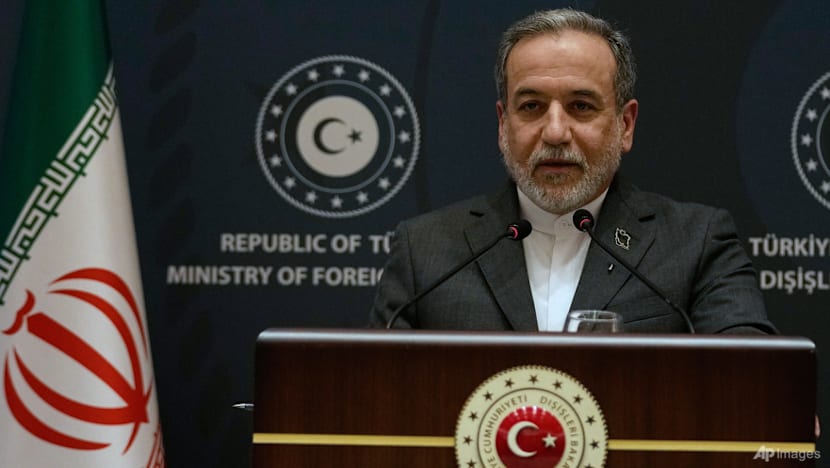
Iranian Foreign Minister Abbas Araghchi speaks to journalists during a joint press conference with his Turkish counterpart Hakan Fidan in Istanbul, Turkey, on Jan 30, 2026. (File photo: AP/Khalil Hamra)
Doubts have swirled about the fate of the negotiations, with a report earlier on Wednesday that the talks were falling apart, sending oil prices surging and increasing expectations of US military action.
But Iranian Foreign Minister Abbas Araghchi said nuclear talks were now scheduled for Friday in Oman. Diplomats had earlier said the meeting would happen on Friday in Turkey.
"Nuclear talks with the United States are scheduled to be held in Muscat," said Araghchi in an X post, thanking Oman "for making all the necessary arrangements".
There was no immediate confirmation from the United States.
"I would say he should be very worried, yeah, he should be," Trump said on Wednesday in an interview with US broadcaster NBC News. "As you know, they are negotiating with us."

"They were thinking about starting a new site in a different part of the country," Trump told NBC. "We found out about it, I said, you do that, we're going to do very bad things to you."
Ties between Tehran and Washington have become increasingly strained in recent weeks since Iran's clerical state violently put down some of the most serious protests against its rule since the 1979 Islamic revolution.
Stephen Zunes, professor of politics at the University of San Francisco, said that while there is some optimism about progress on nuclear issues, Washington’s insistence on broadening the talks to include other concerns could complicate negotiations.
"Obviously there are legitimate concerns about Iran's support for extremist groups, its missiles, and certainly its horrifically violent and oppressive rule over its own people," he told CNA's Asia First.
"But historically, successful arms control agreements have been about the arms or the nuclear material themselves."
Zunes said the Iranian regime’s reputation is at its lowest both domestically and internationally, citing violent repression, corruption, economic mismanagement and recent setbacks suffered by its regional allies.
But he noted that a military confrontation with the US could work in the Iranian government’s favour, as external threats often trigger nationalist sentiment even among critics of the regime.
"So I think the threats against Iran, ironically, strengthen the position of the regime in certain ways," he added.
"CONFLICTING REPORTS"
Hopes of a breakthrough rose when it emerged earlier this week that Iranian and US officials were due to meet, but the talks have been dogged by uncertainty.
US Secretary of State Marco Rubio said on Wednesday that the United States was ready to meet Iran this week - but insisted that discussions must cover its missile and nuclear programmes.
"If the Iranians want to meet, we're ready," Rubio told reporters, but without confirming a meeting on Friday. "If they change their mind, we're fine with that too."
Rubio said that US envoy Steve Witkoff had been ready to meet with Iran in Turkey but then received "conflicting reports" on whether Tehran had agreed.
"That's still being worked out," he said of the location for the talks, speaking before the Iranian foreign minister's comments.
Iran, in previous talks on its disputed nuclear programme, has ruled out discussions on its missiles, casting the weapons that can hit Israel as a tool of self-defence to which every country has a right.
But Iran has been under growing pressure from the protests and after an Israeli bombing campaign last year. Iran has also lost key regional allies with Israel's severe degrading of Lebanon's Hezbollah and the fall of veteran Syrian president Bashar al-Assad.




