







Iran missile and drone barrages create dilemma for Gulf states
Iran's attacks on Gulf states' cities and infrastructure place the neighbours on a potential course for greater military confrontation, said analysts.
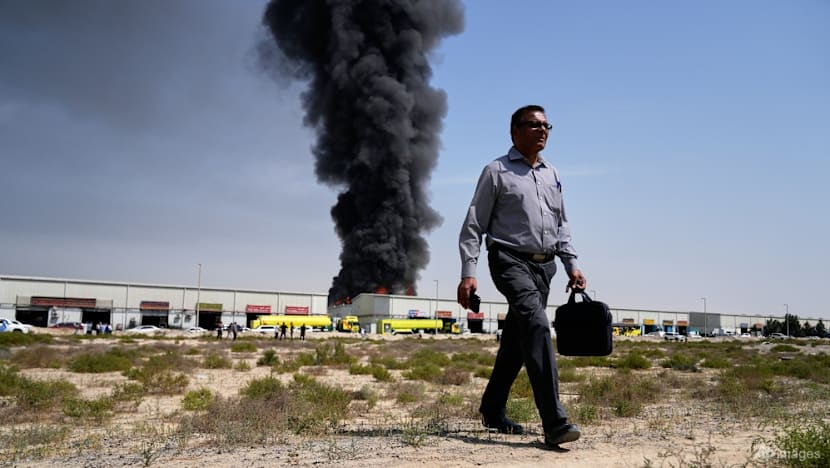
A man walks away after watching as a black plume of smoke rises from a warehouse in the industrial area of Sharjah City, United Arab Emirates, on Mar 1, 2026, following reports of Iranian strikes in Dubai. (File photo: AP/Altaf Qadri)
DOHA: For four days, Iranian missiles and drones have swept Gulf states' cities and infrastructure, sundering ties with Tehran and placing the neighbours on a potential course for greater military confrontation, analysts said.
After years of careful diplomatic rapprochement with the Islamic Republic and weeks of publicly arguing against war, Gulf countries, including Saudi Arabia and the UAE, now face a dilemma: to hit back and risk stiffer attacks, or maintain their defensive position and hope to absorb the blows.
"Arab Gulf states are on the frontlines of a war they sought to avert," Middle East expert Hasan Alhasan wrote for the International Institute for Strategic Studies.
"A debate is brewing in Gulf capitals about the merits of strategic patience and restraint."

Qatar, the Gulf state seen as having the closest ties to Iran, downed two Iranian fighter jets - notable for being the first time a Gulf country has hit manned Iranian planes since the war broke out.
Farea Muslimi, a researcher at the UK-based Chatham House's Middle East and North Africa Programme, told AFP he would be "extremely shocked" if Saudi Arabia, in particular, "did not respond militarily".
"Saudi Arabia, if not the whole Gulf, is preparing for some form of response to Iran. It cannot afford to do nothing after being attacked," Muslimi said.
Saudi Arabia's military raised its readiness levels in response to attacks by Iran, a source close to the army told AFP on Monday, while another warned of a possible military response if its oil infrastructure was targeted.
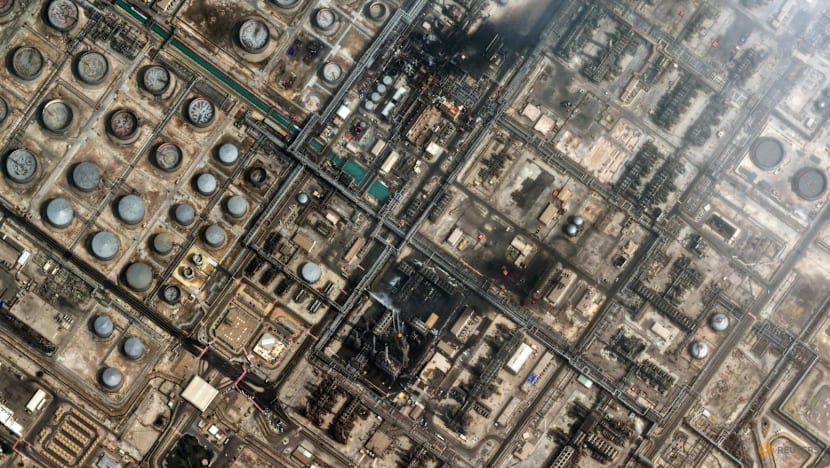
On Monday, Saudi Arabia was forced to halt some operations on its massive Ras Tanura refinery due to Iran's attacks.
Falling debris from an intercepted Iranian attack sparked a fire at the facility, according to the kingdom's energy ministry.
"ANGRY AS HELL"
A 2019 attack - claimed by Yemen's Houthis but blamed by Riyadh and Washington on Tehran - hit a Saudi processing plant and oil field, prompting the kingdom to rethink its previous hardline response to Iran.
In a landmark Chinese-brokered deal, Tehran and Riyadh agreed in March 2023 to restore ties and reopen their respective embassies, marking a significant improvement in relations between the longtime rivals.
Hesham Ghannam, a Saudi security analyst, said that ahead of Saturday's attacks, Riyadh "denied airspace and basing rights, signalling neutrality to Tehran", but "Iran struck Saudi territory anyway", wiping out the diplomatic investment.
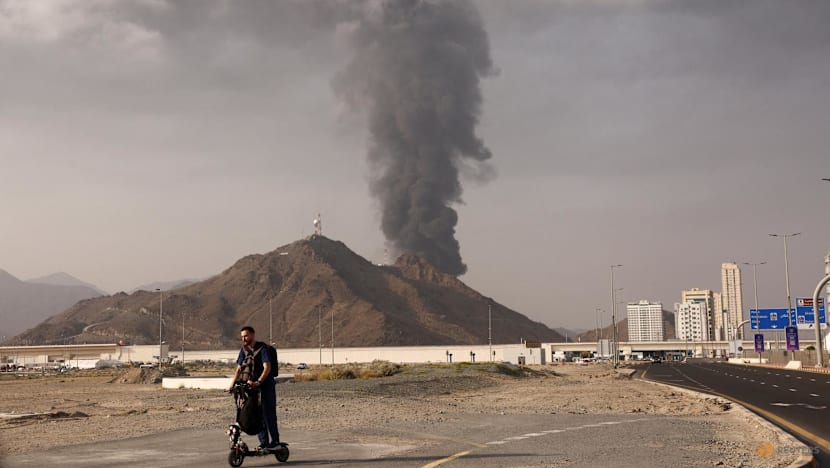
Drone strikes hit the UAE's Fujairah oil refineries on Tuesday, with falling debris from an intercepted drone sparking a fire in an oil field, authorities said.
The UAE has been targeted by more than 800 drones and 200 missiles since Saturday, according to its defence ministry, bearing the brunt of Iran's retaliatory campaign across the Gulf.
The attacks have killed three people in the Emirates, out of eight in total across the Gulf, and set fires at landmarks including The Palm and the Burj Al Arab, prompting Abu Dhabi to close its embassy in Tehran and recall its ambassador.
The UAE fully reopened its embassy in Tehran in 2022 during a thaw in relations, after years of tensions and a tougher line taken during US President Donald Trump's first term.
UAE-based political scientist Abdulkhaleq Abdulla said that since Saturday, the relationship had reached "the lowest of the low", describing the barrages as "an aggression that takes us ... to probably a new stage".
"We are definitely angry as hell, and this is just the beginning of things to come."
"IRAN HAS BECOME AN ENEMY"
Despite being Iran's second-largest trade partner, the UAE was disproportionately targeted, Abdulla said, with 63 per cent of projectiles aimed at the six Gulf states landing in the Emirates.
"There is an understanding now, a Gulf understanding, and a perception that Iran has become an enemy of a sort, has become an aggressor," he added.
Before Qatar downed two Iranian Sukhoi Su-24 warplanes on Monday, its state-run QatarEnergy, one of the world's largest producers of liquefied natural gas, had been forced to suspend production after drones targeted two of its key facilities.
Sharing the world's largest gas field with Iran, Qatar maintained relations with the Islamic republic despite being targeted by Iranian rockets in June 2025 during the last conflict between Israel and Iran.
At a Tuesday news briefing, Qatar's foreign ministry spokesman Majed Ansari said all Qatar's "red lines have already been crossed", calling the strikes "a blatant attack on our sovereignty".
"We reserve the right to retaliate," he said, adding that leaders were "considering right now all the options".




