







Israelis chant threats, anti-Palestinian slogans at Jerusalem Day march
Thousands of mostly young Israelis marched through Jerusalem’s Old City during the annual Jerusalem Day parade, while many Palestinians stayed indoors and kept their shops closed.
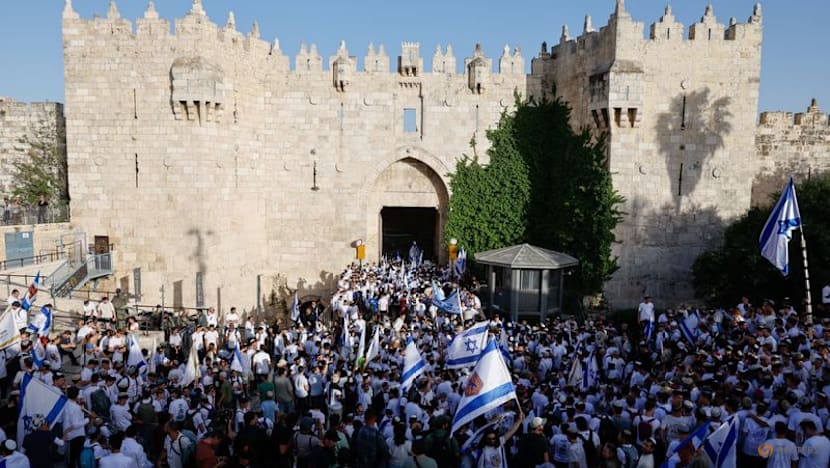
Israelis participate in the annual Jerusalem Day march in Jerusalem, May 14, 2026. (Photo: REUTERS/Amir Cohen)
Every year, tens of thousands of Israelis - many of them teenagers and young adults - parade through Jerusalem to celebrate what Israeli authorities call the "reunification" of Jerusalem following Israel's capture and annexation of East Jerusalem in the 1967 Arab-Israeli war.
The annexation of east Jerusalem, home to a predominantly Palestinian population, is not recognised by the United Nations, which considers it illegal under international law.
Over the years, the annual march has repeatedly descended into violence, with groups of mostly young ultranationalists targeting Palestinians with racist chants, intimidation and assaults.
This year's march comes against the backdrop of the Iran war and a ceasefire in Gaza, which sees near-daily violations.
By late morning, most Palestinian shopkeepers in the Old City had pulled down their metal shutters and deserted the stone alleyways, an AFP correspondent reported.
A handful of shops remained open under the protection of activists from the Israeli-Palestinian grassroots movement Standing Together, who deployed across the Old City in an effort to shield Palestinian residents and businesses from harassment and attacks.
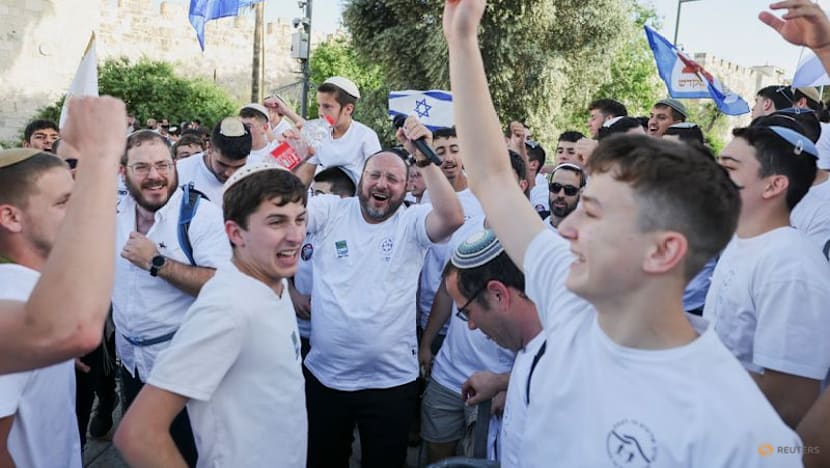
Videos circulating on social media showed activists being shoved and surrounded by groups of youths wearing matching white T-shirts emblazoned with Jerusalem-themed slogans.
In one video, the youths hurled plastic chairs at a Palestinian shopkeeper while chanting "Arab sons of whores".
The shopkeeper appeared to throw one chair back before raising a stick in warning.
SHOW OF SOLIDARITY
Some people clapped rhythmically, while others pounded on the metal shutters of closed Palestinian shops.
Authorities sometimes order Palestinian shops in the Old City to shut for the march, which ends at the Western Wall - the last remnant of the Second Temple destroyed by the Romans in 70 AD, the holiest site where Jews are allowed to pray.
Earlier in the day, on the steps outside Damascus Gate - one of the main entrances to the Old City - dozens of Israeli peace activists dressed in white handed flowers to passersby, as though apologising in advance for what was to come, the correspondent reported.
Ilan Perez, 52, said he wanted to "show my sympathy and love with flowers", which he clutched in his hands.
"It was important for me to come in order to show some solidarity with the local community and say that as a Jew, as a Zionist, as someone who wants a Jewish state here, I want them to be part of it and be part of the nation with equal rights," said Perez, who works in the tech industry and had come from the city of Raanana, near Tel Aviv.

Rula Daoud, co-director of Standing Together, said the march was becoming more violent every year, particularly after Hamas's October 7 attacks on Israel.
She accused the police of not intervening to curb the violence.
"This day, thousands of basically settlers and right-wing fascist young and older people will be roaming the streets chanting very racist things, trying to destroy places owned by Palestinians and just terrorising the whole place," she said.
"Our presence is to just protect people from being attacked, places from being vandalised. And we try to de-escalate this day."
Marchers also confronted journalists, shoving them and even blocking them from filming the event.




