







Labour-starved Russia seeks Indian workers as Delhi demands safety guarantees ahead of Putin-Modi talks
Russian President Vladimir Putin’s two-day visit to New Delhi from Thursday (Dec 4) will be closely watched by global powers, including China and the United States.
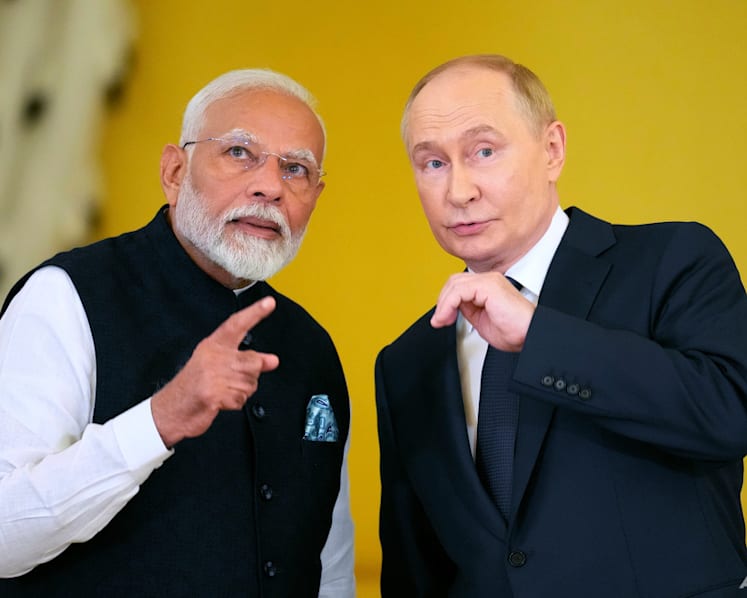
FILE - Russian President Vladimir Putin, right, and Indian Prime Minister Narendra Modi examine a hall prior to the award ceremony of Narendra Modi with the Order of St. Andrew the Apostle the First-Called in the Kremlin in Moscow, Russia, on July 9, 2024. (AP Photo/Alexander Zemlianichenko, File)

This audio is generated by an AI tool.




NEW DELHI: India is bracing for a high-stakes diplomatic test this week as Russian President Vladimir Putin arrives in New Delhi for a pivotal summit with Prime Minister Narendra Modi – talks that could reshape the flow of Indian workers into a labour-starved Russia.
Putin’s two-day visit from Thursday (Dec 4), which will be closely watched by global powers including China and the United States, comes amid shifting geopolitical alignments and Moscow’s deepening economic isolation due to the war in Ukraine.
A key item on the agenda for the 23rd India-Russia Annual Summit is expected to be a landmark manpower agreement that could streamline the process for Indian professionals to work in Russia.
LABOUR MOBILITY PUSH
Both sides, which are hoping to deliver a message of unity, view labour mobility as a mutually beneficial avenue of cooperation.





For Russia, it helps address an acute shortage of skilled workers. For India, it opens a new frontier for employment.
More than 70,000 Indian nationals are expected to be formally employed in Russia by the end of the year under new quotas. Sectors seeking talent include construction, textiles and high-tech machinery.
Reports indicate that Russia’s Ural region – the country’s heavy industrial heartland – is particularly keen on attracting Indian workers.
However, analysts believe Moscow will need to offer safer working conditions and more competitive salaries to succeed.
This comes as destinations such as the United Arab Emirates and Saudi Arabia, along with emerging markets like Japan and Israel, are aggressively courting Indian labour.
“Russia has not been one of the primary destinations for Indian middle classes,” said Harsh V Pant, vice president of foreign policy at think-tank Observer Research Foundation.
“I think it will be incumbent on Russia to, in some ways, provide those incentives that would be required for this kind of mobility to work because other countries are doing that,” he added.
“So there is also competition among major countries in the world at the moment and among India’s partners.”
But a more urgent challenge looms.
Over the past year, New Delhi has repeatedly raised concerns about Indians being recruited – sometimes under false pretences – into Russia’s military.
Last month alone, the government confirmed that 44 Indian nationals are currently serving in the Russian army, with many reportedly coerced or misled by agents promising safe civilian jobs.
Observers said it is important for the proposed labour pact to include ironclad safeguards to prevent civilian workers from being drawn into the conflict in Ukraine.
“I think it can be insisted on and it can be built into the framework, because that would be a good way of providing some degree of insurance to people who may decide to move,” said Pant.
ENERGY, DEFENCE COOPERATION
Traditional pillars such as energy and defence are also expected to dominate formal talks on Friday.
“This visit is a signal from both countries that particularly in the context of the current international flux, they attach value to the relationship,” said former Indian ambassador to the US Arun Kumar Singh.
“They have valued historically how strong and stable the relationship has been. There are options and ways to deepen the partnership in different areas, and they will both benefit from that.”
On energy security, Russia – now India’s largest crude supplier since the start of the Ukraine war – is keen to maintain the flow of discounted oil there.
But recent US sanctions on Russian producers Rosneft and Lukoil, combined with Washington’s 50 per cent tariff on imports from India over Russian oil purchases, are reshaping trade patterns.
Major Indian companies have stopped buying Russian oil or are buying from non-sanctioned entities.
India is also sourcing crude oil from a broader set of countries such as Guyana, Saudi Arabia and increasingly the US to fill the supply gap.
During his visit, Putin is expected to propose deeper discounts to retain India’s business.
Beyond oil, New Delhi is pushing for expanded Russian imports of agricultural products, pharmaceuticals and machinery to counterbalance trade asymmetries.
Bilateral trade has surged fivefold since 2021 to US$68 billion, mainly from imports of Russian crude, but India’s trade deficit has ballooned to US$58.9 billion over the same period.
At the summit, both countries may also explore direct financial settlement mechanisms that bypass Western sanctions, including linking national payment systems for cross-border transactions that rely less on Western financial networks.
“Russia would be also looking at a post-Ukraine economic situation. It's pretty dire for Russia,” said Observer Research Foundation’s Pant.
“So it would want India as an emerging economy to help it out,” he added.
“The other is technology, where I think Russia certainly has, like in the past, indicated that unlike the West – which continues to remain reticent in sharing and the cutting-edge technologies with India – (it) has had no such compunction.”
India is reportedly considering new defence acquisitions from Russia, including fighter jets and additional units of the S-400 air defence system.
As New Delhi balances ties with both Washington and Moscow, observers stressed that its national interests will remain paramount.
“It doesn't make sense for any country to put all the checks in one basket,” said Singh.
“Therefore you have to keep your options open. Russia enables you to keep your options open in the current context,” he added.
“My sense is that India would look at exercising its own sovereign choices, and would look at maintaining the strategic autonomy of its decision-making.”




