







TerraUSD creator Do Kwon sentenced to 15 years' jail over US$40 billion crypto collapse
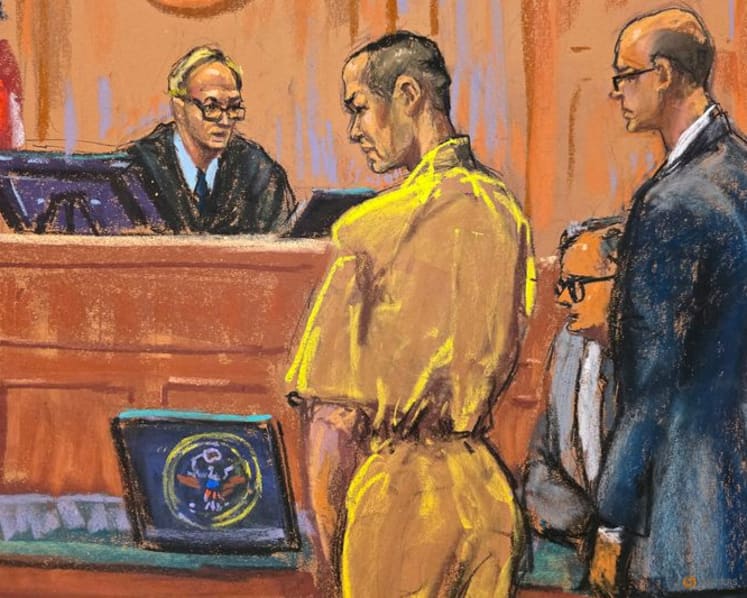
Do Kwon, a South Korean cryptocurrency executive charged with fraud, stands with his attorney David Patton to plead guilty in front of U.S. District Judge Paul Engelmayer in New York City, New York, U.S., August 12, 2025 in this courtroom sketch. REUTERS/Jane Rosenberg
NEW YORK: Do Kwon, the South Korean cryptocurrency entrepreneur behind two digital currencies that lost an estimated US$40 billion in 2022, was sentenced in New York federal court on Thursday (Dec 11) to 15 years in prison for fraud and conspiracy.
US district judge Paul A Engelmayer, who handed down the sentence, sharply rebuked Kwon for repeatedly lying to everyday investors who trusted him with their life savings.
"This was a fraud on an epic, generational scale. In the history of federal prosecutions, there are few frauds that have caused as much harm as you have, Mr. Kwon," Engelmayer said during a hearing in Manhattan federal court.
Kwon, 34, who co-founded Singapore-based Terraform Labs and developed the TerraUSD and Luna currencies, previously pleaded guilty and admitted to misleading investors about a coin that was supposed to maintain a steady price during periods of crypto market volatility.





He was one of several cryptocurrency moguls to face federal charges after a slump in digital token prices in 2022 prompted the collapse of a number of companies.
Dressed in yellow prison garb, Kwon addressed the court and apologised to his victims, including the hundreds who submitted letters to the court describing the harm they had suffered.
"All of their stories were harrowing and reminded me again of the great losses that I’ve caused. I want to tell these victims that I am sorry," Kwon said.
Ayyildiz Attila, one of the hundreds of victims who submitted letters to the court, said he lost between US$400,000 and US$500,000 in the collapse.
"My savings, my future, and the results of years of sacrifice disappeared. I struggled to keep up with payments and responsibilities, and everything I had worked for was erased," Attila said.
Kwon's lawyer Sean Hecker said in an email after the sentencing that Kwon spoke from the heart, expressed genuine remorse and will continue his efforts to make amends.
US attorney Jay Clayton in Manhattan said in a statement following the hearing that Kwon devised elaborate schemes to inflate the value of his cryptocurrencies and fled accountability when his crimes caught up to him.
Related:
Prosecutors had asked for a sentence of at least 12 years in prison, saying the crash of Kwon’s Terra cryptocurrency caused billions of dollars in losses and triggered a cascade of crises in the crypto market. Kwon’s lawyers had asked that he be sentenced to no more than five years so he could return to South Korea to face criminal charges.
Prosecutors charged Kwon in January with nine criminal counts for securities fraud, wire fraud, commodities fraud and money laundering conspiracy.
Kwon was accused of misleading investors in 2021 about TerraUSD, a so-called stablecoin designed to maintain a value of US$1.
Prosecutors alleged that when TerraUSD slipped below its US$1 peg in May 2021, Kwon told investors a computer algorithm known as Terra Protocol had restored the coin's value.
Instead, Kwon arranged for a high-frequency trading firm to secretly buy millions of dollars of the token to artificially prop up its price, according to charging documents.
Kwon pleaded guilty in August to two counts, conspiracy to defraud and wire fraud, and apologised in court for his conduct.
"I made false and misleading statements about why it regained its peg by failing to disclose a trading firm's role in restoring that peg," Kwon said. "What I did was wrong."
Kwon agreed in 2024 to pay US$80 million as a civil fine and be banned from crypto transactions as part of a US$4.55 billion settlement he and Terraform reached with the US Securities and Exchange Commission.
He also faces charges in South Korea. As part of his plea deal, prosecutors will not oppose Kwon's potential application to be transferred abroad after serving half his US sentence.





