







Trump proposes slashing fuel economy rules in boost for gas vehicles
While non-electric vehicle manufacturers are pleased by the possibility, the director of clean vehicles says "drivers will be paying hundreds of dollars more at the pump."
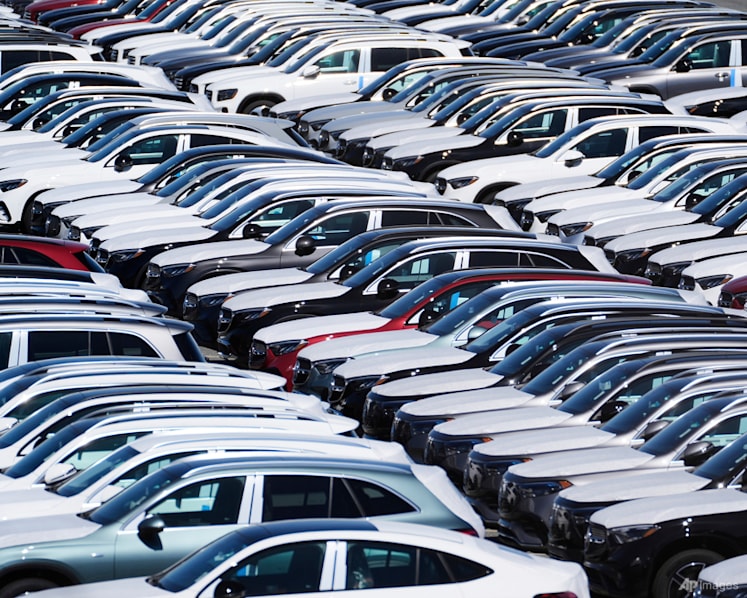
Vehicles are seen at the Mercedes-Benz Vehicle Preparation Center at the Port of Baltimore, where new Mercedes-Benz vehicle imports are processed before distribution to dealerships, Thursday, Mar 27, 2025, in Baltimore. (Photo: AP/Stephanie Scarbrough)
WASHINGTON: The Trump administration on Wednesday (Dec 3) proposed slashing fuel economy standards that former President Joe Biden had finalised last year, in its latest push to make it easier for automakers to sell gasoline-powered cars.
The National Highway Traffic Safety Administration proposed significantly reducing the fuel economy requirements from model years 2022 to 2031, requiring 34.5 miles per gallon on average by 2031, down from 50.4 miles per gallon (21.4 km per liter).
NHTSA is revising down the 2022 fuel economy standards and then proposing to hike them between 0.25 per cent and 0.5 per cent annually through 2031. In 2022, under Biden, NHTSA increased fuel efficiency by 8 per cent annually for model years 2024-2025 and 10 per cent for 2026.
The agency estimates the proposed rule would reduce average up-front vehicle costs by approximately US$900, but would significantly boost American fuel consumption. Reducing the rule for past years will make it much easier for automakers to comply for a period still being reviewed by NHTSA.






END TO CREDIT TRADING PROPOSED
It will also make drastic changes to the programme, including proposing to eliminate credit trading among automakers in 2028, and will end some credits for fuel-saving features. NHTSA said the credit trading was a "windfall for EV-exclusive manufacturers that sell credits to other non-EV manufacturers."
President Donald Trump will be joined by the CEOs of Chrysler parent Stellantis STLAM.MI and Ford Motor F.N to tout the proposal.
Earlier this year, Trump signed legislation that ended fuel economy penalties for automakers, and NHTSA said they faced no fines dating back to the 2022 model year.
Ending credit trading could hurt automakers like EV manufacturers Tesla TSLA.O and Rivian RIVN.O, which have sold credits to rivals making gas-powered models.
Ford CEO Jim Farley praised Trump, in a statement ahead of the event, for "aligning fuel economy standards with market realities. We can make real progress on carbon emissions and energy efficiency while still giving customers choice and affordability."
GM CEO Mary Barra noted on Tuesday at an event that before Congress blocked California's zero-emission vehicle rules in June, the auto sector was facing requirements in some states that 35 per cent of new vehicles sold in 2026 must be EVs.
"We were going to have to start shutting down plants because we weren't going to be able to build and sell those vehicles," Barra said.
RULE WOULD HAVE CUT EMISSIONS
The agency last year said the passenger car and truck rule would reduce gasoline consumption by 64 billion gallons and cut emissions by 659 million metric tons, reducing fuel costs with net benefits estimated at US$35.2 billion for drivers.
The 2022 rule was estimated to reduce fuel use by more than 200 billion gallons through 2050.
Kathy Harris, director of clean vehicles at environmental non-profit the Natural Resources Defence Council, said, "The Trump administration is sticking drivers with higher costs at the pump, all to benefit the oil industry ... drivers will be paying hundreds of dollars more at the pump every year if these rules are put in place."
Trump has taken a series of steps to make it easier to sell gas-powered vehicles and disincentivise EV production, including rescinding EV tax credits and barring California from banning the sale of traditional gas-powered vehicles after 2035.




