







Trump's envoy visits Belarus for talks with Lukashenko on prisoners
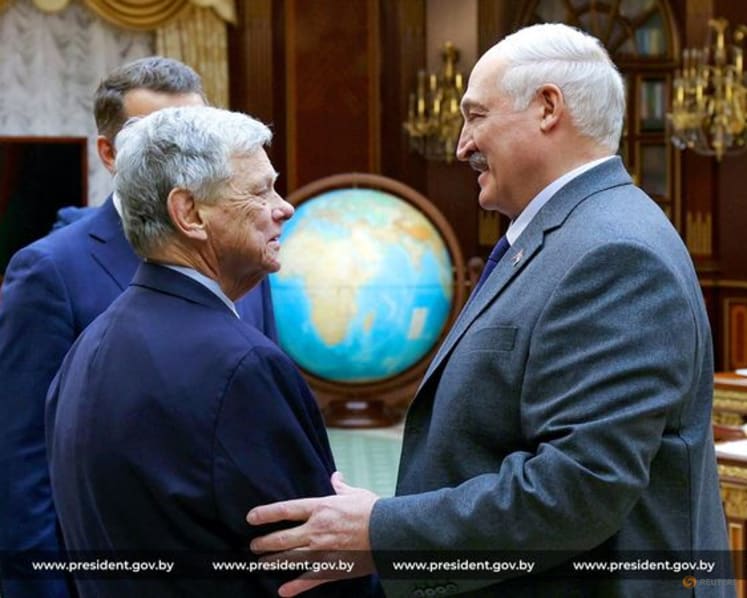
Belarusian President Alexander Lukashenko attends a meeting with John Coale, a representative of US President Donald Trump, in Minsk, Belarus, on Dec 12, 2025. (Photo: President of the Republic of Belarus/Handout via REUTERS)
Belarusian President Alexander Lukashenko held talks on Friday (Dec 12) with US envoy John Coale, tasked by President Donald Trump with negotiating the release of political prisoners in Belarus, and said their meeting could help resolve certain problems.
A brief video published by a Telegram channel linked to Lukashenko's administration showed him greeting Coale with a handshake and a brief embrace and congratulating him on his appointment last month as Trump's special envoy.
"You're currently our top official on Belarus. Tell Trump that we must do something about this. And we will," Lukashenko said, using a familiar form of address as Coale listened to a translation.
TRUMP HAS URGED LUKASHENKO TO FREE "HOSTAGES"
State news agency Belta quoted Lukashenko as saying: "They say Trump loves flattery. But I'm not doing it for the sake of flattery. I want to say that I really like his actions lately."





He added: "We have many questions. The world is changing very quickly, and new problems are emerging that we need to discuss. And perhaps even resolve some of them."
Trump has urged Lukashenko, a close ally of Russian President Vladimir Putin, to free up to 1,400 people that Trump has called "hostages".
When Coale last visited Belarus in September, he persuaded Lukashenko to release 52 people, of whom 40 were political prisoners, according to human rights group Viasna. One was subsequently returned to jail after refusing to be deported.
In return, the United States removed sanctions against the Belarusian state airline.
But since that time, Viasna has designated 167 new individuals as political prisoners. The exiled Belarusian opposition accuses Lukashenko of operating a "revolving door", replacing old detainees with new ones.
TRUMP REOPENS US DIALOGUE WITH VETERAN LEADER
Until Trump began re-engaging with him this year, Western governments had long treated Lukashenko as a pariah, throttling his economy with sanctions to punish him for alleged human rights violations and for backing Russia's war in Ukraine.
Lukashenko allowed Russia to use Belarus as a launchpad for its February 2022 invasion of their mutual neighbour, and subsequently agreed to host Russian tactical nuclear missiles.
Now, political analysts believe, the veteran authoritarian leader is trying to mend fences with the West in order to ease his isolation and get Washington to lift its remaining sanctions.
Lukashenko said on Oct 31 he was ready for a "big deal" with the United States, as long as Belarusian interests were taken into account. But he has previously questioned why he should free people he sees as opponents of the state who might "again wage war against us".
Among the most prominent prisoners are Ales Bialiatski, winner of the 2022 Nobel Peace Prize, and Maria Kalesnikava, a leader of mass protests that were crushed by Lukashenko's security forces after a disputed election in 2020.
US officials have told Reuters that the Trump administration's engagement with Belarus is part of a long-term, broader strategy to pull Minsk out of Moscow's geopolitical orbit, if only marginally. That would represent a win for Washington, given that Belarus has long been a consistent irritant for NATO and a firm ally of Russia.
Neighbouring Lithuania this week imposed a state of emergency because of smuggler balloons launched from Belarus with contraband cigarettes, which have caused havoc in its airspace and forced repeated closures at Vilnius airport. Lukashenko denies responsibility for the disruption, which Lithuania calls a "hybrid attack".
Exiled Belarusian opposition leader Sviatlana Tsikhanouskaya told Reuters this week that the U.S. needed to use both carrots and sticks - meaning sanctions - when negotiating with Lukashenko.
"You have to understand that for Lukashenko, political prisoners are just bargaining chips," she said. "He wants to sell political prisoners as expensively as possible."




