Supreme Court sceptical of Trump bid to end birthright citizenship
The US Supreme Court questioned US President Donald Trump’s effort to limit automatic citizenship for children born in the United States.
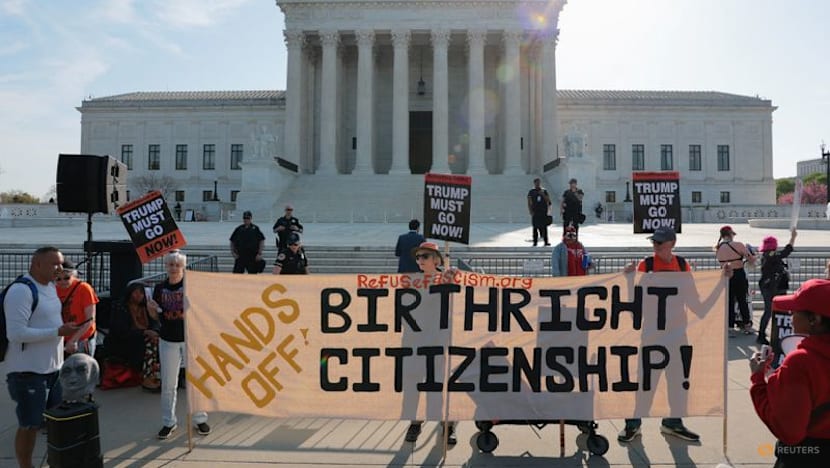
Demonstrators hold signs outside the US Supreme Court building, in Washington, DC, US, Apr 1, 2026. (Photo: REUTERS/Kylie Cooper)
The landmark case is a pillar in Trump's attempts to restrict immigration and his decision to attend oral arguments was unprecedented for a sitting president.
Trump left the hearing following the presentation by his solicitor general, John Sauer, and did not remain for the arguments of American Civil Liberties Union (ACLU) attorney Cecillia Wang, who was defending birthright citizenship.
"We are the only Country in the World STUPID enough to allow 'Birthright' Citizenship!" Trump said in a social media post after returning to the White House.
Trump signed an executive order on the first day of his second term decreeing that children born to parents in the United States illegally or on temporary visas would not automatically become US citizens.
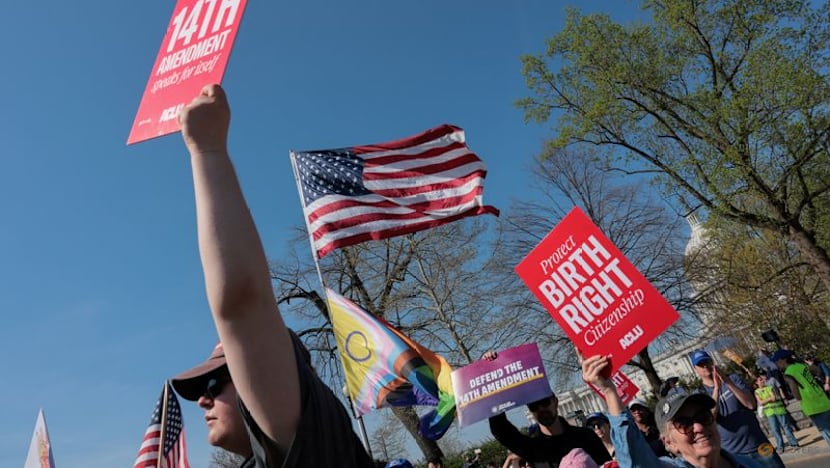
Lower courts blocked the move, ruling that under the Citizenship Clause of the 14th Amendment nearly everyone born on US soil is an American citizen.
"It operates as a powerful pull factor for illegal immigration and rewards illegal aliens who not only violate the immigration laws but also jump in front of those who follow the rules," he said.
It also encourages what Sauer called "birth tourism," in which foreigners come to the United States solely to give birth.
The three liberal justices and several conservatives appeared sceptical of the administration's arguments. Conservatives have a 6-3 supermajority on the court and three justices were appointed by Trump.
"IT'S THE SAME CONSTITUTION"
"We're in a new world now," the solicitor general said, "where eight billion people are one plane ride away from having a child who's a US citizen."
"Well, it's a new world. It's the same constitution," Roberts replied.
The 14th Amendment states that "All persons born or naturalised in the United States, and subject to the jurisdiction thereof, are citizens of the United States."
It does not apply to those not subject to US jurisdiction - the children of foreign diplomats, for example -- and Roberts said the government appeared to be seeking to expand the exceptions "to a whole class of illegal aliens," a move he described as "quirky."


"We try to interpret American law with American precedent based on American history," Kavanaugh said. "Why should we be thinking about ... other countries? I'm not seeing the relevance as a legal, constitutional interpretive matter."
Justice Neil Gorsuch, another conservative, said that when the 14th Amendment was passed, in 1868, there was no such thing as "illegal" immigration.
"If somebody showed up here in 1868 and established domicile, that was perfectly fine," Gorsuch said. "And so why wouldn't we...come to the conclusion that the fact that someone might be illegal is immaterial?"
DECISION BY JULY
Wang, the ACLU attorney, told the justices a rejection of birthright citizenship would call into question "the citizenship of millions of Americans past, present and future."
"Ask any American what our citizenship rule is, and they'll tell you, everyone born here is a citizen alike," Wang said. "That rule was enshrined in the 14th Amendment to put it out of the reach of any government official to destroy."
The Trump administration is arguing that the 14th Amendment, passed in the wake of the 1861-1865 Civil War, addresses citizenship rights of former slaves and not the children of undocumented migrants or visitors.
Trump's executive order is premised on the notion that anyone in the United States illegally, or on a visa, is not "subject to the jurisdiction" of the country and therefore excluded from automatic citizenship.
The Supreme Court rejected such a narrow definition in a landmark 1898 case involving a man who was born in San Francisco to parents from China.
If the Supreme Court rejects ending birthright citizenship, it would be the second major loss for Trump this term - the justices struck down most of his global tariffs in February.
A decision in the case is expected by late June or early July.