







Inside Singapore’s push to reinvent public service work with agentic AI
Vodcast series GovTech Decoded goes behind the scenes to show how artificial intelligence is used to enhance policymaking, boost productivity and support officers.

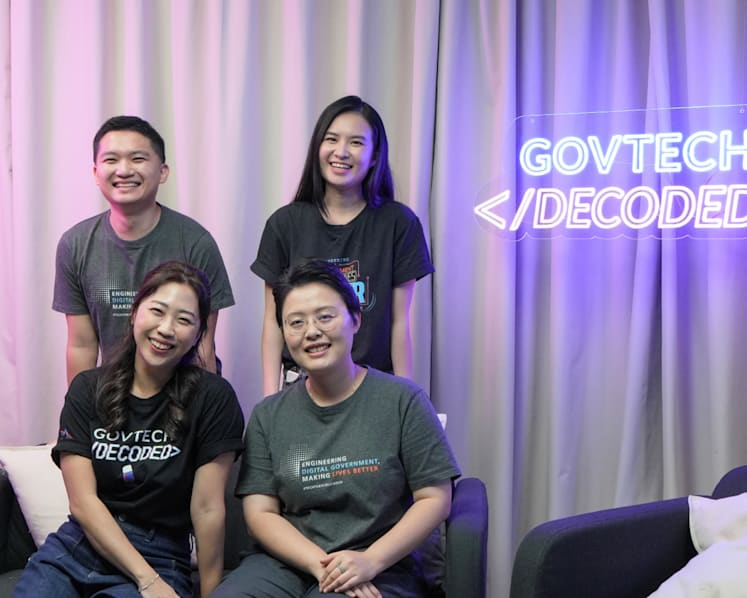
Ms Jessica Foo, senior AI engineer and technical lead at GovTech’s Responsible AI (AI Practice), on the set of the GovTech Decoded vodcast, episode 11. Photos, video: GovTech Singapore

This audio is generated by an AI tool.


Brought to you by

Originally trained as an economist, Ms Jessica Foo was working on the harmonisation of econometrics and machine learning at the Ministry of Trade and Industry when she became interested in the fast-growing field of artificial intelligence (AI).
After attaining a graduate certificate in AI from Stanford University, she joined the Government Technology Agency of Singapore (GovTech Singapore) as an AI engineer and went on to attain a master’s degree in engineering at the National University of Singapore.
Today, Ms Foo is a senior AI engineer and technical lead at GovTech’s Responsible AI (AI Practice) team, where she works to ensure that technologies like agentic AI are being responsibly integrated into government systems.
One of the projects that Ms Foo had worked on is Pensieve-AI, a digital drawing application that can accurately identify seniors with early memory problems in under five minutes. Formerly known as Project Pensieve, the app is jointly developed by Singapore General Hospital and GovTech, and is currently in its beta phase.
The app is featured in episode 11 of GovTech Decoded, a vodcast series that breaks down complex trends and technical concepts into accessible insights, and spotlights how the public service is using technology to build a future-ready Singapore.





Titled Reinventing Work with Agentic AI, episode 11 offers a behind-the-scenes look at AI’s growing role in government, including how agentic AI is being deployed responsibly.
Unlike traditional AI, which primarily responds to commands and requires human intervention, agentic AI focuses on autonomous decision-making and action. It is designed to set goals, plan and execute tasks with minimal human intervention.
Speaking on the GovTech Decoded vodcast, Ms Foo recalled attending triaging meetings to understand how doctors came up with dementia diagnoses, and observing the elderly taking assessments via Pensieve-AI. “AI is pervasive in society but what I enjoy most is working with people who want to do what’s best for Singaporeans and the public,” she said.
DRIVING PRODUCTIVITY WITH HUMAN-AI PARTNERSHIP
In episode 11 of GovTech Decoded, Ms Foo shared how agentic AI is also capable of drawing on information from past interactions to guide future actions. Instead of simply automating repetitive tasks, the system can send emails, book meeting rooms and create calendar invites on its own.
Still, agentic AI is not expected to replace humans at work, said GovTech data scientist Lois Ji, who is currently deployed to SkillsFuture Singapore (SSG). “AI is not here to steal your jobs,” she emphasised. “It’s here to change the way we work and sometimes the way we live, but it can’t possibly replace everything we do.”
GovTech cybersecurity engineer Wan Ding Yao, who is currently posted to the Cyber Security Agency of Singapore (CSA) to work on national strategies and policies for emerging technologies such as AI, echoed Ms Ji’s sentiments.
He added that automation of routine cybersecurity tasks through AI helps free up manpower. “We see this as human-AI collaboration,” he said. “Officers can focus on higher-value work like vulnerability research, which typically requires greater human ingenuity and creativity.”
DRIVING DIGITAL TRUST THROUGH RESPONSIBLE AI
In Reinventing Work with Agentic AI, the trio discussed how AI safety and security require a whole-of-government effort. By protecting against bias, misinformation and misuse in government systems, responsible AI minimises the risk of harm to individuals and society.
According to Ms Foo, responsible AI is guided by six core principles: safety, robustness, fairness, explainability, privacy and transparency. As agentic AI is incorporated into more public service systems, abiding by these principles helps mitigate risks while unlocking the technology’s benefits and fostering digital trust among Singaporeans.
To scale up AI capability building across the government, GovTech has produced a series of playbooks covering areas such as agentic AI architecture and responsible system design. It has also developed an open-source agentic risk and capability framework to define risks and technical controls for agentic AI systems.
Mr Wan shared that CSA has built on this framework to develop practical security guidance for agentic AI system owners. The document, Securing Agentic AI, was recently released for public consultation by Minister for Digital Development and Information Josephine Teo at Singapore International Cyber Week 2025.
When it comes to responsible AI use, public officers are the first line of defence, noted Ms Foo. In addition to undergoing a mandatory AI literacy course, public officers have access to GovTech Singapore’s Responsible AI Playbook, which outlines best practices in evaluating the safety of AI applications. Tools like LionGuard also help to detect unsafe content online, including in Singlish, Malay, Mandarin and Tamil.
At SSG, AI-generated information – as well as the level of data and environment access given to agents – is closely governed and reviewed to ensure agentic AI is used responsibly within the customer relationship management (CRM) team.
DRIVING EFFICIENCY THROUGH AI INNOVATION AND COLLABORATION
When developed responsibly, AI applications can create greater efficiency in the public service.
At SSG, a prototype application is being piloted internally to offer agentic AI support to each member of the CRM team. Every AI agent mirrors a specific function within the team, enabling more effective analysis of public and user feedback to help inform policymaking.
When a question such as “Which divisions should follow up with these cases that are more complex and cross-cutting in nature?” is asked, the CRM team member can run searches on the agentic system – which is populated with both enterprise metadata and CRM case data – to get a quick but comprehensive answer, instead of combing through documents or checking with a colleague.
The public service is also drawing on the expertise of commercial and academic partners. In August, Minister Teo announced that GovTech will partner Google’s cloud computing platform on a sandbox environment for agentic AI experiments.
Ms Foo added that GovTech regularly shares its research with the international academic community to garner feedback and test its thinking. “We need to have a human-centered approach to AI – where we see AI as complementary and supportive of humans, rather than displacing or replacing human effort,” she said.
As agentic AI continues to transform public service workflows, GovTech Singapore’s focus on experimentation, evaluation and collaboration will help ensure these technologies are deployed responsibly, for the public good.
Learn more about GovTech Decoded and watch episode 11.




