







Singapore among Southeast Asia’s AI frontrunners, but deeper transformation is needed
Redesigning workflows, reskilling teams and building trust are key to unlocking long-term impact.

As AI becomes embedded in business processes, leaders must ensure it delivers real impact. Photos: Shutterstock; Infographics: BCG

This audio is generated by an AI tool.


Brought to you by

The outlook for artificial intelligence (AI) in Asia Pacific appears strong, with organisations in the region showing greater confidence in the technology’s potential than their global peers, according to Boston Consulting Group’s (BCG) AI At Work: Is Asia Pacific Leading the Way? report.
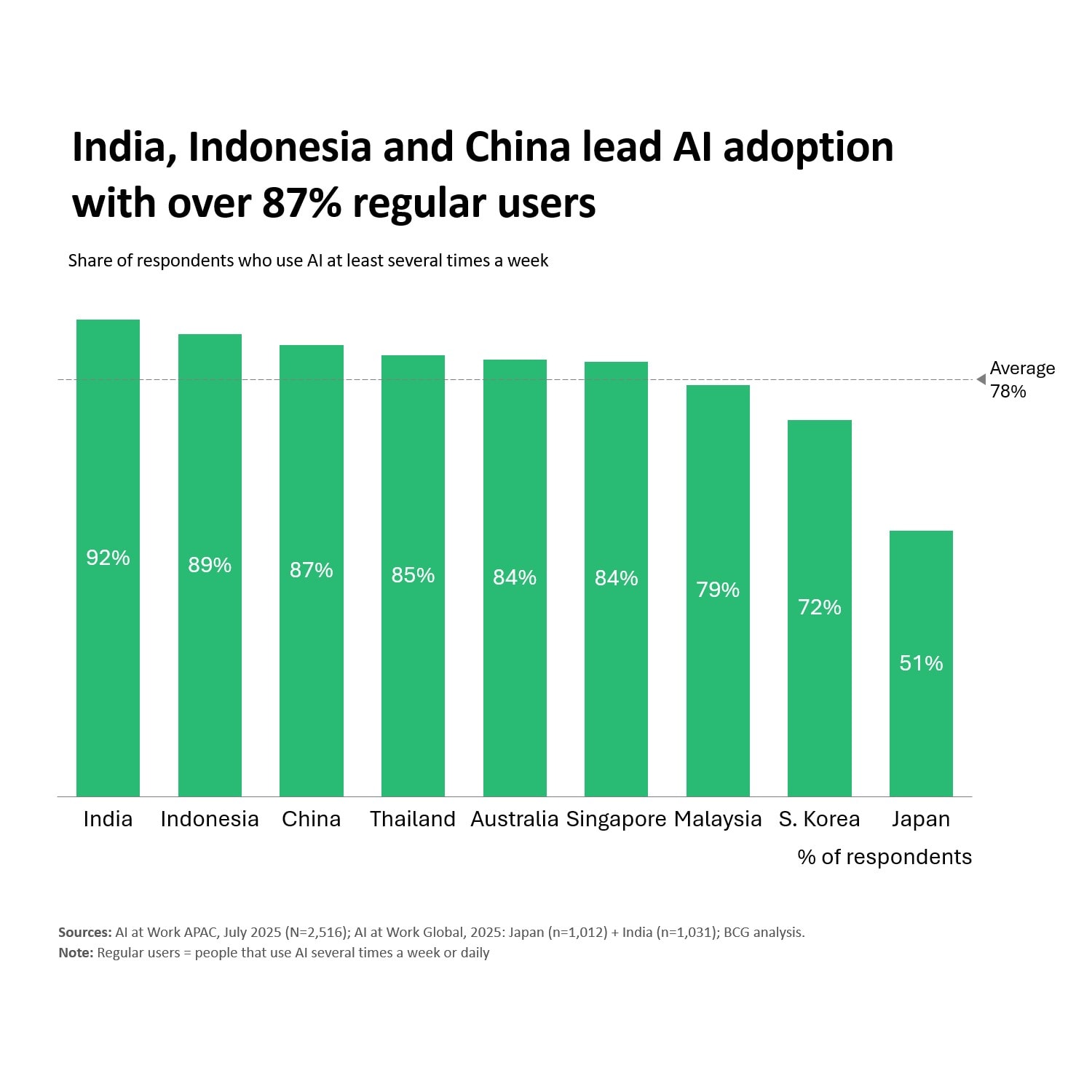
Released in October, the report found that 78 per cent of respondents across the region use AI regularly, with Indonesia-, Thailand- and Singapore-based firms leading adoption in Southeast Asia.
Mr Jeff Walters, managing director and senior partner, and Asia Pacific AI leader at BCG X, the firm’s tech build and design division, attributed Singapore’s rapid uptake to its strong digital infrastructure, proactive government policies and a well-educated, tech-savvy workforce. He cited initiatives such as the National AI Strategy 2.0 and SkillsFuture Singapore’s efforts to build an AI-fluent workforce.
“Singapore’s service-led economy is well positioned to benefit from productivity gains driven by generative AI, especially in areas such as content creation and data analysis,” added Mr Sagar Goel, managing director and partner, and global insights partner at BCG Henderson Institute, the firm’s think tank. “Its global outlook and competitive mindset are also helping to accelerate AI adoption, ensuring both businesses and individuals remain ahead in a fast-evolving digital landscape.”





THE RISK OF LOSING MOMENTUM IN TRANSFORMATION

While AI adoption continues to grow across Asia Pacific, the risk of stagnation remains. According to the report, only 57 per cent of companies in the region are reshaping workflows – compared with 70 per cent of global leaders.
As AI becomes more integrated into business processes, leaders have a responsibility to ensure it drives meaningful change and business value. Mr Walters identified three strategies for AI transformation: deployment, where AI is embedded into daily operations to enhance productivity; reshaping, which involves transforming end-to-end processes; and invention, which focuses on creating new business models and offerings powered by AI.
“Many firms in Asia Pacific stop at deployment,” he noted. “When companies only implement tools without rethinking how work is done, the gains are often marginal. The priority now is to invest in reshaping and inventing.”
Achieving this requires focusing on people, not just technology. “Unless jobs themselves are redefined, meaningful value cannot be created,” said Mr Walters. “For Singapore firms, the next step is not more tools – it’s redesigning systems and managing change effectively to convert adoption into real productivity gains.”
BUILDING CONFIDENCE THROUGH LEADERSHIP AND COMMUNICATION

Frontline employees in Asia Pacific – including white-collar workers with no managerial responsibilities – are embracing AI at notably higher rates than their global counterparts: 70 per cent versus 51 per cent, according to the AI At Work report. Mr Walters sees this as a sign of strong grassroots interest in experimenting with the technology.
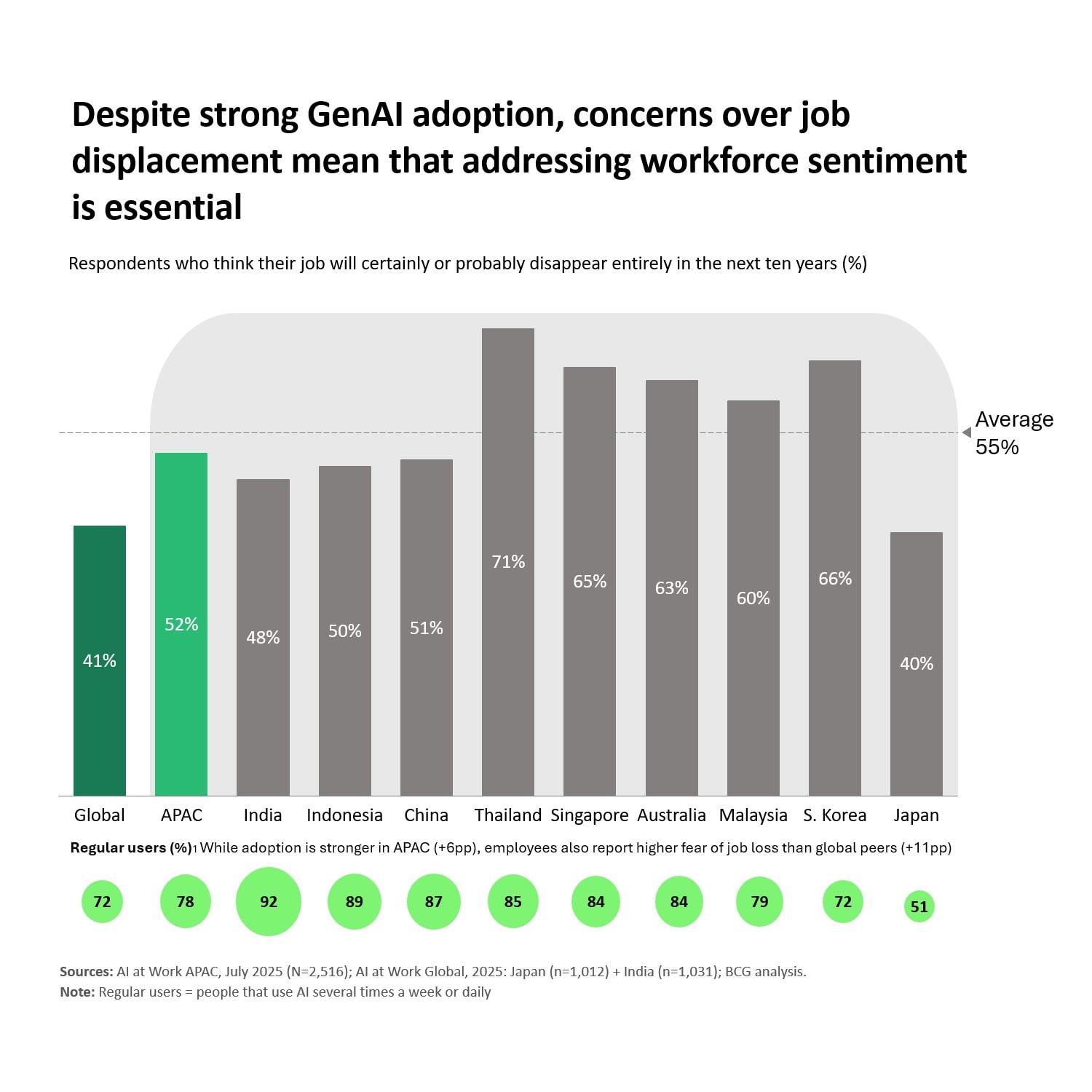
Despite this, only a third of these workers feel supported by leadership as the effects of generative AI begin to reshape workplaces. Fear of job loss is a key barrier. The report found that 65 per cent of respondents in Singapore believe their jobs will certainly or probably disappear within the next 10 years, compared to the global average of 55 per cent.
Mr Walters said leaders should be clear about why they are adopting AI, whether to boost efficiency or drive growth. Showing AI’s practical value – such as relieving teams of repetitive work, improving quality or unlocking new revenue – is also key. “One effective tactic is to identify and automate the most frustrating tasks in a given role. It’s a quick win that can build momentum in the reshaping phase,” he said.
Building AI literacy across all functions – not just digital teams – is central to transformation. This includes redesigning work, aligning incentives and embedding reskilling into organisational culture. Tactics such as training early adopters to mentor peers, and recognising teams that proactively retrain, can help build internal advocacy and sustain enthusiasm.
MANAGING RISKS TO UNLOCK AI’S POTENTIAL

As AI use grows, the rise of “shadow AI” – where employees experiment with the technology without formal approval – presents substantial risks if companies do not take action. The AI At Work report found that 58 per cent of employees in Asia Pacific have used AI tools independently.
“People want to innovate, but governance hasn’t kept pace,” said Mr Walters. “The challenge for companies is to channel that energy by offering tools that are both effective and secure.”
He urged leaders to establish safe, governed access that enables experimentation within clear boundaries. With defined policies, risk protocols and approved platforms, firms can encourage innovation without compromising on data security or compliance.
Leadership support plays a critical role in shaping sentiment. When leaders actively back AI use, the proportion of frontline workers who see AI as positive for their careers increases from 12 per cent to 46 per cent. “To move from pilots to real transformation, leaders must provide clarity and equip teams with the tools and guidance to act with confidence,” said Mr Walters. “In Singapore, firms that turn AI readiness into resilience will be best placed to build organisations where AI drives productivity, innovation and long-term advantage.”
Find out how your firm can bridge key gaps in AI adoption and transformation by downloading Boston Consulting Group’s AI At Work report.




