Conflict and fear sap campaign energy ahead of Myanmar election
In Mandalay city, about 600 km north of Yangon, the lack of campaigning is palpable, with no sustained canvassing for votes just days ahead of the polls, two residents say.
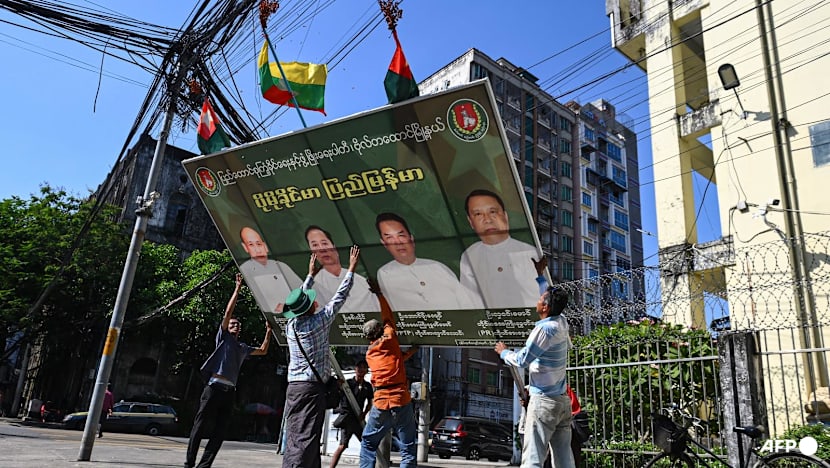
Members of Union Solidarity and Development Party (USDP) remove their signboard on the final day of the campaign on Dec 26, 2025, ahead of the start of Myanmar's general election in Yangon. (Photo: AFP/Sai Aung Main)
Campaigning ahead of Myanmar's general election that begins on Sunday (Dec 28) has been shorn of the energy of previous polls, residents said, as voting is scheduled amid a civil war and a humanitarian crisis as well as wide criticism that it is a sham to help the junta perpetuate power.
Myanmar has been in the throes of a nationwide conflict since the military deposed an elected government led by Nobel laureate Aung San Suu Kyi in a 2021 coup, alleging poll fraud in a general election held the preceding year.
Although the junta insists the election has popular backing, the vote has been widely criticised by the United Nations, Western governments and human rights groups as an attempt by the military to entrench its rule through political proxies.
Three residents of Myanmar's commercial capital Yangon, parts of which will vote on Sunday, said they remember past campaigns being rife with activity, including lively rallies, noisy road shows and large gatherings.





"This time, the candidates did not really come out on the streets. I only see sign boards on the streets about them," said a 31-year-old from Yangon, who asked not to be named because of security concerns.
"I am someone who goes out the whole day, but I don't see any candidates campaigning even for USDP and for smaller parties," he added, referring to the military-aligned Union Solidarity and Development Party.
After the first phase on Sunday, the military-led administration will hold two more on January 11 and January 25, covering areas across 265 of Myanmar's 330 townships.
Dates for counting votes and announcing the results have not been declared.
A decade ago, when Myanmar held its second election since the end of five decades of military rule in 2011, streets were awash with sign boards and flags in the signature red of Suu Kyi's National League for Democracy (NLD), creating a carnival-like atmosphere.
Even the 2020 election, subdued by COVID-19 restrictions, had a more visible campaign, four people said.
In the city of Mandalay, about 600 km (370 miles) north of Yangon, the lack of campaigning is palpable, with no sustained canvassing for votes just days ahead of the polls, two residents said.
"The only real activity is the setting up of campaign billboards," 36-year-old Nwe told Reuters, adding that the few rallies being held were under guard.
"When parties campaign in neighborhoods, they don't go alone," she said, "They travel in groups with security."
The USDP, led by former generals from Myanmar's armed forces known as the Tatmadaw, has the most visible campaign presence on the streets, all five voters said.
Myanmar's humanitarian situation and economy
WHAT IS THE HUMANITARIAN SITUATION?
Myanmar's humanitarian crisis is one of the most severe in Asia, driven by the intensifying civil war and repeated natural disasters, including a massive earthquake in March.
The ruling junta has previously suppressed information about a severe food crisis gripping the country by pressuring researchers not to collect data about hunger and aid workers not to publish it, Reuters has reported, besides cracking down on journalists since the coup.
Myanmar is one of the world's most under-funded aid operations, with only 12 per cent of required funds received, the United Nations says.
United States' cuts to humanitarian aid are having a crushing impact on people, the UN special rapporteur on the situation of human rights in Myanmar has said.
The UN estimates that 20 million of Myanmar's 51 million people need aid as soaring inflation and a plunging currency push about half the population below the poverty line.
More than 3.6 million people have been displaced from their homes, with over 6,800 civilians killed in the conflict triggered by the coup, according to UN estimates.
With mounting violence forcing increasing numbers of people to flee, more than 12 million in Myanmar will face acute hunger next year, including 1 million who will need lifesaving support, according to the UN's World Food Programme.
More than 16 million people across Myanmar are acutely food insecure, meaning that their lack of food threatens lives and livelihoods, WFP estimates.
They are the fifth-largest group needing aid anywhere in the world, making Myanmar "a hunger hotspot of very high concern," the agency said.
More than 540,000 children across the country are expected to suffer this year from acute malnutrition - life-threatening wasting that can have severe and lifelong effects – a 26 per cent increase from last year, WFP said.
One in three children under the age of five is already suffering from stunted growth, according to WFP.
HOW HAS THE ECONOMY FARED?
Myanmar's economy - once deemed as one of the region's most promising - has struggled in recent years, reeling from the civil war, natural disasters and mismanagement.
But despite the challenges, Myanmar's economy is showing some signs of improvement and its GDP growth is estimated to rebound to 3 per cent in the next fiscal year, the World Bank said this month.
The projected growth is driven by post-earthquake reconstruction and continued targeted assistance for the hardest-hit areas, although inflation is expected to remain above 20 per cent.
With electricity supply deteriorating, exposing millions of people to chronic blackouts, households and businesses are increasingly embracing solar energy for reliable power.
Russia, which has been building ties with the junta, signed an investment agreement with Myanmar in June that it said could open up new opportunities for Russian energy companies in the Southeast Asian country.
POLLS UNDER FEAR
The United Nations said on Tuesday that civilians were being threatened over their participation in the polls, both by Myanmar's military authorities and by armed groups opposing the Tatmadaw.
"These elections are clearly taking place in an environment of violence and repression," said UN Human Rights Chief Volker Turk.
All five residents interviewed by Reuters said they had received no direct instruction from junta officials asking them to vote, although there was fear of the consequences of not casting their ballot.
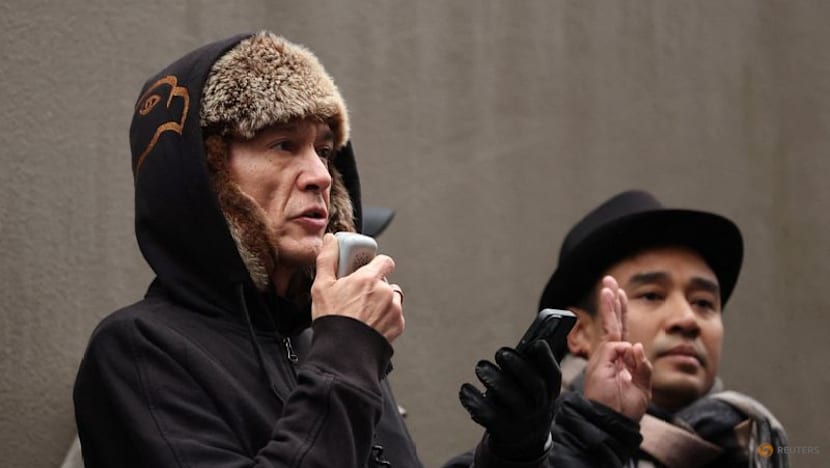
The shadow National Unity Government, which contains remnants of the NLD and other anti-junta entities, said it was not putting pressure on people to abstain from voting.
Mandalay resident Nwe said people worry that not voting could lead to travel restrictions and other repercussions.
"Rumors are rampant, so even though there is no official news, people are privately terrified," she said.
In Yangon, a 34-year-old resident said his family doesn't want him to vote, fearing that he might be included in a military conscription scheme that the Tatmadaw enacted in 2024.
"For me, I am scared of getting arrested if I don't vote," he told Reuters.
Ahead of the polls, Myanmar's junta has said the election is not being conducted with coercion, force or suppression.
In an opinion piece on Thursday, the state-run Global New Light of Myanmar argued that observers were wrong to judge the upcoming polls by Western standards.
"They fail to see that for ordinary citizens, this election – however imperfect – is an exit strategy from the state of emergency and a path back into a legal framework," it said.