At Hanoi's popular railway cafe street, trains may stop running under safety and urban renewal plans
The transport authorities warned of travel delays and detours if the route is cut, raising costs for daily passengers and affecting businesses as well as the draw to tourist sites.
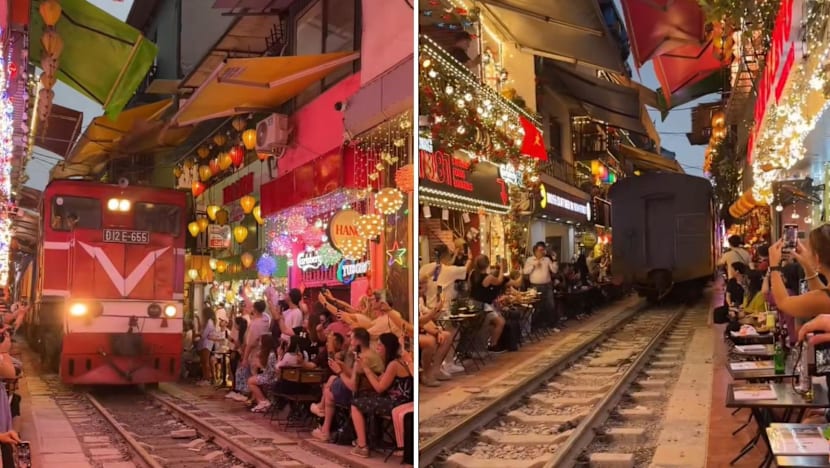
In Vietnam, cafes line both sides of an active rail track at Hanoi's railway cafe street, where visitors patronise cafes and shops, throng the stretch to take photos or watch trains pass just in front of them. (Images: TikTok/florianlavielle)

This audio is generated by an AI tool.
Hanoi has proposed halting passenger train services on a stretch of railway that runs through its popular "railway cafe street", but railway authorities and transport experts said that this could affect thousands of travellers daily, compromise train operations and weaken tourism appeal.
Travellers arriving in Hanoi from the south could face inconvenience if they have to transfer by road to continue their journeys on northbound routes, and this would affect elders, families with children and passengers carrying heavy luggage, Vietnamese online news site VnExpress reported.
Located mainly in the Kham Thien and Phung Hung areas of Hoan Kiem district, the narrow street in the Vietnamese capital has become a major tourist draw.
Cafes and shops line both sides of an active rail track in the city centre, where visitors sip coffee or throng to take videos or watch trains pass just in front of them – sometimes at chairs and tables placed a metre or less away from the track.
Despite laws requiring a safety buffer, cafes continue to push in to get the best views for patrons, and tourists persist in taking photos and videos on this unusual street.
The plans to halt the trains may just end up drawing more people to visit, observers noted, as videos on social media have already done their share of luring people to see the risky sights themselves.
In June last year, a viral video showed a tourist filming an oncoming train with his mobile phone before he narrowly escaped being seriously injured.
In October, another video captured a train crashing into tables and chairs placed too close to the tracks, VnExpress reported.





In the latest development, the Hanoi People's Committee sent a document to the Ministry of Construction, proposing to adjust passenger services on the national railway section between Hanoi Station and Gia Lam Station.
Under the proposal, southbound passenger trains would terminate at Hanoi Station, while northbound services would end at Gia Lam, the Vietnam News Agency reported.
Passenger transfers between the two stations would be handled by the city's construction and transport authorities.
If the plan is executed, passenger trains would no longer run through the stretch of track between Hanoi Station and Long Bien Station, where the cafe-lined railway cuts through densely populated inner-city neighbourhoods.
The city has also asked the ministry to hand over management of the national railway infrastructure on the Gia Lam-Hanoi section by the second quarter of this year, Asia News Network reported.
This would allow Hanoi to carry out urban renewal and conservation projects along the western edge of the Old Quarter and in the eastern part of the central heritage zone around the Imperial Citadel of Thang Long.
DISRUPTING TRAIN ROUTES, INCREASING TRAVEL TIMES
However, the Vietnam Railway Authority warned that the move could undermine the competitiveness of some popular train services, and that longer transfer times could push passengers back towards road transport.
The Hanoi-Gia Lam section is a key cross-city rail link connecting the capital's northern and southern rail networks.
About 20 passenger trains and six freight trains use the corridor daily, serving routes to cities including Bac Ninh, Haiphong and Lao Cai.


State-owned operator Vietnam Railways said the plan would require passengers travelling north to make an extra 10km transfer from central Hanoi to Gia Lam Station.
The detour could add between 30 and 40 minutes to journeys and raise transport costs, affecting thousands of passengers each day, VnExpress reported.
Travellers arriving in Hanoi from the south could also face delays if they are required to transfer by road to continue on northbound routes.
Infrastructure constraints remain another concern.
Gia Lam Station does not have enough platforms and facilities to handle a sharp increase in passenger volumes if multiple services are diverted there each day.
The Vietnam Railway Authority said that it is working with the Vietnam Railways Corporation to assess the proposal's impact before submitting feedback to the city authorities.
Raising cultural concerns, Mr Nguyen Van Quyen, chairman of the Vietnam Automobile Transport Association, told VnExpress that trains running through central Hanoi are not just a mode of transport but part of the city's historical and cultural identity.
He warned that removing passenger trains from the corridor would diminish the appeal of landmarks such as Long Bien Bridge and the railway cafe area, which have become popular with visitors.
He urged the city to instead retain passenger rail services while strengthening safety measures at level crossings and easing congestion in the city centre.
For the city government, the proposal is part of a broader plan to preserve and enhance the historical and cultural value of the railway corridor, particularly around the iconic Long Bien Bridge, which also carries rail traffic, Asia News Network reported.
Hanoi also plans to develop cultural, service and tourism spaces around the 131 stone railway arches beneath the elevated track running from Hanoi Station to Long Bien.
Some of the arches have already been partially repurposed as art spaces and cafes in recent years.
SAFETY CONCERNS
This is not the first time Hanoi's railway cafe street has come under scrutiny over safety concerns.
This latest development is another chapter in the uncertain future of the landmark, which has repeatedly been caught between the interests of small businesses and the authorities.
The street first drew the attention of city officials in 2019, when barricades were erected and cafes along the track were ordered to shut over safety risks.
The crackdown was later eased following backlash from businesses, which warned that the move would deal a heavy blow to tourism revenue.
The area fell quiet for about two years during the COVID-19 pandemic when there were lockdowns and travel restrictions.
Businesses then began reopening in March 2022, despite official warnings, after Vietnam relaxed its border curbs.
In September that year, the authorities in Hanoi's Hoan Kiem district again ordered the temporary closure of all shops along the railway stretch, pointing to safety violations flagged by the national railway operator.