India’s clean energy ambitions grow, even as fossil fuels stay in the mix
Analysts say significant investment and infrastructure development are still needed to keep the country’s green plans on track.

This audio is generated by an AI tool.
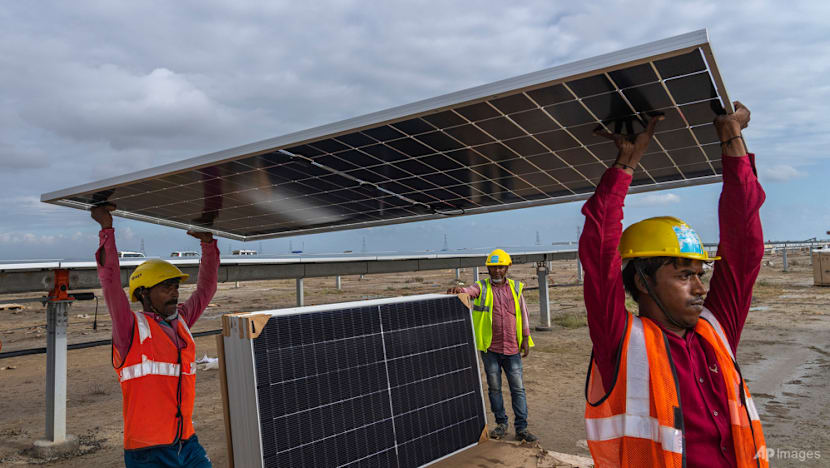
GOA: India’s energy transition is gathering pace, with renewable power taking centre stage as the country looks to fuel its fast-growing economy.
But while India has made significant strides in expanding clean energy capacity, experts warn that major challenges remain – particularly when it comes to the infrastructure needed to store and deliver that power reliably.
“You have to make the grid reliable,” said Amit Sharma, CEO of Tata Consulting Engineers.
“You need battery storage, which is quite expensive, and a lot of pumped storage, which takes solar and wind energy, puts that in energy reservoirs, and then feeds it back into the grid.”
Experts say that will require massive investments.
“We think around US$400 billion cumulatively over the next 15 years will be needed to support the build-out of power infrastructure,” said Paul McConnell, head of outlooks and scenarios at S&P Global.
“(There’s little value in) adding generating capacity if it can’t deliver power to where it’s needed.”
GREEN ENERGY PUSH
India, which remains heavily dependent on fossil fuel imports, sees clean energy as a way to rein in costs while reducing its carbon footprint.
The government is aiming to nearly double the nation’s non-fossil fuel power capacity by 2030.
Those ambitions are on full display this week at India Energy Week in Goa, the country’s flagship energy conference, where the clean energy transition was firmly in the spotlight.
One emerging option being showcased is green hydrogen – a fuel produced by splitting water into hydrogen and oxygen using renewable electricity.
But it remains costly, at just under US$4 per kilogram.
“If we can bring it down to below US$3 … there will be a public policy pressure (to) shift to green hydrogen … since we spend US$150 billion on imports of energy (each year),” said India’s Minister for Petroleum and Natural Gas Hardeep Singh Puri.
FOSSIL FUELS REMAIN CENTRAL FOR NOW
Even so, the government made it clear that fossil fuels will remain a key part of India’s energy mix for the foreseeable future, and securing oil and gas supplies remains a priority.
“I must re-emphasise that if investment in existing oil and gas production were to stop today, global oil output would decline by around 8 per cent annually. Over the next decade, that would be equivalent to losing more than the combined annual production of Brazil and Norway,” said Puri.
“The history of energy has never been about replacement alone. It has been about addition. New sources have consistently complemented existing ones.”
India is expected to account for more than a third of the growth in global energy demand over the next two decades, driven by economic expansion and a population of more than 1.4 billion.
Prime Minister Narendra Modi told the conference that India remains open for investment.
“We are trying to increase our investment in our oil and gas sector to US$100 billion by the end of this decade. Our goal is to expand the scope of exploration to 1 million sq km.”
GEOPOLITICS & PRICE
Some 75,000 delegates from around the world are expected to attend India Energy Week, which ends on Friday (Jan 30).
The event comes amid geopolitical tensions, including pressure from the United States for India to cut back on Russian oil purchases – a move some Indian refiners have already begun to make.
Following recent US actions targeting Venezuela’s leadership, analysts say India could benefit if Venezuelan crude re-enters global markets.
“It's (the) price. Russian crude has been attractive because of the steep discounts at which it has been offered,” said Vandana Hari, CEO of oil market analysis firm Vanda Insights.
“So, Venezuela coming back (to the table) will definitely be a welcome addition but it would have to come at the right price.”
Beyond sustainability, affordability and energy security are also key themes at the conference, as India seeks to meet surging demand while keeping costs under control.
Alongside renewables, other energy sources – including biofuels and nuclear power – are also being promoted as part of India’s broader push to diversify its energy mix.