US tariff uncertainty pushes Indian exporters to more stable markets like Japan
The impact is being felt across India’s textile industry, which employs around 45 million people, with American buyers withholding orders or demanding steep discounts.
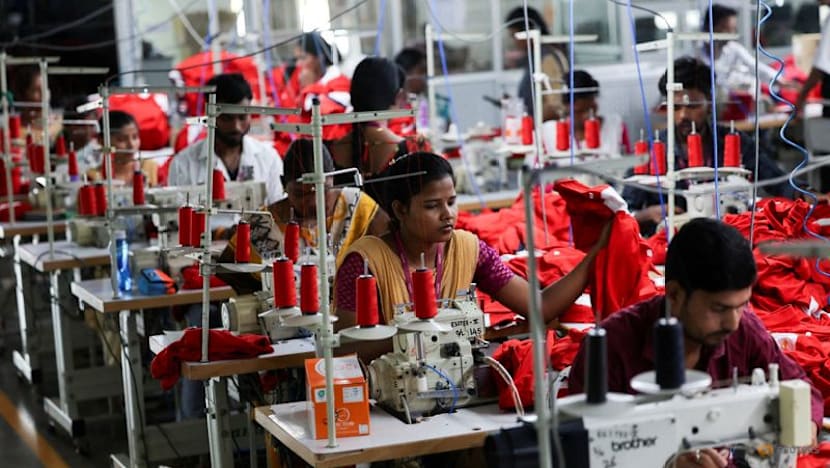
People work at a garment factory in Tiruppur, in the Southern state of Tamil Nadu, India, Apr 23, 2025. REUTERS/Francis Mascarenhas/File Photo

This audio is generated by an AI tool.


NEW DELHI: Doing business with the United States is now nearly impossible, Indian exporters say.
Lalit Thukral, chairman of the Noida Apparel Export Cluster, who represents a consortium of garment exporters outside New Delhi, has spent decades supplying textiles to what has long been India’s largest export market.
But a combination of steep tariffs, legal uncertainty and geopolitical tensions has left them struggling to plan ahead.
For India’s textile sector, the uncertainty stems from multiple developments.
In February, the US Supreme Court struck down President Donald Trump’s reciprocal tariffs, just days after Washington and New Delhi had agreed on the framework of an interim trade deal.
This would cap US tariffs on Indian goods at 18 per cent, down from between 25 per cent and 50 per cent. But Indian officials have since indicated that any agreement will only be signed after the US finalises its tariff structure.
Progress has been limited. The two sides have not held substantive talks since the court ruling, and it remains unclear when - or even if - a deal will materialise.
Since the ruling, Trump has imposed a new 10 per cent global import duty under a separate legal justification, though this will expire in July.






WITHHOLDING ORDERS, DEMANDING DISCOUNTS
For exporters like Thukral, the shifting landscape has made business planning increasingly difficult.
A US probe into excess industrial capacity from 16 major trading partners, including India, has further frayed expectations of a recovery.
“We were very hopeful that the interim deal will be signed quickly and that will ease business pressures. But now with the US involved in the Iran war, we don't know what that means for trade talks,” he told CNA.
“We are no longer in a position to even plan - it's impossible.”
The impact is being felt across India’s textile industry, which employs around 45 million people.
Manufacturers say US buyers are withholding orders or demanding steep discounts, while rising raw material and shipping costs - exacerbated by the US-Israel war on Iran - are squeezing already thin margins.
On factory floors, affected companies are cutting production and, in some cases, laying off workers.
LOOKING TO JAPAN
With uncertainty persisting in the US market, exporters are increasingly turning to more predictable ones.
“We don't know what will happen (in the US). Tomorrow, there might be new tariffs again,” said Thukral.
“Now increasingly, exporters are looking at Japan as a possible destination - it's a market that takes high quality products. And business delegations are travelling to Japan for this,” he added.
India is one of the world’s largest textile and apparel exporters, but its presence in Japan remains limited. Shipments account for less than 1 per cent of Tokyo’s US$30 billion textile import market.
Still, some companies see opportunity.
Mukesh Khinchi, general manager for sales and marketing (Far East) at Banswara Syntex Limited, said the Japanese market holds immense potential for Indian traders if they can meet its requirements.
“It's not an easy market to get into because the quality standards are quite high vis-a-vis the European or the American market. It took us almost two years to get our initial breakthroughs,” he noted.
Khinchi’s company has been exporting to Japan since 2016, adapting its products to local preferences and expectations.
“Japan is a more product-conscious market where, along with the price and other things, you need to offer a solution - and you need to make a product which is more durable and more long-lasting with higher performance,” he added.
New Delhi already has an economic partnership agreement with Tokyo, which exporters say makes it easier to operate there.
However, analysts caution that demand from Japan is unlikely to match the scale of the US market, underscoring the need for Indian exporters to diversify beyond a single dominant market.
The government has also been encouraging this shift, having recently signed trade deals with the European Union and Australia.
Some experts say more needs to be done to strengthen India’s global competitiveness.
“We haven't been able to create something like a ‘wow’ factor for Indian textiles and apparels. And I think that is the way we should move forward,” said Arpita Mukherjee, a professor at the Indian Council for Research on International Economic Relations.
“That (textile) ministry needs to move forward with that target, with a vision plan and with an action document to build brand India.”