Indonesian civil servants to undergo military training to boost national defence
Some 4,000 of them will begin training, which is voluntary, in the first half of 2026, says Indonesia Defence Minister Sjafrie Sjamsoeddin. But observers have voiced concerns about the plan.
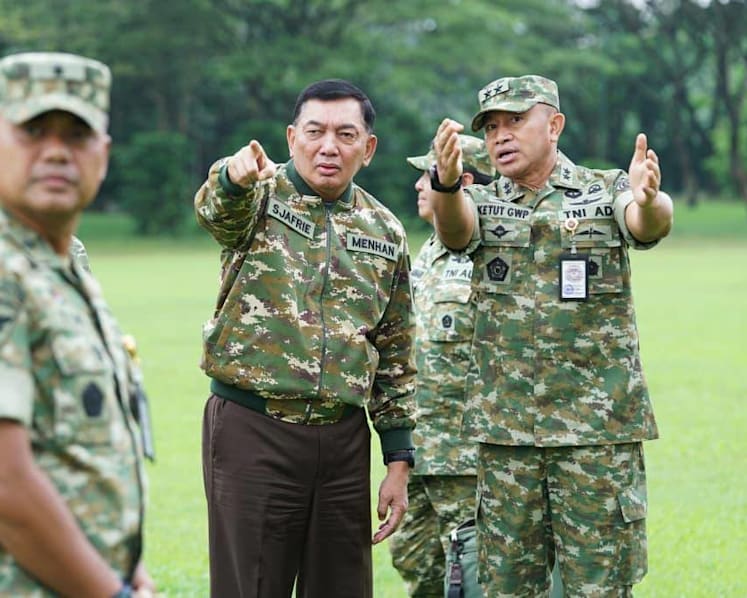
Indonesia Defence Minister Sjafrie Sjamsoeddin (second from left) at a national defence retreat for the Indonesian Journalists Association in Cibodas, Bogor. (Photo: Facebook/Kementerian Pertahanan Republik Indonesia)
JAKARTA: Some 4,000 civil servants in Indonesia will undergo military training in the first half of 2026 under the government’s plans to make them part of the military reserve.
The programme aims to foster nationalism and a stronger sense of service to the country, said Indonesia’s Defence Minister Sjafrie Sjamsoeddin last Saturday (Jan 31) at a national defence retreat for the Indonesian Journalists Association in Cibodas, Bogor.
Participants will be aged 18 to 35 and will undergo basic military training in stages, he said.
They will not replace the Indonesian military in carrying out core national defence duties, and will return to their respective institutions after the training, he added.
“We (will) start training the civil servants in the first half of 2026 and concentrate on those from ministries for the first semester,” Sjafrie said.
“We will divide it every quarter so that by the first semester we will have a sufficiently large reserve component. That is the projection of how the state must defend itself.”
Training would likely start in April, but details of the programme and the quota for each participating government institution are still being worked out, ministry spokesperson Rico Ricardo Sirait told The Jakarta Post on Monday (Feb 2).
The programme is part of a policy in place since 2021 to strengthen national defence, he said.
Between 2021 and 2025, 1,333 civil servants at the Defence Ministry went through the training, he added.
It is now being extended beyond the defence ministry and will target 49 ministries and government institutions in Jakarta, he said, as reported by news outlet Kompas on Tuesday.
The training will be voluntary and not compulsory, Rico said.
Indonesia expanded its military’s reserve component, Komponen Cadangan (Komcad), in July 2025, according to Indo-Pacific Defense Forum, a platform sponsored by the United States Indo-Pacific Command that provides updates on the Indo-Pacific security environment.
It got civil servants and government contract workers to undergo structured military training as part of changes to the government’s total defence framework. The three-month training includes military discipline, survival skills and command structure, the Indo-Pacific Defense Forum reported.





PRAGMATIC, BUT ALIGNED WITH MODERN WARFARE?
Sjafrie’s announcement has drawn mixed reactions from observers.
Defence analyst Anton Aliabbas told The Jakarta Post that the policy was pragmatic.
Tapping civil servants aligns with the government’s broader efficiency agenda, and minimises economic disruption for the participants, who would continue receiving their salaries during training, he said.
Others felt military training did not gel with the ethos of public service.
"The spirit of civil servants is one of service for the benefit of the community, not simply of obeying orders from superiors," Agus Pramusinto, a professor of Public Administration at Gadjah Mada University, told Kompas.
"Command culture is different from service culture. Civil servants must prioritise democratic public service," said Agus.
Some observers also wondered if the military training aligned with the needs of modern warfare.
“In modern warfare, victory is determined by professional soldiers supported by sophisticated technology, intelligence capabilities and cyber infrastructure, not by expanding reserve personnel with limited training,” military analyst Al Araf told The Jakarta Post.
Usman Hamid, executive director of Amnesty International Indonesia, told Kompas the government should focus on strengthening the professional army within the Indonesian National Armed Forces. “It should not create military training that risks causing social friction within the community," said Usman.
The defence ministry’s budget allocation for 2026 is 187.1 trillion rupiah (US$11.15 billion). Its expenditure last year reportedly rose to 247.5 trillion rupiah, nearly 50 per cent higher than the initial allocation of about 165 trillion rupiah.