Malaysia’s AGC rebuts claims by Najib’s lawyer that High Court ruling on house arrest dilutes royal power
The Attorney General’s Chambers also cautioned against attempts to incite or disrupt public order through misleading interpretations of the court's judgment.
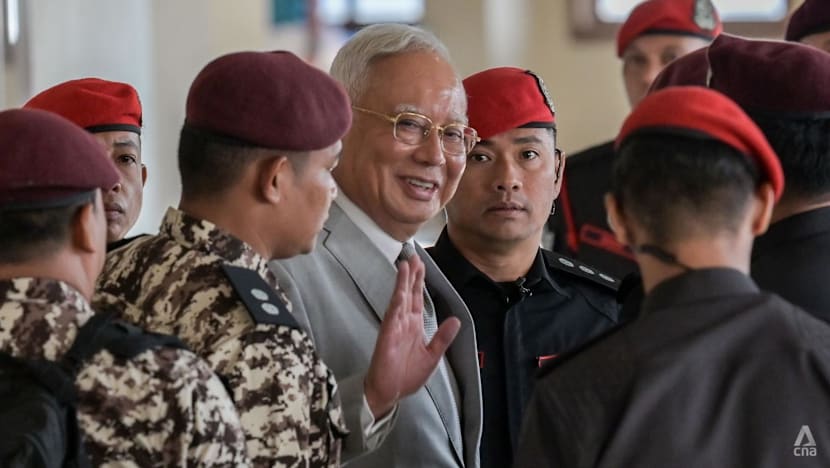
Former Malaysia Prime Minister Najib Razak arrives at the Kuala Lumpur Courts Complex at 8.53 am ahead of his scheduled court case, Dec 22, 2025. (Photo: CNA/Fadza Ishak)
KUALA LUMPUR: Malaysia’s Attorney General’s Chambers (AGC) has rebutted claims by former Prime Minister Najib Razak’s lawyer that a High Court ruling on Monday (Dec 22) has diluted the power of the king and Malay rulers to grant pardons.
The claim by Muhammad Shafee Abdullah, Najib’s lead counsel, is “not true at all and does not reflect the actual grounds given by the High Court”, the AGC said in a statement on Tuesday.
The High Court had rejected Najib’s bid to serve the rest of his prison term at home.
Najib had argued the Pardons Board’s decision to halve his prison sentence from 12 to six years was accompanied by an addendum order issued by the king that granted him house arrest.
The High Court ruled that the addendum order’s existence was not in dispute. But it was not deliberated on or decided at the 61st Pardons Board meeting on Jan 29 last year when the board agreed to reduce Najib’s sentence.
According to the federal constitution, the Pardons Board tenders its advice to the king for the purpose of exercising his powers of pardon, and must meet in the presence of and be presided over by the king, Justice Alice Loke noted in her ruling.
Hence, the addendum order, which was dated Jan 29, 2024, did not comply with Article 42 of Malaysia’s federal constitution and is not valid, she ruled.
After the verdict, Shafee told journalists: “Today’s decision seems to suggest that every decision pertaining to a pardon must be made within the Pardons Board. That has taken away what the king and Malay rulers have enjoyed on the full discretion of matters of pardon.”
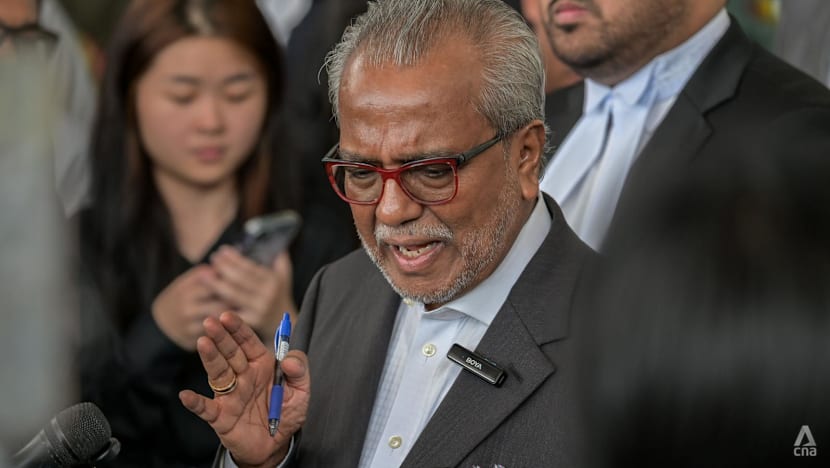
The AGC said the High Court ruling had reaffirmed the power of pardon is a prerogative of the king, as guaranteed under Article 42 of the federal constitution.
But Article 42 also provides that in exercising this prerogative, the king, Malay rulers and governors must convene with the Pardons Board when deciding pardon applications.
"In Najib's case, the minutes of the 61st meeting of the Pardons Board for the Federal Territories of Kuala Lumpur, Labuan, and Putrajaya clearly show that the issue of house arrest was never discussed (or) ordered by the 16th King during the meeting,” stated the AGC.
According to the constitution, the Pardons Board comprises the Attorney General, the minister responsible for the Federal Territories of Kuala Lumpur, Putrajaya and Labuan, and three other members appointed by the king, the High Court ruling noted.
The Pardons Board meeting only considered Najib's application for a full pardon, and the order made by the then-king – Sultan Abdullah Ri'ayatuddin Al-Mustafa Billah Shah – was solely to reduce the term of imprisonment and the fine, the AGC said.
"As such, the High Court judge ruled that any purported additional order for house arrest was not made pursuant to Article 42 of the constitution, as the matter was neither discussed by the board nor decided by the 16th King during the same meeting,” the AGC said.
"This clearly shows that the High Court's decision did not undermine the powers of the King, the Malay rulers, or governors in granting pardons,” it added.
"Moreover, the judge in the written judgment had recognised the prerogative powers of the King, the Malay rulers and governors, which cannot be exercised by any other party.”
AGC CAUTIONS AGAINST ATTEMPTS TO MISLEAD
The AGC also cautioned against attempts to incite or disrupt public order through misleading interpretations of the court's judgment, reported news outlet New Straits Times.
The AGC said it is committed to defending the royal institution and upholding the constitution.
"All parties should respect the appeal process that has been initiated by Najib," it added.
Malaysia Prime Minister Anwar Ibrahim also called for calm on Tuesday and for all parties to respect the judiciary following the High Court’s ruling on Najib’s house arrest bid.
“Based on the principle of legal sovereignty, all parties should respect the decision made by the judges, including the legal avenues available for filing appeals, as provided under the law and in accordance with the powers of the Yang di-Pertuan Agong (the king),” Anwar said in a statement.
His remarks came after a Democratic Action Party (DAP) lawmaker’s social media post that was perceived as celebrating the judgment against Najib.
The post came under fire from leaders of another party, the United Malays National Organisation (UMNO), and sparked threats of an UMNO pullout from the unity government. The DAP is also a part of Anwar’s unity government.