Myanmar military signals leadership change ahead of presidential vote
The leadership change comes just days before Myanmar's newly-convened parliament is due to meet to start the process to pick a new president.

Members of Parliament and military-appointed lawmakers attend a session of the Pyithu Hluttaw (House of Representatives) following a phased election dominated by the army-backed Union Solidarity and Development Party, in Naypyitaw, Myanmar, on Mar 16, 2026. (Photo: Reuters)
Myanmar's military leadership is set for a reshuffle following an annual armed forces parade on Friday (Mar 27), state media reported, in a rare public signalling of transition by the secretive institution that has dominated the Southeast Asian nation.
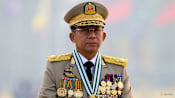
The imminent leadership change comes just days before Myanmar's newly-convened parliament is due to meet on Monday to start the process to pick a new president, a role the current military chief Min Aung Hlaing has long had his eyes on, Reuters has reported.
In a Thursday meeting with retired officers of the Myanmar military, also known as the Tatmadaw, its deputy chief Soe Win said that "leadership changes" would take place after the armed forces day ceremony, which typically features an ostentatious parade held in the capital Naypyitaw.
"Irrespective of who leads, Tatmadaw will continue to follow the guidance of successive leaders, advisors and mentors, as well as established military doctrines and policies," Soe Win said, according to the Global New Light of Myanmar newspaper.





A political transition is underway in Myanmar following a general election held in December and January, which was widely derided as a sham and won by a military-backed party, opening the door for Min Aung Hlaing to become president.
The poll came amidst a raging civil war, triggered by a 2021 coup that unseated a democratically elected government led by Nobel Peace Prize winner Aung San Suu Kyi, a conflict that has plunged the impoverished country into further turmoil.
It is highly unusual occurrence for Myanmar's military - which is locked in fighting with a range of armed groups on multiple frontlines - to preemptively disclose a high-level leadership change, said Htin Kyaw Aye, an independent analyst.
"This is a scripted transition, however, such a disclosure of information suggests that there may be underlying anxieties regarding the leadership transition and the redistribution of high-level positions," he said.
A career infantry officer, 69-year-old Min Aung Hlaing, who was hand-picked by former military ruler Than Shwe to become the commander-in-chief in 2011, has yet to publicly name a successor.