







As ringgit strengthens against US dollar, some Malaysian furniture exporters remain unfazed
One exporter said a 19 per cent US tariff has given Malaysian products an edge over Chinese goods, which face duties of at least 25 per cent.
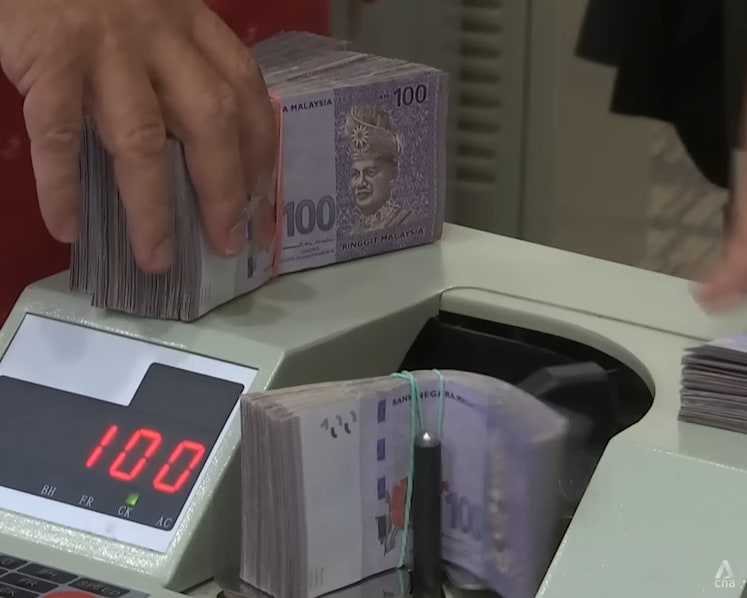
Malaysia ringgit banknotes being counted at a money counting machine.

This audio is generated by an AI tool.




KUALA LUMPUR: The Malaysian ringgit on Tuesday (Jan 27) broke the threshold of 4.0 against the United States dollar, marking its strongest level in more than seven years as it continues a broader rally driven by domestic fundamentals and global market shifts.
The ringgit further surged to 3.9175 against the greenback on Wednesday at 6pm. It opened at 3.9130 on Thursday morning.
The appreciation reflects a strong performance for the ringgit in 2025 and early 2026, making it one of the best-performing currencies in Asia.
But some Malaysian furniture exporters told CNA they remain largely unfazed by the stronger currency, despite unilateral US tariffs sending many export-driven industries into a tailspin last year.
American tariffs on Malaysian exports have given them a competitive advantage over Chinese competitors, they noted.





BOTTOM LINE NOT YET AFFECTED
Tong Sim Wood Industries, which supplies wood braces to the US energy sector, said tariffs imposed by the Trump administration have given its exports an edge over Chinese products, which face much higher duties of at least 25 per cent.
The US imposed a 19 per cent tariff on Malaysia last year – one of the lowest rates among members of the Association of Southeast Asian Nations (ASEAN).
“China is still the biggest competitor, but I think we have a good chance in the coming years, as long as we have the advantage on the tariff … to compete in the US market,” said Tong Sim Wood Industries’ managing director Edmund Lim.
The US remains among Malaysia’s top three export partners.
Mr Lim added that even the ringgit’s recent strength has not affected its bottom line, due to Malaysia’s relatively lower production costs from raw materials to labour.
“As of this year, I think we are still okay as long as (the ringgit) doesn't go beyond 3.8 (against the US dollar),” he said
“We are still in a good position because our labour cost is not that high compared to some parts of China and the region.”
The company has also adopted Chinese technology to improve its environmental, social and governance compliance by recycling sawdust and plastic to produce wood composites used in sustainable building materials and furniture.
TRADE DEAL WITH US
While Malaysia’s furniture industry has welcomed the reciprocal tariff agreement for the business certainty it brings, Prime Minister Anwar Ibrahim’s government is facing strong opposition in parliament over the trade deal signed with US President Donald Trump during the ASEAN leaders’ summit last October.
Malaysian Investment, Trade and Industry Minister Johari Abdul Ghani told parliament on Tuesday that the government will reassess the deal to ensure Malaysia’s economic interests are protected.
“Particular focus will be given to Malaysia’s exports to the United States, worth RM233 billion (US$59 billion), as well as the estimated 648,000 jobs and livelihoods tied to the trade,” he noted.
The government’s cost-benefit analysis will take at least six months to ensure all factors and possible effects are considered, he added.
Malaysia has not received official notice or notification from the US on a timeline for ratifying the deal.
Analysts said the ringgit’s recent strength reflects both domestic and external factors, even as exporters contend with the challenges of a stronger currency and global geopolitical uncertainty.
As businesses strive to adapt and survive in a challenging global environment, exporters say much of what lies ahead remains beyond their control, particularly as there is still no easing in sight to the prolonged US-China rivalries that continue to shape global trade.





