UK universities expand into India amid shifting demand, tighter visa rules
International education already contributes more than 30 billion pounds annually to the British economy, and expansion into India is expected to drive that figure higher.

Students studying at the University of Southampton Delhi campus.

This audio is generated by an AI tool.




NEW DELHI: British universities are no longer just inviting Indian students to study in the United Kingdom – they are bringing their campuses to India instead.
Nine UK institutions are setting up operations in the world’s most populous nation, as Britain targets 40 billion pounds (US$53 billion) in education exports by 2030.
This also comes as fewer Indian students travel to the UK following tighter visa rules.
The University of Southampton was among the first to establish a physical presence in India, opening a campus outside the capital New Delhi in July last year.
It offers six undergraduate and four postgraduate programmes carrying a British accreditation, but at significantly lower fees than studying in the UK.
Its programmes are focused on employability in India, said Eloise Philips, academic provost at the University of Southampton’s Delhi campus.
“Most of our students actually want to work and stay out here in India and give back to the Indian economy, so we’re working with big industry partners to offer students that opportunity,” she told CNA.
“I think we’re bridging that gap. Embedded in all our UK curriculum is that focus on AI, the focus on being career-ready.”
The university’s expansion was made possible after India introduced new regulations in 2023 allowing foreign universities to set up campuses, giving them access to one of the world’s fastest-growing education markets.
Eight other UK institutions – including Liverpool, Bristol, York and Aberdeen – have announced similar plans.
EXPORT, SCALE OPPORTUNITIES
The push follows the India-UK free trade agreement signed last year, as well as a broader Vision 2035 framework that identifies education as a key pillar of bilateral cooperation.
For the UK, the move represents a significant export opportunity.
International education already contributes more than 30 billion pounds annually to the British economy, and expansion into India is expected to drive that figure higher. Offshore campuses are also becoming an increasingly important source of income for universities.





For India, the appeal lies in scale.
The country aims to raise higher education enrolment to 50 per cent by 2035, up from around 28 per cent in 2021. This would require creating capacity for tens of millions of students.
However, access is only part of the challenge. Ensuring graduates are job-ready remains a concern.
According to the Mercer-Mettl India Graduate Skill Index 2025, which assessed over 1 million learners across 2,700 campuses, only 42.6 per cent of Indian graduates who apply for jobs are considered employable.
The report added that employers are increasingly seeking softer skills like critical thinking, which UK universities have said they are focusing on developing from day one.
Some experts argue that more targeted training aligned with real labour market needs is essential.
“Skill gaps exist across all sectors, but if you select the top five or seven sectors and take it as a study material like the Germans did for automobiles, it is very good because then the results are very fast,” said Arpita Mukherjee, professor at the Indian Council for Research on International Economic Relations.

CONCERNS LINGER
Beyond education and skills, the UK also sees its university expansion as a way to enhance its influence and soft power in India.
Still, questions remain over how effective the partnership will be.
Experts say the UK needs to streamline recognition of Indian degrees, while both countries must ensure that only world-class institutions are allowed to operate in India.
Finding such establishments in their home country without the immigration uncertainty could prove a big draw for students.
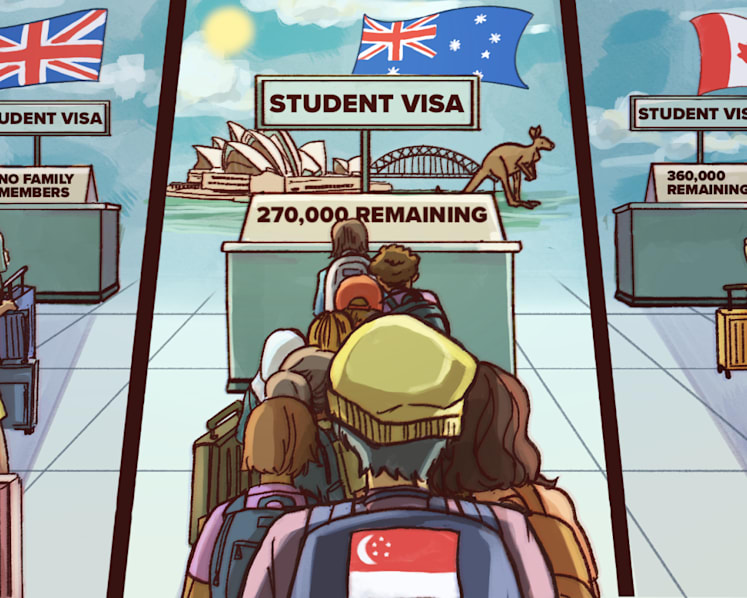
As of January 2024, the UK tightened visa rules and banned most international students from bringing dependents.
This led to a drop of 12 per cent in the number of Indian students in the UK in the 2024 to 2025 academic year, following a 5 per cent decline the previous year, according to a Times Higher Education report.
For some students, studying at a UK campus in India offers a practical alternative.
“If I stay here with my family, I can do more studies here also … and I can save money for (a) visa,” said New Delhi student Akshara Darade.
But key questions remain, including whether these offshore campuses can maintain UK academic standards while keeping fees affordable – and whether a UK degree earned in India will carry the same value as one obtained in Britain.
For now, the answer may determine whether this cross-border education model becomes a lasting success.