









Presented By
NANYANG BUSINESS SCHOOL
RETOOLS ITS DEGREE
FOR THE AI AGE
Content share and bookmark
How a new generation of business students is preparing to lead in a world shaped by technology, data and geopolitical change.
At Nanyang Business School (NBS), a revamped four-year undergraduate curriculum is redefining what it means to study business. Designed for a rapidly evolving economy, the Bachelor of Business (BBus) with Honours blends interdisciplinary learning, technological fluency and hands-on industry exposure to prepare students for tomorrow’s business challenges.
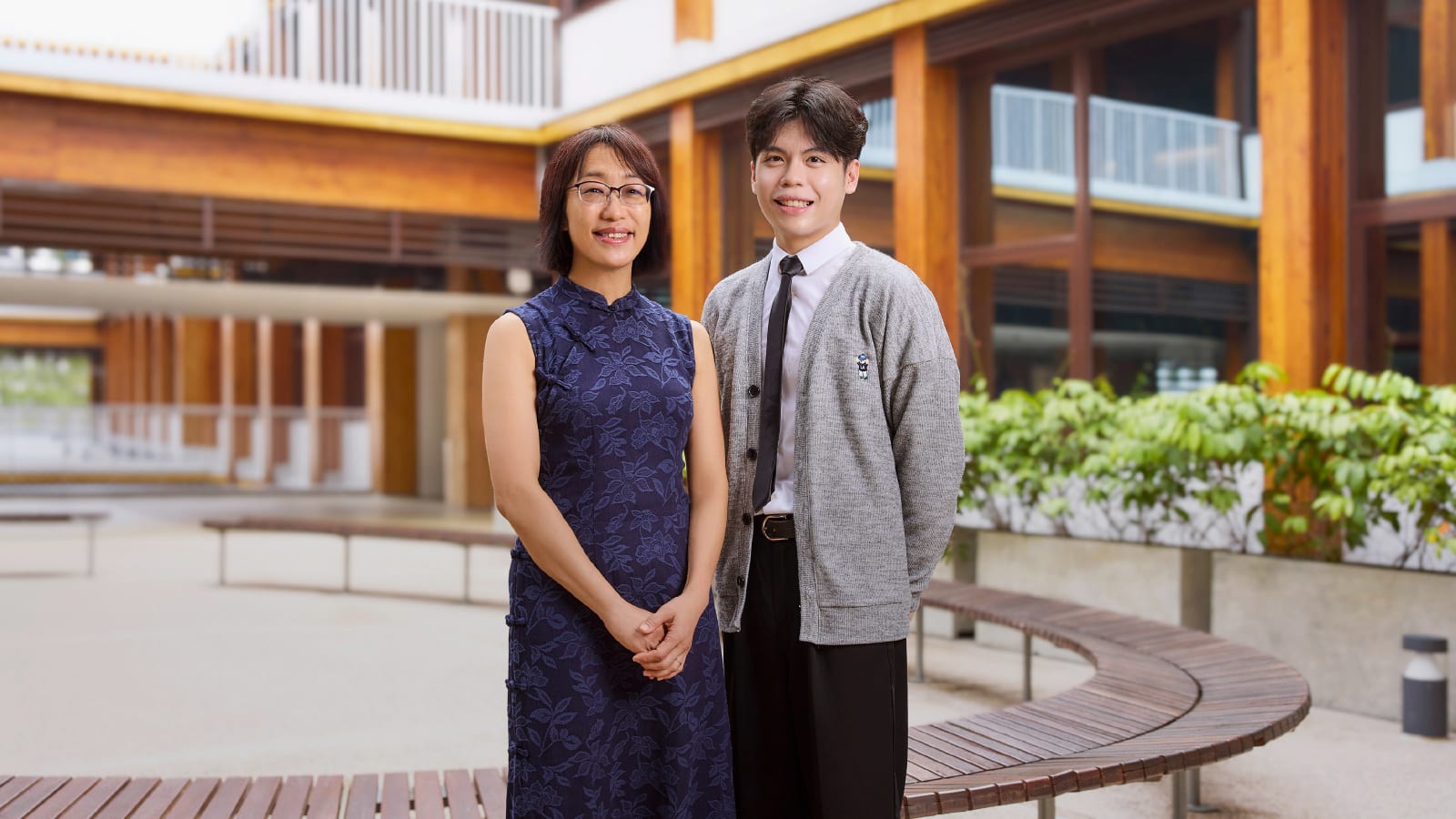
For first-year NBS student Kenneth Chong, learning to code has become part of how he thinks about business – not an optional technical skill but a core capability for modern business leaders. He completed hands-on coursework in data analysis using Python and R, two widely used programming languages.
This mix of business and tech is deliberate. As artificial intelligence (AI) reshapes industry, the lines between marketing and programming are blurring, and what once looked like separate fields are now complementary parts of the same skill set.
Mr Chong is enrolled in Nanyang Technological University’s (NTU) double-degree programme in accountancy and business and is part of the Nanyang Global Leaders (NGL) programme – NBS’ flagship pathway for top students, launched in 2025.
NBS’ revised BBus with Honours curriculum balances academic depth, applied learning and global exposure. (Videos: NBS)
He said the experience has sharpened his analytical thinking and strengthened his confidence in using data to solve business problems.
For Mr Chong, the lesson was clear: Tomorrow’s business leaders must be as comfortable with data and technology as they are with strategy and leadership.
The shift to a four-year BBus with Honours from the 2026 academic year is led by Professor Jun Yang, dean of NBS. Over the past three decades, her academic career across engineering, business, technology and finance has taken her from mainland China to Hong Kong and the United States, shaping how she approaches business education across different contexts. Her background has fostered a global, broad-based outlook that underpins the school’s teaching and research strategy.

“Geopolitical shifts and AI-driven disruption are transforming economies,” said Prof Yang. “Employers increasingly value graduates with a global perspective who understand industry trends and can tackle real-world business problems. Interdisciplinary learning teaches students to think broadly and approach challenges from multiple angles, while an agile, technology- and AI-savvy mindset helps them adapt quickly, be creative and innovate boldly.”
As NBS marks its 30th anniversary, the school has nurtured more than 69,000 graduates across its business and accountancy programmes, many of whom are shaping industries and driving economic progress in Singapore and around the world.
Today, the school is reimagining business education to prepare a new generation for an AI-powered economy – a strategic transformation led by Prof Yang that equips students with firm foundations in business and technology, cultivating the critical thinking and interdisciplinary skills they need to thrive.
The revised curriculum is designed to balance academic depth, applied learning and global exposure, with enhanced flexibility for students to tailor their pathways. “Our students graduate with strong academic foundations, practical experience and the adaptability to succeed in a rapidly changing world,” said Prof Yang.


Created in consultation with industry partners, the four-year programme is not simply an extension of the prior three-year structure, emphasised Prof Yang. “We took a deliberate approach to redesigning the programme, transforming the entire learning journey from the ground up.”
The curriculum builds students’ confidence in technology and sharpens their analytical, problem-solving skills, preparing them for evolving business challenges and labour market demands. Its “learning how to learn” philosophy underpins foundational training – from calculus to technology for business – alongside communications- and career-focused modules.
As a business school within a leading technological university, NBS is uniquely positioned to integrate technology directly into business education. Embedded in NTU’s tech ecosystem, NBS gives students exposure to analytics, programming and emerging technologies while grounding these capabilities in business strategy and decision-making.
The result is a generation of graduates who can bridge two worlds – fluent in the language of business and versed in the power of technology.
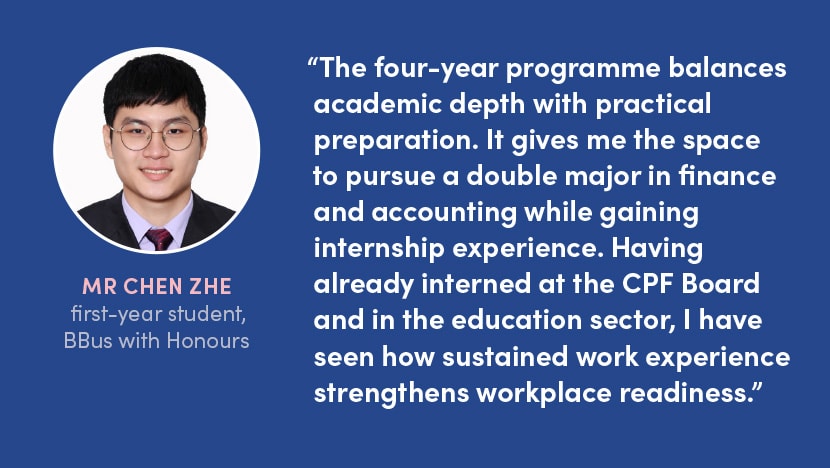
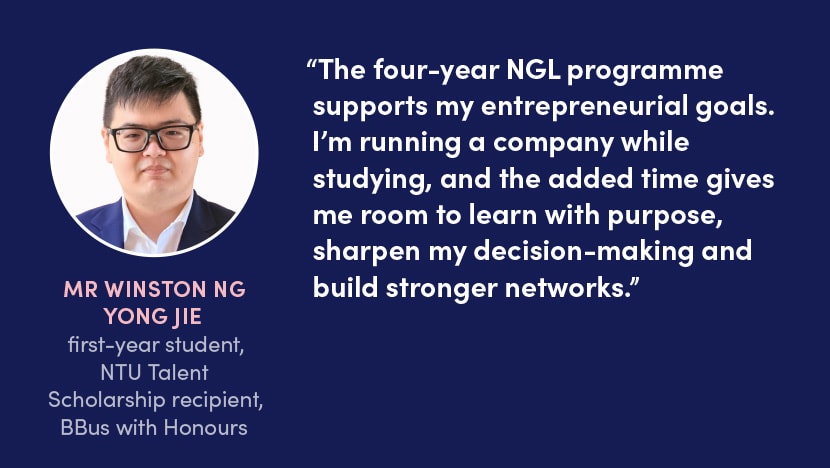
BUILDING INTERDISCIPLINARY CAPABILITIES
The purpose-built curriculum aims to set NBS apart from other four-year business programmes through its emphasis on industry relevance and more personalised pathways. Associate Professor Angie Low, associate dean of undergraduate education at NBS, oversees the redesign.

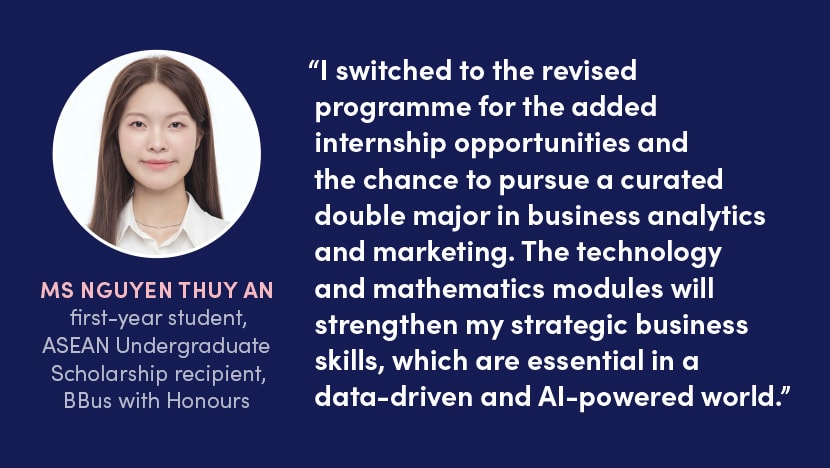
A key feature is the Career Accelerator Programme, combining extended, credit-bearing internships with structured coaching and faculty mentorship. These semester-long placements move students beyond short internships to sustained industry engagement, helping them develop professional maturity, workplace judgement and clearer career direction.
“Students will graduate with meaningful work experience, strong industry networks and a clearer career direction,” said Assoc Prof Low. “This allows them to enter the workforce with proven capabilities, making them more competitive in both local and global talent markets.”
The programme offers curated double-major pathways, such as finance and accounting, risk analytics and finance, and marketing and business analytics.
With traditional disciplinary boundaries blurring, business education can no longer be confined to a single field. “Business students need strong fundamentals, sharp insights and tech fluency,” said Prof Yang. “They must also be able to navigate diverse business environments across Asia and beyond.”
REIMAGINING ACCOUNTANCY FOR A TECH-DRIVEN ECONOMY
NBS’ Bachelor of Accountancy programme pairs rigorous accounting foundations with technology and workplace exposure, preparing graduates for roles beyond traditional audit and compliance.
Key features of the curriculum include:
- An expanded scope that integrates core accounting principles with analytics, sustainability and digital capabilities, equipping graduates for evolving industry demands
- Future-ready skill sets that prepare students for careers shaped by AI, sustainability reporting and data-driven decision-making
- Real-world industry exposure through multiple internships, strengthening career readiness
DEVELOPING FUTURE-READY BUSINESS LEADERS
Beyond the classroom, Mr Chong has taken on roles in student initiatives such as NBS Changemakers and NBS MarkeThink Club, focusing on publicity and project management.
As an NGL scholar, he has access to mentorship from senior business leaders, workshops, networking and global immersion programmes designed to stretch students beyond the classroom. “These experiences broaden my perspective, refine my professional skills and prepare me for the global workplace,” he said.
The NBS Global Leaders programme offers mentorship by top executives and builds business acumen through real-world projects.
While some may prefer to enter the workforce earlier, Mr Chong sees value in using the extra year to build depth through internships, leadership roles and overseas exposure. He views the fourth year as an investment in deeper expertise, expanded leadership experience and international opportunities.
Prof Yang said the revamp gives students more scope to make intentional choices about their learning. “I encourage aspiring business leaders to make full use of the opportunities and shape your own university experience,” she said. “Start building your career from day one – the future will belong to those who see further, think bigger and inspire others to build what comes next. At NBS, we give students the platform to grow into changemakers.”

