Asian stocks hit record high, dollar wobbles on US-Iran peace deal hopes
A potential deal to end the war, which started at the end of February, sent oil prices sliding nearly 8 per cent on Wednesday.
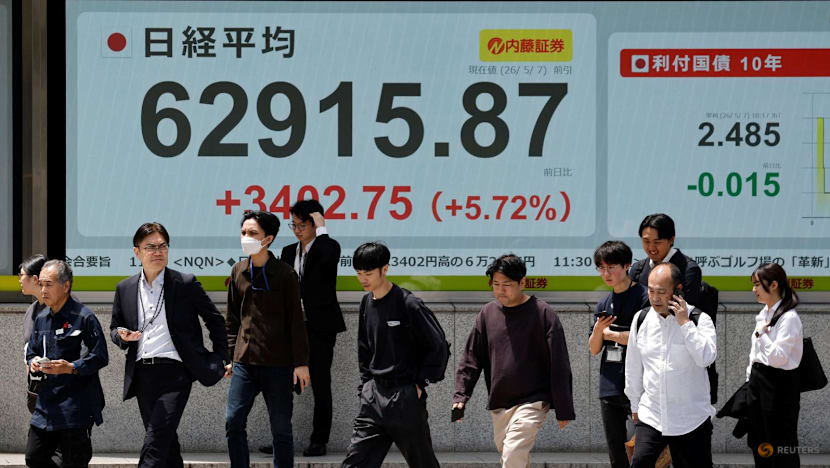
Pedestrians walk past a stock quotation board showing the Nikkei share average outside a brokerage in Tokyo, Japan, May 7, 2026. (Photo: Reuters/Kim Kyung-hoon)
SINGAPORE: Asian stocks soared to record highs on Thursday (May 7) while the US dollar slipped and oil nursed steep losses as traders embraced the prospect of a peace deal in the Middle East, although the fate of the critical Strait of Hormuz remains unresolved.
Japan's Nikkei returned from a long holiday to cross 62,000 for the first time, catching up on a blistering AI-led rally after robust earnings that also catapulted South Korean and Taiwan stocks to records.
The benchmark Nikkei 225 index rose 4.19 per cent to 62,009.59. The broader Topix climbed 2.12 per cent to 3,807.84.
MSCI's broadest index of Asia-Pacific shares outside Japan was up 1 per cent, hitting another all-time high. The index is up 7 per cent so far this week.
Kyle Rodda, senior financial analyst at Capital.com, said the market moves on Thursday were justified as a deal would be a breakthrough.
"But we've seen this story before, and the rug could get pulled out of the market pretty quickly too. Ultimately, if we keep seeing progress in talks, Asian markets will keep rallying."
"Today’s sharp gain of the Nikkei was led by the strong performance of chip shares, driven by Advanced Micro Devices’s strong forecast," said Takamasa Ikeda, a senior portfolio manager at GCI Asset Management. "The contents of the US-Iran peace proposals are thin, but there is an expectation in the market that further military action will not take place."
Iran said it was reviewing a peace proposal that sources said would formally end the war while leaving unresolved the key US demands that Iran suspend its nuclear program and reopen the Strait of Hormuz, whose closure has sent oil prices surging.
A potential deal to end the war, which started at the end of February, sent oil prices sliding nearly 8 per cent on Wednesday. Brent crude was a touch higher at US$102.11 a barrel in early Asian hours on Thursday.
Still, oil prices are around 40 per cent higher than they were when the conflict began, while 10-year Treasury yields are around 40bps higher, underscoring the challenge facing the global economy from higher energy prices and pricing pressures.
"Even if the strait reopens in coming weeks, oil is likely to stay elevated and slow to ease given damage to energy infrastructure and precautionary stockpiling," said OCBC analysts in a note.
Federal Reserve officials said the war is raising the risk of a sustained inflation shock, with continued high oil prices and developing concerns about problems with global supply chains.

KOSPI TAKES A BREATHER FROM NEW PEAK
South Korea's benchmark Kospi index breached the historic 7,500-mark for the first time at the open on Thursday, after closing up more than 6 per cent on Wednesday, ending at 7,384.56.
It rose as high as 7,532.88 earlier on Thursday.
It was up 0.04 per cent, at 7,387.58 as of 9.53am local time.
YEN STAYS IN SPOTLIGHT
In currency markets, the euro held on to its overnight gains of around 0.5 per cent and last fetched US$1.1747. Sterling was at US$1.3591 after rising 0.4 per cent on Wednesday. The dollar index, which measures the US currency against six units, was at 98.032.
The yen remains in the spotlight after bouts of surges in the past few sessions triggered speculation that Tokyo may be stepping in to support the battered currency.
It was last at 156.29 per dollar, little changed on the day, having hit a 10-week high of 155 in the previous session in a sudden jump.
OCBC analysts said the key question is whether the Ministry of Finance will continue to defend the yen or has already deployed sufficient firepower.
"Intervention alone is unlikely to shift the broader trend unless backed by stronger policy support like a more assertive BOJ hiking cycle or better alignment with external drivers such as lower oil prices and US yields," they said in a note, maintaining their year-end target of 155.
The rocketing oil prices whacked global markets in March but a fragile ceasefire and the prospect of a deal spurred a risk-on rally since April that has been fuelled further by strong earnings reports from technology companies.
Overnight, the S&P 500 and the Nasdaq surged to record-high closes on earnings. S&P 500 companies are on track for their strongest profit growth in more than four years.
Investors were awaiting the non-farm payrolls report on Friday, with US jobs seen increasing by 62,000 in April after rebounding 178,000 in March, according to a Reuters survey of economists.