Oil prices settle at pre-Iran war levels as crude output grows
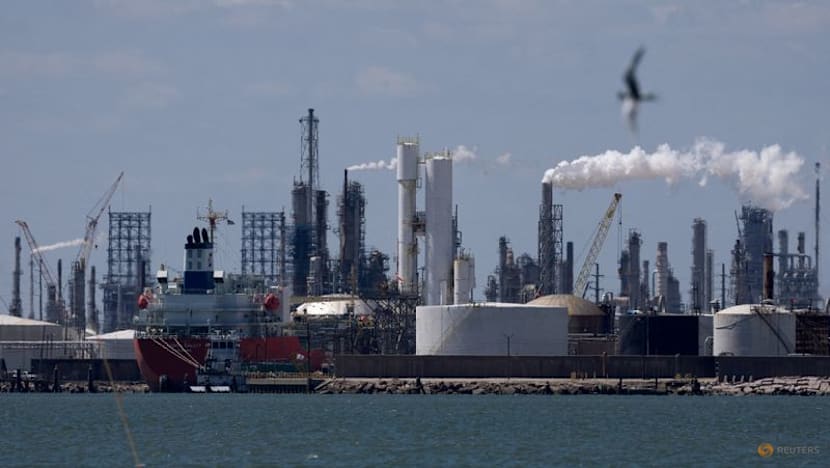
FILE PHOTO: The Rishiri Galaxy, an oil and chemical tanker sailing under the flag of Panama, is docked at the Texas City docks next to the Marathon Galveston Bay Refinery shortly after U.S. President Donald Trump announced a 60-day waiver of the Jones Act shipping law, in Texas City, Texas, U.S. March 18, 2026. REUTERS/Antranik Tavitian/File Photo
NEW YORK, July 6 : Oil prices settled around pre-Iran war levels on Monday as Saudi Arabia slashed its official selling prices, OPEC+ approved another production target increase starting in August, and exports through the Strait of Hormuz recovered further.
Brent crude futures, which hit a four-year high above $126 in late April, settled at $71.99 a barrel, down 13 cents or 0.2 per cent. U.S. West Texas Intermediate crude futures finished at $68.55 a barrel, down 14 cents or 0.2 per cent. There was no settlement for WTI on Friday as U.S. markets were closed for a public holiday.
Both contracts were little changed last week after mostly falling over the past month back to levels last seen in late February, prior to the start of the four-month war that created the biggest energy disruption in history, according to the International Energy Agency.
"The downward move is still influenced by earlier stranded tankers managing to exit the Gulf, resulting in an increase in oil on water," UBS analyst Giovanni Staunovo said.





Investors kept a close eye on talks between the U.S. and Iran over the fate of shipping through the Strait of Hormuz while keeping tabs on the recovery in Gulf oil exports.
President Donald Trump said on Monday the United States would either reach a deal with Iran or "finish the job," renewing his threat of military action as Tehran projects defiance following the funeral of former Supreme Leader Ayatollah Ali Khamenei.
Indirect U.S.-Iran talks ended last week without any public sign of headway toward a lasting peace, despite a 60-day ceasefire intended to create space for diplomacy following the U.S. and Israeli strikes that triggered the conflict.
SUPPLIES RAMP UP
The United Arab Emirates raised its crude output to near record highs above 3.8 million barrels per day in June after it quit OPEC to escape production caps, two people familiar with production data said on Monday.
Saudi Arabia has set the official selling price for its flagship Arab Light crude to Asia in August at $1.50 a barrel below the Oman/Dubai average, marking the biggest monthly cut in the price since Reuters records began in 2003. Abu Dhabi National Oil Company has also been selling crude through tenders at discounted prices, traders told Reuters.
"It is increasingly looking like the Gulf producers are gearing up for a price war," said Robert Yawger, director of energy futures at Mizuho.
The Organization of the Petroleum Exporting Countries and its allies including Russia agreed on Sunday to further increase output targets by 188,000 bpd from August, on top of similar increases for June and July.
However, these increases have remained largely on paper because of the Iran war, which closed the Strait of Hormuz to tanker traffic for key OPEC producers, including Saudi Arabia, Kuwait and Iraq, capping their output.
"They are selling into a falling market, offering little hope of an imminent price recovery," said PVM analyst Tamas Varga. "However, lower oil prices will undoubtedly stimulate demand further down the line."
SOME OIL SHOCKS CONTINUE
Elsewhere, Ukraine's military said on Monday it struck Russia's largest oil refinery in Omsk, as well as facilities in Yaroslavl and Leningrad regions overnight.
In the United States, stocks of crude oil in the U.S. Strategic Petroleum Reserve fell by 6.2 million barrels in the week ending July 3 to 319.5 million barrels, the lowest level since April 1983, according to data from the Department of Energy on Monday.
Shipping groups Maersk and Hapag-Lloyd will resume some sailings through the Suez Canal, which accounts for 10 per cent of global trade. The Asia-Europe trade corridor was abandoned by most shippers after attacks in the Red Sea by Yemen's Houthis during the Gaza war. Resuming sailings through this route will reduce the duration of the passage by four weeks, a Hapag-Lloyd spokesperson said.