







Stocks gain on softer inflation, bank results while oil rises on US-Iran hostilities
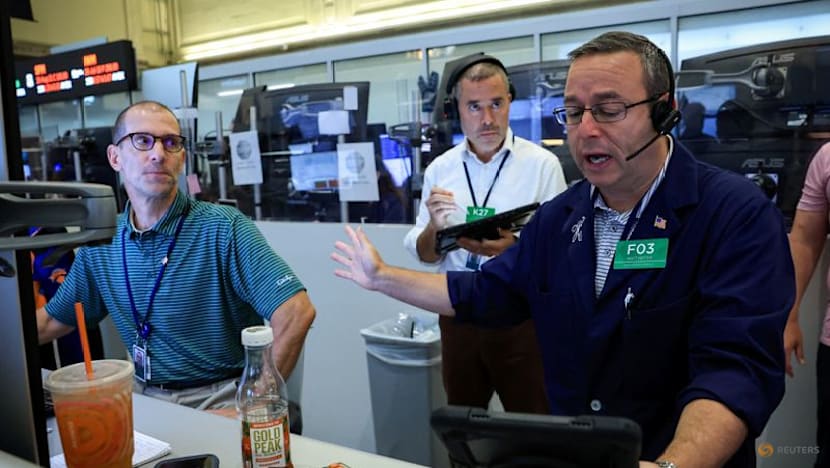
Futures-options traders work on the floor at the New York Stock Exchange's NYSE American (AMEX) in New York City, U.S. July 14, 2026. REUTERS/Brendan McDermid
NEW YORK/LONDON, July 14 : MSCI's global equities index rose on Tuesday after softer-than-expected U.S. inflation data and strong bank earnings, while oil prices gained on supply concerns as the U.S. and Iran exchanged strikes and battled for control of the Strait of Hormuz.
The U.S. Consumer Price Index increased by a lower-than-expected 3.5 per cent in the 12 months through June after surging 4.2 per cent in May. The index fell 0.4 per cent on a monthly basis, largely due to the recent retreat in gasoline prices from multi-year highs as a fragile U.S.-Iran ceasefire took hold in June.
After surging 9 per cent on Monday, oil's gains were more modest on Tuesday, as U.S. President Donald Trump backed away from a proposal to charge a 20 per cent transit fee for the vital Strait of Hormuz, saying that he would instead seek investment deals with Gulf states.
But Iran's Deputy Foreign Minister Kazem Gharibabadi told state TV that the strait was part of Iran's national security and that it would exercise its sovereignty over it whatever the cost.





Meanwhile, the U.S. military said on Tuesday it was launching more strikes against Iran. Iran fired ballistic missiles at a U.S. air base in Jordan, while the U.S. has attacked Iranian targets for three successive nights.
U.S. crude oil futures settled up 1.5 per cent, or $1.20, at $79.34 a barrel. Brent settled at $84.73 per barrel, up 1.7 per cent, or $1.43, after both hit a roughly one-month high earlier in the day.
Shares of big U.S. banks rallied following results that showed the major firms were boosted by strong trading revenue and corporate deal-making. JPMorgan Chase reported a record quarterly profit, pushing its shares to an all-time high, while Goldman Sachs, Bank of America and Citigroup all exceeded Wall Street's profit estimates.
IBM shares finished down 25 per cent after it warned it would take a big earnings hit in the second quarter as it failed to keep pace with a shift in corporate spending from software to data-center infrastructure. The technology company was the biggest drag on the S&P 500.
While equity traders for now shrugged off the latest Middle East hostilities, Tim Ghriskey, senior portfolio strategist at Ingalls & Snyder, said the war was still an overhang for the stock market.
"Right now the market is discounting this issue but it's lingering. It's dampening market strength from the very strong results we saw from financial companies," he said, adding that "the favorable CPI number we see could be very different next month given what we're seeing in the oil market."
On Wall Street, the Dow Jones Industrial Average rose 9.63 points, or 0.02 per cent, to 52,508.27, the S&P 500 rose 28.25 points, or 0.38 per cent, to 7,543.59 and the Nasdaq Composite rose 233.83 points, or 0.90 per cent, to 26,107.01.
MSCI's gauge of stocks across the globe rose 4.71 points, or 0.42 per cent, to 1,121.57.
Earlier, the pan-European STOXX 600 index finished up 0.17 per cent, recovering from losses of as much as 0.9 per cent before the U.S. inflation data eased rate hike worries.
DOLLAR WEAKER AFTER INFLATION DATA
Federal Reserve Chair Kevin Warsh, in his first delivery of the central bank's semi-annual monetary policy report to Congress, said he was doubling down on the Fed's 2 per cent inflation target. He said he was just as committed to the Fed's employment mandate as to the inflation mandate that he has repeatedly emphasized since taking over the U.S. central bank.
In currencies, the dollar broadly weakened after the softer-than-expected U.S. inflation data tempered expectations for Fed policy tightening.
The dollar index, which measures the greenback against a basket of currencies including the yen and the euro, fell 0.33 per cent to 100.94, with the euro up 0.33 per cent at $1.1418.
Against the Japanese yen, the dollar weakened 0.11 per cent to 162.24.
U.S. Treasury yields fell in response to the inflation data, which Peter Cardillo, chief market economist at Spartan Capital Securities, said "should relieve some worries in the bond market."
The yield on benchmark U.S. 10-year notes fell 2.06 basis points to 4.589 per cent, from 4.61 per cent late on Monday. The 30-year bond yield rose 0.51 basis points to 5.1031 per cent.
The 2-year note yield, which typically moves in step with interest rate expectations for the Federal Reserve, fell 6.75 basis points to 4.196 per cent.
Among precious metals, spot gold rose 1.29 per cent to $4,051.79 an ounce.





