







Stocks eke out record closing highs, oil slides as markets eye US-Iran peace progress
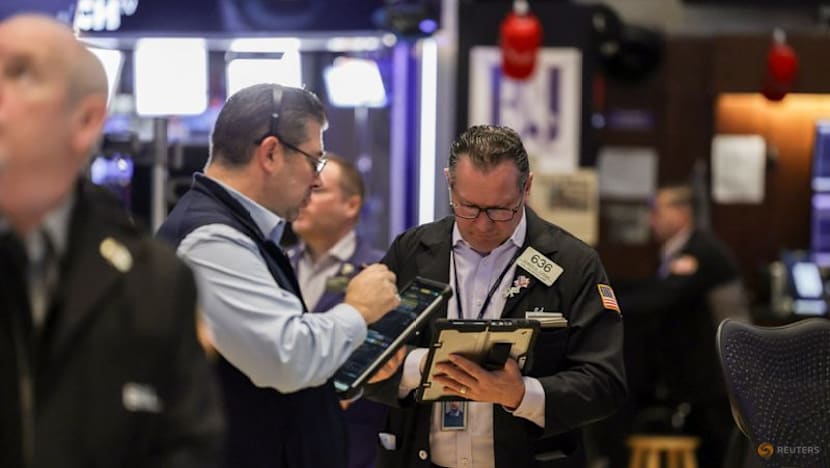
Traders work on the floor at the New York Stock Exchange (NYSE) in New York City, U.S., May 27, 2026. REUTERS/Jeenah Moon
NEW YORK, May 27 : Wall Street stocks showed little conviction on Wednesday, inching to all-time closing highs, while crude oil prices retreated as investors assessed developments in U.S.-Iran peace negotiations.
The S&P 500 and the Nasdaq ended only slightly higher, with a pullback in chip stocks capping their gains, while the Dow ended more decisively higher. All three indexes reached record closing levels.
U.S. Treasury yields eased on hopes that the months-long blockade of the Strait of Hormuz could soon be lifted, easing fears that the resulting energy price squeeze could metastasize into higher inflation, and in turn, tighter monetary policy.
Iran's state TV said it obtained a draft of an unofficial framework of an initial understanding between Washington and Tehran toward ending the conflict, which would entail Iran restoring shipments through the crucial waterway to pre-war levels within a month. The White House said the report was false.





"Today's one of those days where geopolitics take over, with competing statements coming in fast and furious; there's so much news out there," said Tim Ghriskey, senior portfolio strategist at Ingalls & Snyder in New York. "So it's sort of a neutral day, but of course we've had a huge run since the end of March, when the markets just shot upward."
This follows claims from Iran on Tuesday that the United States violated the ceasefire, potentially complicating peace efforts. For its part, Washington insisted its recent strikes were defensive in nature.
As of Wednesday, however, the fragile truce remained intact, offering hope that a deal could be imminent.
Financial markets are currently pricing in a 38.1 per cent likelihood that the U.S. Federal Reserve will raise interest rates in December, according to CME's FedWatch tool, which showed zero possibility of a December rate hike one month ago.
Thursday has a loaded docket of economic data, including the Commerce Department's second take on first-quarter GDP and its broad-ranging Personal Consumption Expenditures (PCE) report, which will include the Fed's preferred inflation gauge.
Analysts expect year-on-year headline and core inflation growth of 3.8 per cent and 3.3 per cent, respectively, well above the central bank's annual 2 per cent target.
The Dow Jones Industrial Average rose 182.60 points, or 0.36 per cent, to 50,644.28, the S&P 500 rose 1.24 points, or 0.02 per cent, to 7,520.36 and the Nasdaq Composite rose 18.55 points, or 0.07 per cent, to 26,674.74.
European shares ended little changed, hovering close to record highs reached prior to the Iran war as strength in automobile and chemical stocks offset lingering worries regarding the conflict and its possible inflationary impact.
MSCI's gauge of stocks across the globe rose 0.97 points, or 0.09 per cent, to 1,122.39.
The pan-European STOXX 600 index rose 0.03 per cent, while Europe's broad FTSEurofirst 300 index rose 1.65 points, or 0.07 per cent.
Emerging market stocks rose 18.52 points, or 1.08 per cent, to 1,738.93.
Crude oil prices dropped on signs of progress in a U.S.-Iran deal to reopen the Strait of Hormuz.
"Oil is off its high at this point, I think oil is getting closer to where it ought to be, given that it doesn't appear that (the war) is going to escalate from here and that everybody's looking for an off-ramp," said Oliver Pursche, senior vice president at Wealthspire Advisors in New York.
U.S. crude fell 5.55 per cent to settle at $88.68 per barrel, while Brent settled at $94.29 per barrel, down 5.31 per cent on the day.
U.S. Treasury yields edged lower on continued signs of progress in Middle East peace talks.
The yield on benchmark U.S. 10-year notes fell 1.4 basis points to 4.477 per cent, from 4.491 per cent late on Tuesday.
The 30-year bond yield fell 1.8 basis points to 5.007 per cent from 5.025 per cent late on Tuesday.
The 2-year note yield, which typically moves in step with interest rate expectations for the Federal Reserve, fell 1.7 basis points to 4.033 per cent, from 4.05 per cent late on Tuesday.
The dollar held steady after Tuesday's uptick, while the yen slid to its weakest level against the greenback since late April, brushing against levels that triggered an official Japanese intervention last month as investors eyed a potential flare-up of turmoil in the Middle East.
The dollar index, which measures the greenback against a basket of currencies including the yen and the euro, rose 0.1 per cent to 99.20, with the euro up 0.01 per cent at $1.1629.
Against the Japanese yen, the dollar strengthened 0.14 per cent to 159.52.
In cryptocurrencies, bitcoin fell 1.31 per cent to $75,025.00. Ethereum declined 0.97 per cent to $2,055.62.
Gold prices declined to a two-month low as war-related inflation increased the odds that the Fed could hike interest rates this year.
Spot gold fell 1.19 per cent to $4,452.38 an ounce. U.S. gold futures fell 1.19 per cent to $4,447.00 an ounce.





