







UOB banks on ASEAN to weather tariff uncertainty; Q4 net profit slips 7%
Junior employees at UOB will get an extra half-month base salary payout on a one-off basis, in recognition of their contributions amid a challenging external environment.
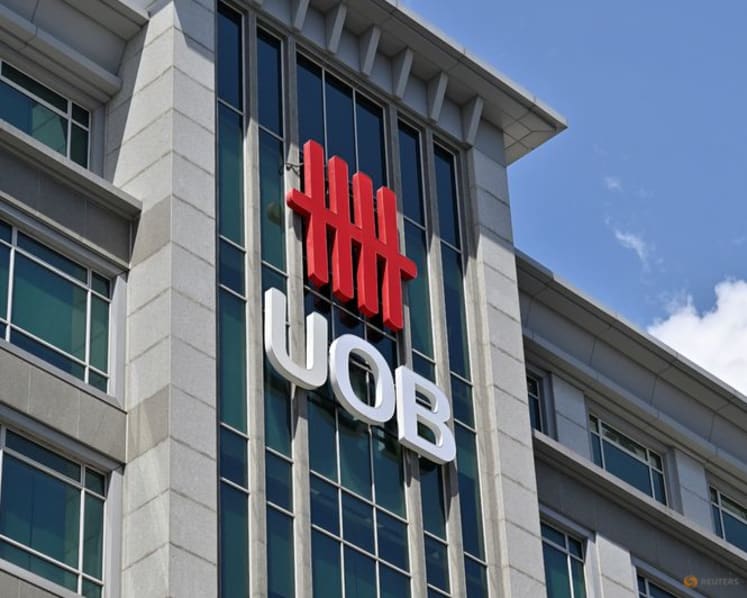
A view of the United Overseas Bank (UOB) signage in Singapore on May 3, 2023. (File photo: Reuters/Caroline Chia)
SINGAPORE: Singapore's United Overseas Bank, or UOB, said on Tuesday (Feb 24) that it will leverage its presence in ASEAN and opportunities from shifting global trade flows to drive growth in 2026, against the backdrop of tariff and geopolitical turbulence.
The remarks from the bank's top executives came after Southeast Asia's third-largest bank by assets reported a 7 per cent fall in net profit in the fourth quarter from a year earlier, as margin headwinds outweighed loan growth.
Net profit for October-December dropped to S$1.41 billion (US$1.11 billion) from S$1.52 billion a year earlier, though it beat the mean estimate of S$1.35 billion from three analysts polled by LSEG.
Speaking at the bank's results briefing, CEO Wee Ee Cheong said UOB's "ASEAN 4" markets - Malaysia, Thailand, Indonesia, and Vietnam - were a bright spot for the lender last year, with total income there up 5 per cent even as the group's total income fell 3 per cent.





"The market is very uncertain. The biggest risk is something that is a little bit beyond our control. But (for) the ASEAN we are talking about, I feel quite confident," he said.
The bank also announced that it will be providing its junior employees with an extra half-month base salary payout on a one-off basis, in recognition of their contributions amid a challenging external environment.
"This supplementary payout will be paid to about 6,000 employees across the Group in the second quarter of this year and will amount to a total of about S$4 million," said UOB.
For the full 2025 financial year, UOB's net interest margin, a key gauge of profitability, dropped to 1.89 per cent from 2.03 per cent a year earlier. Its net interest income slid 3 per cent year-on-year to S$9.36 billion.
Net fee income rose 7 per cent to a new record of S$2.6 billion, helped by wealth management and loan-related fees amid favourable market conditions and rising consumer confidence.
Net new money inflows also stayed positive, with high-net-worth assets under management rising 6 per cent from the previous year to S$201 billion in 2025.
The results followed a 72 per cent slump in its third-quarter net profit, with UOB attributing the rebound to lower credit costs.
Still, credit-cost "hot spots" remain in Greater China and the United States, tied mainly to commercial real estate exposures, said CFO Leong Yung Chee.
UOB declared a final dividend of S$0.71 per share. Alongside an interim dividend of S$0.85 per share, that brings its total dividend for the year to S$1.56 per share.
Shares of UOB fell nearly 4 per cent on Tuesday, underperforming the Singapore domestic benchmark's 0.7 per cent decline.
Analysts at CGS International said in a note that they reiterate their "hold" call on UOB, citing a lack of additional capital return initiatives and potential downside risks from a weaker ASEAN economic outlook and further provisioning for the bank's Greater China commercial real estate portfolio.
CAPITALISING ON SHIFTING SUPPLY CHAINS
On the global trade outlook, the bank's executives were sanguine that intra-regional trade would remain robust even amid broader uncertainties.
US President Donald Trump's tariff salvo has dominated markets since he took office last year, with the latest Supreme Court ruling and his subsequent response throwing the situation into deeper uncertainty.
"I think there will be some time required for the system to absorb, comprehend and react to it. But we are confident ... the companies' business activities will find a way to navigate through," said Leong.
The bank's trade loans, which constitute about 13 per cent of the group loan book, grew about 26 per cent year-on-year, and helped drive cross-selling into FX, hedging and cash management.
It is an area the lender is aiming to focus on, the executives said, citing its "capital-friendly" nature and positive spillovers for the broader business.
UOB broadly maintained its outlook guidance for 2026, except it now sees high single-digit fee growth for the year versus the high single-to double-digit fee growth that was projected in November.
When asked why, Leong said the shift was mainly due to a more conservative lower growth outlook, even as wealth, consumer spending and customer treasury trends remain supportive.





