







Wall Street slides to near three-week low as Greenland dispute triggers global sell-off
The CBOE Volatility index, also known as Wall Street's fear gauge, touched a two-month high at 19.42 points.
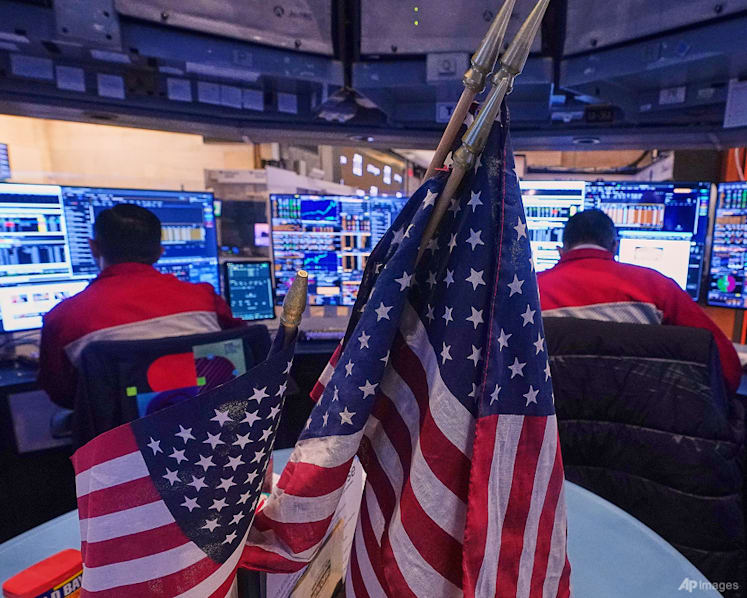
A pair of traders work on the floor of the New York Stock Exchange, on Jan 12, 2026. (File photo: AP/Richard Drew)
Wall Street's main indexes slid to a near three-week low on Tuesday (Jan 20), as investors were spooked by fresh tariff threats from President Donald Trump against Europe amid a dispute over control of Greenland.
US traders came back from a market holiday to a risk-off wave already in motion, pushing gold to fresh record highs, dragging stocks lower across the globe and leaving US Treasuries wobbling under renewed selling pressure.
Trump said on Saturday that additional 10 per cent import tariffs would take effect on Feb 1 on goods from Denmark, Norway, Sweden, France, Germany, the Netherlands, Finland and Great Britain - all already subject to tariffs imposed by the US.
The tariffs would increase to 25 per cent on Jun 1 and would continue until a deal was reached for the US to purchase Greenland, Trump wrote in a post on Truth Social. Leaders of Greenland, an autonomous territory of Denmark, and Denmark have insisted the island is not for sale.





"We're getting the weakness because the headlines are going to drive angst and concern about what the future holds," said David Lundgren, chief market strategist at Little Harbor Advisors.
"We're seeing a broadening away from the Mag 7 into small and mid-cap companies. And possibly, a broadening away from the US to other markets overseas that have been underperforming."
On Tuesday, Trump marks one year back in office - a volatile period for markets that saw the S&P 500 plunge to near bear market territory following "Liberation Day" tariffs in April before rebounding to record highs on strong earnings and a resilient economy.
Critical Metals, which has a strategic presence in Greenland, rose 2 per cent.
The CBOE Volatility index, also known as Wall Street's fear gauge, touched a two-month high at 19.42 points.
At 9.39am the Dow Jones Industrial Average fell 603.23 points, or 1.23 per cent, to 48,752.19, the S&P 500 lost 89.62 points, or 1.29 per cent, to 6,850.39 and the Nasdaq Composite lost 367.72 points, or 1.56 per cent, to 23,147.67.
JAM-PACKED WEEK OF DATA AND EARNINGS
Investors headed into a jam-packed week, with a slate of market-moving data such as the third-quarter US GDP update, January PMI readings and the Personal Consumption Expenditures report, which is the Federal Reserve's preferred inflation gauge.
Earnings season is also kicking into a higher gear. Several industry bellwethers, including Intel and Netflix, are set to report their quarterly earnings this week.
Netflix gained 2.1 per cent, after switching to an all-cash offer for Warner Bros Discovery's studio and streaming assets without increasing the US$82.7 billion bid.
The streaming giant, due to report its quarterly earnings after the bell, was the only stock in the mega-cap 'FAANG' group of tech stocks - Meta, Apple, Amazon, Netflix, and Google - to trade in the green.
Meanwhile, industrial giant 3M fell 3 per cent after it forecast annual adjusted profit slightly below Wall Street estimates.
Of the 33 S&P 500 companies that had reported as of Friday, 84.8 per cent topped analysts' expectations, according to data compiled by LSEG.
Markets are also watching the potential for a Supreme Court decision tied to Trump's tariffs, alongside speeches by global leaders at the World Economic Forum in Davos, Switzerland.
Among other stocks, RAPT Therapeutics soared 64 per cent after Britain's GSK agreed to buy the US firm for US$2.2 billion





