Commentary: How two men smashed through an 'unbreakable' marathon barrier
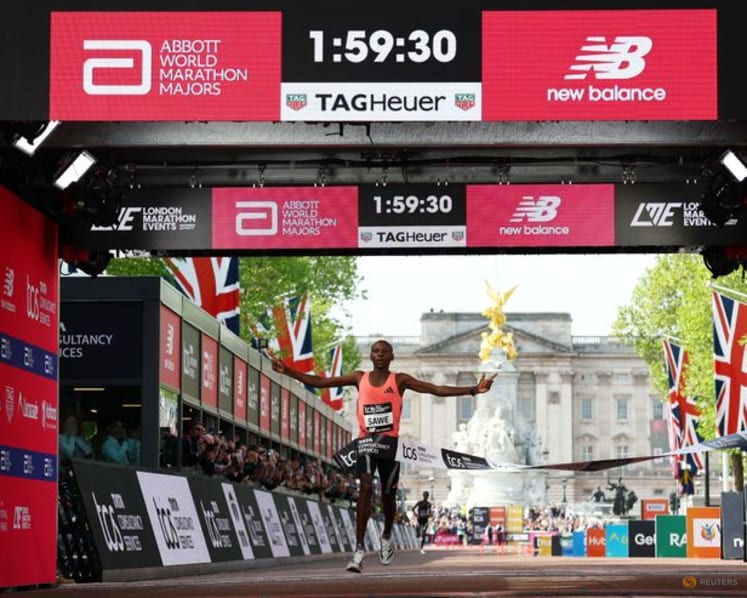
History was made at the 2026 London Marathon on Sunday (Apr 26) when two men finished the 42km marathon in less than two hours.
BRISBANE, Australia: On May 6, 1954, Sir Roger Bannister did what was deemed impossible in athletics: He ran a mile in less than four minutes.
The milestone was celebrated worldwide, not just by athletics fans. It was considered at the time to be a similar achievement to scaling Mount Everest for the first time, which Sir Edmund Hilary and Tenzing Norgay had done the year before.
On Sunday (Apr 26), Kenya’s Sabastian Sawe and Ethiopia’s Yomif Kejelcha achieved a breakthrough comparable to Bannister’s some 72 years ago: Running the 42 kilometres of a marathon in less than two hours.
Let’s break down this new benchmark and work out how these athletes were able to do it.





WHAT HAPPENED IN LONDON?
Sawe smashed the men’s world record by an astonishing 65 seconds in winning the event in 1 hour, 59 minutes and 30 seconds. Kejelcha – remarkably running in his first marathon – also crossed the line in under two hours (1:59:41).
The race was blisteringly fast. Even third-place getter Jacob Kiplimo of Uganda broke the previous world record – set in 2023 by Kenya’s Kelvin Kiptum in the United States – by seven seconds (finishing in 2:00:28).
Sawe ran quicker as the marathon went on, covering the second half of the race in 59:01. He pulled clear of Kejelcha after about 30km and made his solo break in the final two kilometres.
After the race, Sawe said: "I’ve made history today in London, and for the next generation I’ve shown them that nothing is impossible. Everything is possible, with a matter of time."
THE TRAINING AND NUTRITION
Sawe’s team said he trained by running up to 240km a week and fuelled himself before the race with bread and honey. This reported training volume is likely an important factor in running a sub two-hour marathon.
Running up to 240km a week is beyond what most runners can tolerate. But high training volume, especially when much of it is done at relatively low intensity, is associated with faster marathon performances.
Nutrition during the race was also well planned.
A two-hour marathon is run at such high intensity that carbohydrate intake becomes important to maintain performance. The body stores carbohydrate in the muscles and liver but those stores are limited. According to his nutrition team, Sawe took a carbohydrate drink and a gel leading up to the start, then used carbohydrate drinks and gels throughout the race.
His reported intake averaged about 115g of carbohydrate per hour. While this is not a recommendation for the recreational runner, at the intensity required to run a two-hour marathon, it helps to maintain energy supply and pace late in the race.
THE PHYSIOLOGY
Although Sawe and Kejelcha’s laboratory data are not public, the physiology required to run a fast marathon is due to three main attributes: an exceptional capacity to take in and use oxygen during running; the ability to maintain a high fraction of that capacity for prolonged periods; and an exceptional running economy, which means using less oxygen at a given speed.
Exceptional marathon performances also depend on durability, which is the ability to prevent deterioration of these qualities throughout the race.
WHAT ABOUT THE SHOE?
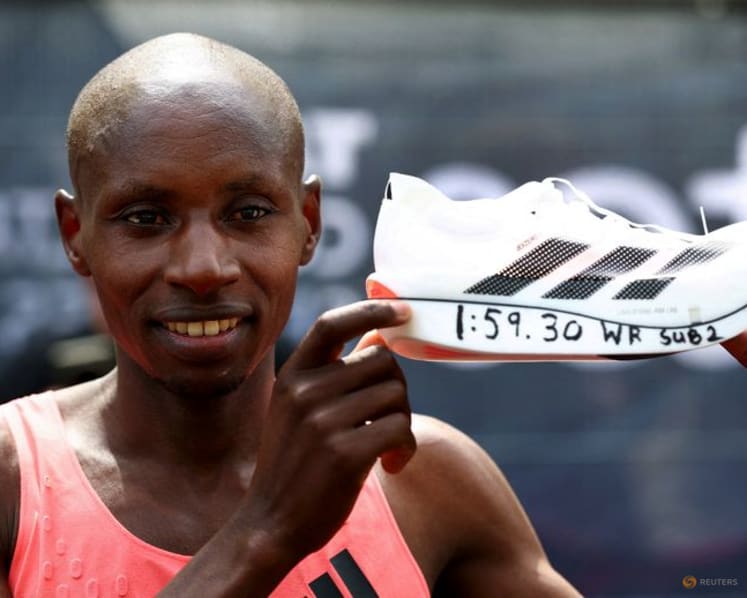
Sawe and Kejelcha wore the lightest “supershoe” in history: Adidas’ Adios Pro Evo 3. Adidas says it is “the fastest and lightest supershoe ever made”. It weighs less than 100g. Supershoes can improve running economy by about 4 per cent compared with conventional racing shoes.
The Adios Pro Evo 3 combines several features common in supershoes: very low weight, thick resilient foam and a stiff carbon-based structure in the midsole. The heel thickness is reported to be 39mm, just under the 40mm limit permitted by World Athletics.
While most runners benefit from supershoes, the effect is variable and not the same for all runners. Researchers have suggested this is due to two ways in which the footwear interacts with the runner.
Firstly, the foam and stiffening element can affect the “spring-like” bounce of the body as the foot hits and leaves the ground.
Secondly, they can change how the runner moves, including how the foot and ankle work, how long the foot stays on the ground, and the timing of energy return. As such, a shoe may be capable of storing and returning more energy, but the athlete still has to interact with it effectively. The exact benefit of the Adios Pro Evo 3 over other supershoes has not been independently measured, but even small improvements are likely to be important over a marathon.


The conditions in London also likely contributed to these performances. While London is considered to be a relatively fast course (although not as fast as Berlin), the weather conditions were close to ideal: between 13 and 17 degrees Celsius during the race, which is at the upper end of the theoretical optimum for marathon running but within the range associated with fast endurance performance.
A PERFECT STORM
As recently as 2017, a sub-two hour marathon was considered unlikely to occur for generations.
The best explanation for the performances in London is the convergence of many factors including exceptional physiology, years of high-volume training, efficient biomechanics helped by the use of advanced footwear, optimised fuelling and favourable weather conditions.
Mark Connick is a Postdoctoral Researcher in Paralympic Classification and Biomechanics at Queensland University of Technology. This commentary first appeared on The Conversation.