







Commentary: A Golden Globe for best podcast? It makes sense but also doesn’t
Treat podcasting the way Hollywood treats film and television, if the Golden Globes wants this new category to endure, says Abbie Ruzicka for New York Times Opinion.
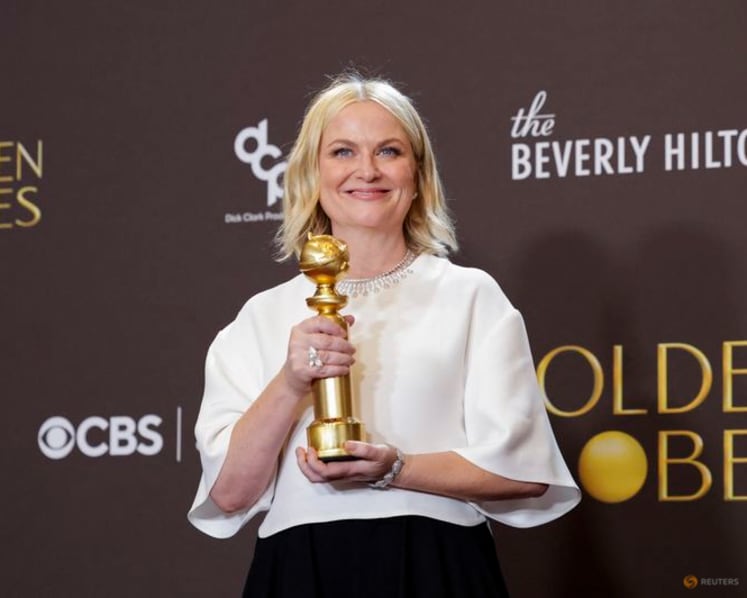
BOSTON, Massachusetts: For the first time in the Golden Globes champagne-soaked history, there will be an award given for Best Podcast. The inclusion makes sense. The category, as it exists, does not.
Six shows have been nominated: Armchair Expert with Dax Shepard, Call Her Daddy, Good Hang with Amy Poehler, The Mel Robbins Podcast, SmartLess and NPR’s Up First. The Globes have framed the addition of the category as an effort to recognise “new forms of storytelling”.
The list of 25 eligible shows was assembled with the help of the entertainment analytics company Luminate, using audience and engagement metrics. (Worth noting: Both Luminate and the Globes are owned by Penske Media.)
The Globes have not fully explained how its “independent body of international journalist voters” was ultimately asked to evaluate work that differs so dramatically in form and intent. It’s not immediately clear how Up First, a 10-minute news recap podcast meant for a morning commute, is meant to be evaluated against SmartLess, a celebrity clubhouse talk show hosted by the buddies Will Arnett, Jason Bateman and Sean Hayes.





Or how the lightness of Amy Poehler’s interview show Good Hang, which pointedly avoids advice and self-help, is meant to be measured against the earnestness of “change your life” guru Mel Robbins, who offers near wall-to-wall advice on her podcast.
The full list of 25 eligible nominees also included some of the most popular, influential and politically spicy shows, including those from Tucker Carlson, Ben Shapiro and Joe Rogan. But they didn’t make the cut.

WHERE THE AUDIENCE HAS ALREADY GONE
More than a few observers noted that the celebrity-heavy nature of the finalists suggests this is, at least in part, a way to lure more big names to a ceremony that’s always relied on star power to justify its existence. The new category reads less like a sudden appreciation for the medium than a bid for relevance.
Big award shows, like the so-called legacy media they celebrate, are facing an audience crisis. Young people are not watching traditional TV, much less going to the movies. They instead find their culture through podcasts, clips and feeds.
Podcast advertising in the United States generated roughly US$2.4 billion in 2024, according to the Interactive Advertising Bureau, a trade group, with millions more flowing directly from listeners through subscriptions and memberships.
At the same time, Hollywood’s own economics have grown shakier: Global box office revenues remain below pre-pandemic highs, linear television advertising continues to decline and studios are being bought up and merged.
To acknowledge podcasting now is to acknowledge where attention has already gone.


PODCASTING ISN'T A GENRE
But the execution of the Golden Globes reveals a lack of understanding about what podcasts are and why they matter.
Podcasting isn’t a genre; it’s an industry. Mashing together news, interview shows, celebrity-driven conversations and self-help monologues doesn’t make much sense.
More striking still is what the nominations are missing entirely. Narrative podcasts, arguably the most ambitious corner of the medium, have been left out altogether.
This is the side of podcasting that is most deeply entangled with Hollywood, yielding television and film adaptations such as Homecoming, Limetown, Dr Death and The Thing About Pam, while also competing directly with prestige TV for attention. It is where much of the craft lives. A few were included in the original 25, but among the finalists, this entire body of work has been sidelined.
The omission points to a larger problem. Narrative podcasts, while critically influential and disproportionately valuable as intellectual property, are often the hardest to make money from. This is likely why platforms have increasingly favoured personality-led, brand-safe shows.
TREAT PODCASTING LIKE FILM AND TV
Podcasting does have its own awards, the Ambies. The competition is run by the Podcast Academy, which distinguishes between format (interview show vs documentary vs fiction) and topic (comedy, business, sports) with published judging criteria.
The Webby and Signal Awards (of which I have served as a judge in the past) also recognise podcasts across a vast number of categories. There are also journalism awards, including the Pulitzer given for audio reporting every year.
None of those are perfect, and admittedly feel more like trade-industry awards than the giddy glamour of the Globes. But they all begin with the understanding that podcasting is not one thing.
If the Golden Globes want this category to endure, the fix may be simple. Treat podcasting the way Hollywood treats film and television. Including categories such as nonfiction narrative, interview shows, chat shows, scripted fiction and limited series wouldn’t fragment the field. They would give it shape.
The Globes have never been the final word on culture. They’re thirsty for relevance but strangely behind the times. (Remember when, in 2023, they had to acknowledge that its voters were shockingly lacking in diversity?)
But the awards remain a rare visible stage for podcasting. For this industry, that matters. Having opened the door, now comes the harder part: listening.
Abbie Ruzicka is a co-founder of Arcana Audio, an independent production company. She worked as an executive producer for Spotify and Gimlet, developing and starting podcasts and new audio formats. This article originally appeared in the New York Times.




