







Commentary: Iranians cannot just ‘take back’ their country after US-Israel strikes
Even after the death of Supreme Leader Ayatollah Ali Khamenei and numerous senior leaders, there has been no popular uprising so far, says war studies lecturer Samir Puri.

This audio is generated by an AI tool.


SINGAPORE:On Saturday (Feb 28), the day the United States launched its attack on Iran, President Donald Trump used his speech to speak directly to the Iranian people: “When we are finished, take over your government. It will be yours to take. This will be probably your only chance for generations.”
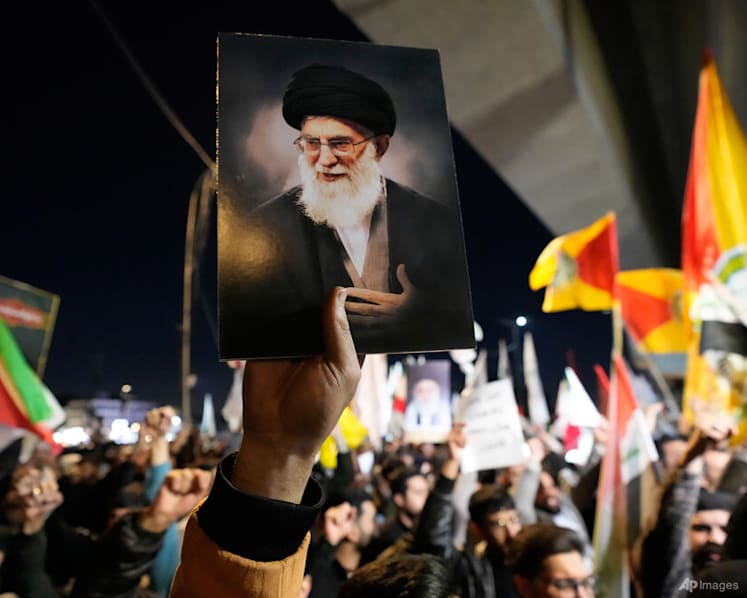
So far, there has been no popular uprising to “take back” the country from the regime, even after the killing of Supreme Leader Ayatollah Ali Khamenei. But the question is: Can Iranians rise up to bring the regime down?
Iran's regime has not instantly collapsed, despite being battered in the US-Israeli assault and the deaths of the ayatollah and numerous senior leadership figures. It appears intent on fighting on and projecting a sense of continuity in its wartime leadership. Some US officials are also reportedly sceptical of achieving regime change.
Recognising the complexity of the task, Mr Trump has now estimated the US offensive on Iran will last four to five weeks but could “go far longer than that”.





AIR POWER ALONE CANNOT TOPPLE REGIMES
The history of coercive bombings campaigns does not support the assumption that air power and airstrikes alone can topple and replace regimes.
Regime change against the Taliban in Afghanistan in 2001 and Saddam Hussein in Iraq in 2003 required land invasions by US-led coalitions. In both countries, there were also local opponents of these regimes (specifically, the Northern Alliance in Afghanistan, and Kurdish forces in northern Iraq) to add to the equation.
When Muammar Gaddafi was toppled in Libya in 2011, US, British and French forces limited their roles to air power and airstrikes, but in support of ground fighting against Gaddafi’s regime was conducted by local Libyan forces. Nor did this have a neat end, leading to civil wars that persisted, on and off, until 2020.
In Iran, there are plenty among its 90 million-plus population who despise the theocratic regime. There have been many angry protests against the government, most recently in 2019 (initially over fuel prices) and between 2022 and 2023 (after the death of a young woman in police custody).
Many also rose up in nationwide protests in December and January, sparked by soaring inflation, and were subsequently killed by the regime’s security forces. This recent episode is almost certainly what gave Mr Trump confidence to call for a popular uprising.
NO ORGANISED ANTI-REGIME EFFORT
However, Iran’s anti-regime opposition is not properly organised and much of it is not armed, while the regime is firmly embedded in Iranians’ lives – it directly controls the government, the military and vast sectors of the economy.
There is currently little chance that an alignment emerges between different parts of Iranian society that oppose the regime. These groups include the urban protestors that took to the streets in recent months in the Persian heartlands; the Kurds in western Iran; and the Baloch in eastern Iran. They dislike the regime for different reasons and are unlikely to unite to coherently challenge the regime.
That said, it is possible that some may try seizing control of small localities. Some localised regime breakdown is possible given the vastness of the country, given the difficulty the regime may face in maintaining wartime control of all of Iran’s territory.
But local uprisings will be very different to taking control of the seat of government in Tehran. Moreover, no unifying figure Iranian opposition figure has emerged so far, whether in Iran or in exile, to claim the mantle and rally the opposition. No clear leader has been able to paint a vision of the day after any regime collapse.
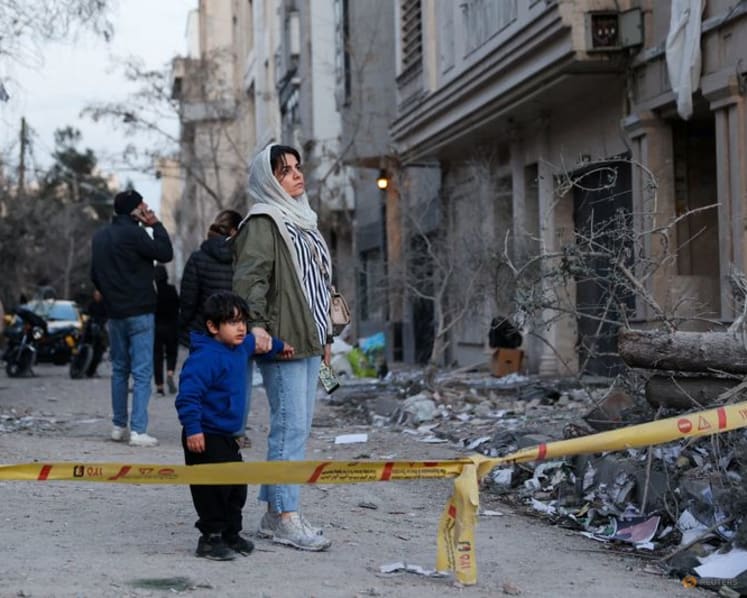
In cities like Tehran, many Iranians may be too traumatised by the airstrikes and the very real possibility of the war escalating further to risk mounting an uprising. Even if elements of the Iranian population now rise up, the most likely outcome would be a bloody civil war in which the Iran Revolutionary Guard Corps (IRGC) violently suppresses them.
Protestors taking to the streets would not be enough to tip the situation now, unless this happens concurrently with Kurdish and Baloch insurgencies, but this would be more likely lead to protracted civil war rather than definitive regime change.
DIFFERENT PICTURE OF SUCCESS FOR US AND ISRAEL
Despite the Israeli and American militaries collaborating closely when striking Iran, it cannot be assumed that Mr Trump and Israeli Prime Minister Benjamin Netanyahu will be on the same page when it comes to the scope of the mission or how success will be determined.
Mr Trump’ stated goals for “Operation Epic Fury” have already shifted since day one. On Mar 2, he spelled out four goals that focused on narrower military and strategic aims: destroying Iran’s missile capabilities; annihilating its Navy; preventing Iran from obtaining a nuclear weapon; and stopping Iran from supporting terrorist groups like Hezbollah outside its borders.
But given how Mr Trump initially framed the situation, there is every chance that if the war drags on for longer than he would like, he could ultimately declare “mission accomplished” – and blame any lack of real regime change on Iranians for not acting on the opportunity the US and Israel have given them.
Israel has now widened its “Operation Lion’s Roar” to include Lebanon, striking the Iran-backed Hezbollah armed group, whereas the US military remains focused on attacking the Iranian regime. If Iran is simply left in a state of chaos and weakness, this outcome will suit Israel.
The history of recent wars, interventions and uprisings in the Middle East and Afghanistan is messy. It has given rise to the aphorism of “replacing tyranny with chaos”, meaning that toppling or weakening a despotic regime only begets more suffering and instability.
Iran threatens to become the latest example of this.
Dr Samir Puri is Visiting Lecturer in War Studies at King’s College London. His books include The Great Imperial Hangover and Westlessness.




