







Commentary: Paddington, pints and the art of modern diplomacy
Japan’s ambassador to the UK is winning hearts by travelling around with a Paddington bear plushie. This offers a lesson for diplomats the world over, says Gearoid Reidy for Bloomberg Opinion.
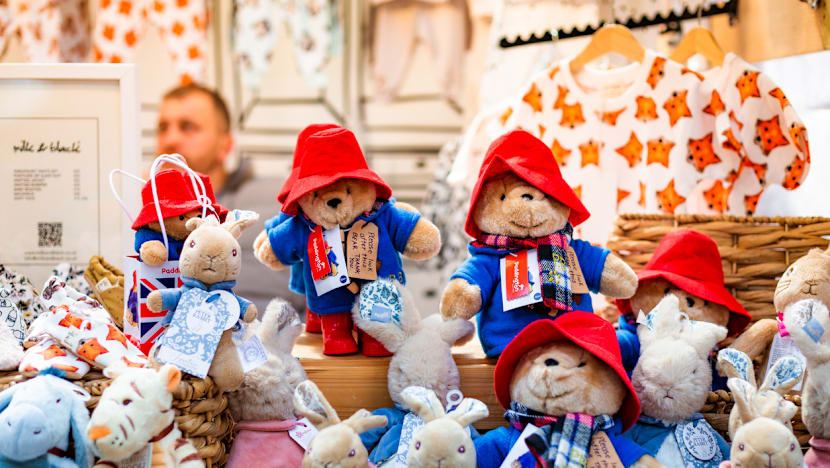
Paddington Bear stuffed toys on sale at Spitalfields Market in London, UK. (Photo: iStock)
TOKYO: This is the face of diplomacy in 2026: A 64-year-old Japanese man with a Paddington bear plushie downing a pint and exclaiming, “That’s boss, that!”
Hiroshi Suzuki, Tokyo’s ambassador to the UK, is winning hearts and minds online, not through promotion of sushi, sumo or the other staples of traditional Japanese culture that envoys normally engage in, but via his love of Britain. On social media, he samples real ales and other local delights, with his signature Peruvian bear in tow.
Appointed in 2024, Suzuki started to make waves early last year. Posts showing him knocking back a beer for New Year’s, enjoying traditional cakes on a trip to Cardiff, and singing the Welsh national anthem went viral. Recent visits to Scotland and Birmingham, where Suzuki dressed in the distinctive suit and flat cap of the Peaky Blinders, the violent interwar crime gang made famous in the BBC TV series, have elevated him even further.
His most popular posts frequently include a local catchphrase - “By’eck, it’s gorgeous!” after downing an impressive amount of ale; “That’s boss scran!” after consuming a Liverpudlian specialty dish. His enthusiasm for anything British seems to know no bounds, from distinctly local drinks like Vimto and Irn-Bru, to haggis and chicken tikka masala.
“Dear Japan, please can we keep him?” asked one follower, voicing a widely held sentiment.
“PADDINGTON BEAR OF AMBASSADORS”
Suzuki, who was once a secretary to the late Japanese leader Shinzo Abe, has some 200,000 followers on X, formerly Twitter. But his influence extends well beyond it.
At last year’s Labour Party conference, attendees and politicians queued up for selfies. He is showing the right way to win friends and influence people. It should be a lesson for diplomats the world over.
In an era of cynicism, Suzuki offers unadulterated wholesomeness. After being dubbed the “Paddington bear of ambassadors” by a UK newspaper, he adopted the moniker, making the character his personal mascot. It now accompanies him on his trips, and his wife has a bear-adorned kimono obi.
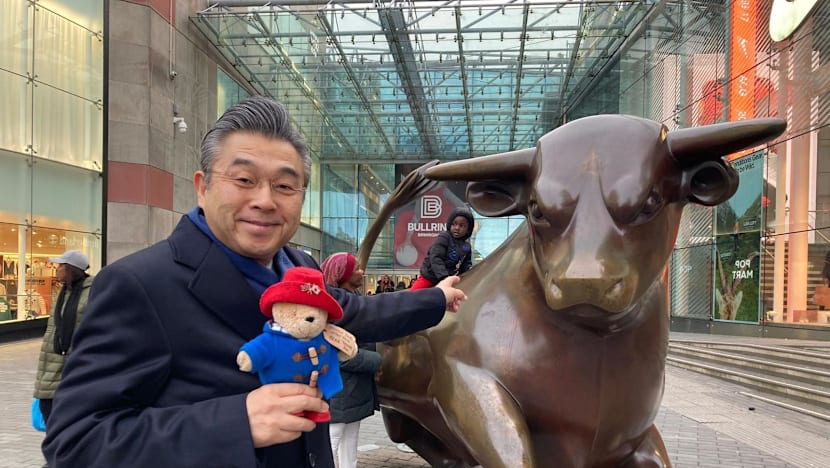
And with the internet increasingly dominated by AI slop, he offers the crucial element of authenticity. Whether eating crumpets or attending Wimbledon, he looks like he’s genuinely having the time of his life.
Suzuki’s love of British things is rather typical of his generation, which grew up when the UK was an epicentre of hipness, from the Beatles and the Rolling Stones to the punk fashions of Vivienne Westwood.
Associating himself with long-standing British activities and values helps at a time when the country is going through something of an identity crisis. “48 times the Japanese ambassador made us proud to be British,” gushes one typical headline. Many contrast his social media appearances with the awkward or even nagging online presence of Britain’s own politicians.
Twee though it might be, the strategy is smarter than it might look. Suzuki’s image stands not just in contrast to dry European diplomats, but to Chinese “wolf warriors”, more likely to take to social media posting AI-generated cringe, or urging a government to “correct its wrong”. Amid uncertain alliances and shifting power structures, this soft approach can translate into real results.
A SOFT-POWER LEVER
He’s not alone.
Teimuraz Lezhava, the Georgian envoy to Tokyo, has built such a formidable social media presence that he’s become known as the “viral ambassador”. Despite his nation having a population of less than 4 million, he has nearly twice as many followers as Suzuki, thanks to direct engagement built through his native Japanese skills and authentic voice (he grew up in Hiroshima, and refuses to use AI to help check his posts, which can be multiple times per day).
“Social media is free, so small countries like us still have a chance,” Lezhava says. Not only does his popularity open doors with ministers and officials, his legions of fans online alert him when they see misinformation about his country or its Russian-occupied areas.


While Lezhava might show off Georgian wine and shkmeruli (a delightful creamy garlic chicken dish), he cautions that relating to the audience is key.
“Half of my posts are about Japan and have nothing to do with Georgia,” he says. The main thing is to embrace local, everyday culture, use the language, travel outside the capital, and keep things informal - no one needs another tweet about the ambassador having the great honour to attend some summit and meet such-and-such official.
And it’s not just for countries with little to spend. The former US ambassador to Tokyo, Rahm Emanuel, put aside his sharp-elbowed reputation to take to social media trumpeting Japan’s charms, from trains to safe streets. (He also had no problems wading into politics, and would frequently troll Beijing - something which helped endear him to locals even if it ticked off the Joe Biden-led White House).
It’s a soft-power lever that many countries often overlook. Japan’s recently appointed ambassador to France, Hideo Suzuki, is among those paying attention, racking up over 2 million views on a post in French of him eating a sugar waffle. “One wonders whether he is the ambassador of Japan to France or the ambassador of France to France,” asked one user.
So diplomats, get yourself a plushie, a pint - and some enthusiasm for local produce. Modern diplomacy starts here.




