From homecoming to ‘reverse Spring Festival travel’: How Chinese New Year reunions are changing in China
Changing work patterns, improved transport links and evolving ideas of family and tradition are signalling a subtle shift in China’s centuries-old homecoming tradition.
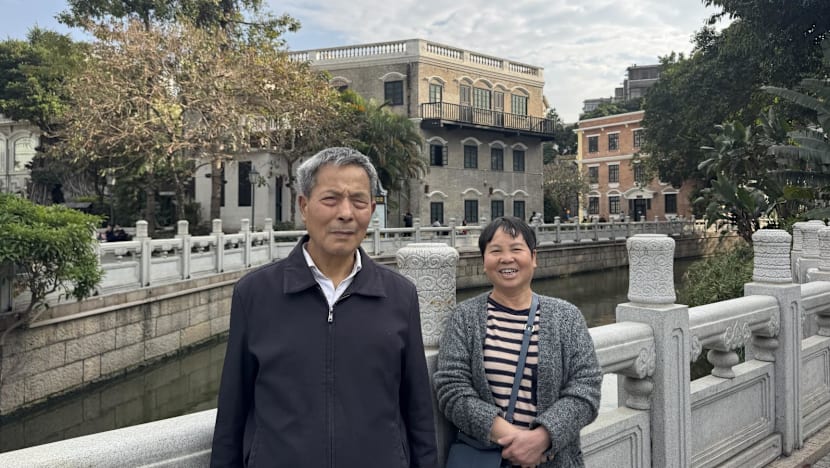
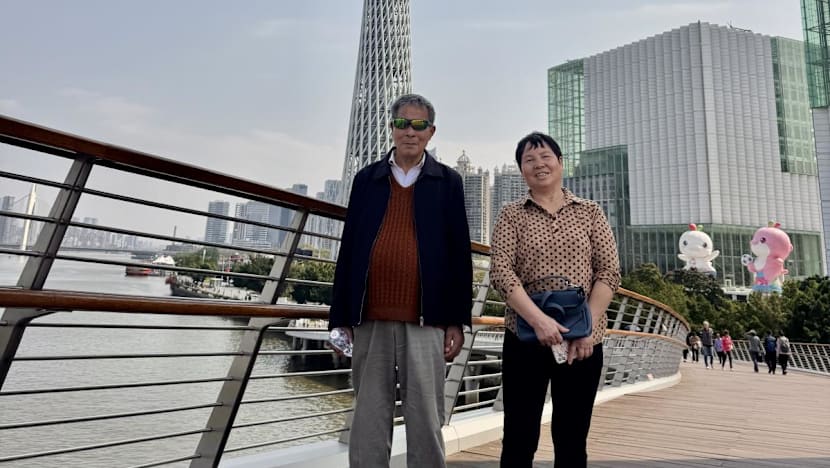
Older relatives visiting Guangzhou during Chinese New Year, reflecting a growing trend of families reuniting in the cities where younger generations work. (Photo: Joe Zhou)

This audio is generated by an AI tool.


SHENZHEN/GUANGZHOU: Every Chinese New Year, a familiar migration sweeps across China.
Millions squeeze onto packed trains, buses and planes, racing back to their hometowns in time for reunion dinner - an annual homecoming rooted in the deeply held belief that children should return to their elders to usher in the new year together.
This year, however, traffic is increasingly flowing the other way.
“Reverse reunion” travel is on the rise, experts say - which sees parents journeying from rural and hometowns and villages to the big cities where their children live and work.
And with this year's nine-day holiday, the longest in decades, bookings for such flights and travel routes have climbed about 35 per cent year on year since January, according to data released by Meituan Travel.
Among those reshaping traditions are Zhou Songlin and his 42-year-old son Joe, a public relations consultant.
As the annual holiday approaches, the pair have slipped into their usual festive routine - staying home, cooking simple meals and sharing bowls of sweet desserts.
Only this year, they are not in their hometown Changsha in central China’s Hunan province - but down south in Guangzhou, where Joe is based.
For the younger Zhou, inviting his father to stay with him during the Chinese New Year break was a practical decision. Work commitments, Guangzhou’s milder winter weather and his recent move into a new home were just a handful of reasons.
Travelling to Guangzhou also made more sense for his father as it's "convenient, safe, comfortable and simple", he added.

Analysts say the rise of “reverse reunion” travel reflects deeper changes in China’s work patterns, migration flows and family life - as millions of younger Chinese remain anchored to mega urban centres even during the year’s most important holiday.
“The emphasis is increasingly on being together, rather than where togetherness happens,” said Zhao Litao, a senior research fellow at the National University of Singapore’s East Asian Institute.
The trend has gained traction in recent years, enabled by improved transportation links and evolving ideas about family roles, said Shen Han, a professor of tourism management at Fudan University.
“Better connectivity (across China) has made it much easier for elderly parents to travel long distances,” she said.
The shift signals a move away from one-way migration flows towards more flexible, two-way mobility during the holiday season - reshaping not just travel patterns, but long-held notions of filial duty.

PARENTS ON THE MOVE
During peak holiday periods, seats along popular travel routes often sell out within minutes.
This year, Wang Yu, a 31-year-old programmer, invited his parents from Hunan to visit him in Shenzhen.
“High-speed rail tickets are easier to get than during the peak return rush and it’s more comfortable for them here,” he told CNA, adding that he plans to take them to popular sights like Shenzhen Bay Park, Xiaomeisha Beach and Xianhu Botanical Garden.
A one-way high-speed rail ticket from Changsha to Shenzhen costs about 450 yuan (US$63), roughly the same as travelling in the opposite direction.
“When timing and financial costs are similar, many (travellers) choose the option that offers greater comfort and flexibility,” said Shen of Fudan University.
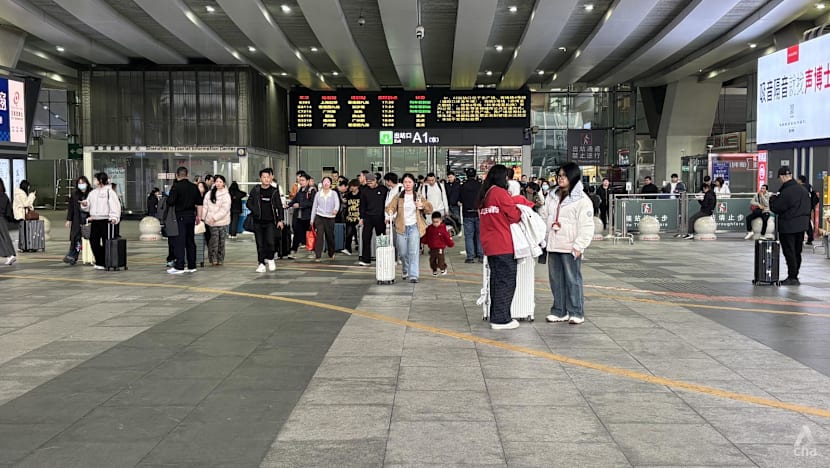
Checks by CNA on popular domestic booking platforms like 12306 China Railway showed tickets from Shenzhen to cities such as Zibo in Shandong and parts of Henan selling out in early February - while seats on some reverse routes remained available at similar prices.
These constraints have nudged more families to flip the journey, analysts said, with parents travelling to cities to avoid the travel crush and booking stress.

Younger Chinese are increasingly concentrated in major cities, experts said - also noting that retired parents have more flexible schedules than their children who often face tighter work constraints.
Smaller family sizes and changing household structures have also reduced pressure on children to return home for the holidays - making more flexible reunion arrangements socially acceptable.
Moving into a new flat inspired 34-year-old Shenzhen-based IT worker Guo Xueqin to host his parents during Chinese New Year for the first time this year.
“Wherever we are, as long as we’re together, it’s the same,” Guo told CNA.
Chen Bo, a senior research fellow from NUS’s East Asian Institute, pointed to decades of rapid urbanisation across China and relaxed household registration rules that have strengthened younger people’s sense of belonging in cities.
“Many now see the place where they work and live as home,” he said. “Bringing (one’s) parents there is also a sign of that identity.”
Ji Wenli, a local volunteer at the Shenzhen North Railway Station, told CNA that she now sees more elderly passengers on the move during festive periods - travelling to join their children in bigger cities.
Most travellers still return to their hometowns for Chinese New Year, Ji said - but the shift towards “reverse reunions” is becoming more visible, even if it is likely to take years to become mainstream.
NEW HOLIDAY ECONOMY
The rise of “reverse reunion” travel during Chinese New Year is also reshaping how - and where - families spend during the holiday.
Data from travel platform Fliggy showed a rise in high-end hotel bookings nationwide during the Chinese New Year period of nearly 70 per cent, while reservations at family-friendly theme park hotels jumped 94 per cent.
Fudan University's Shen said that the surge reflects a growing preference for “stay-and-play” celebrations in major cities, with families combining reunion time with leisure experiences.
Figures from Meituan Travel point to a similar trend. Hotel orders for cross-city stays of two days or more climbed about 65 per cent, with family bookings accounting for more than 60 per cent of total reservations.
Retailers and service providers have also been quick to cash in on the shift.
In megacities like Beijing, Shanghai and Shenzhen, shopping malls and online platforms roll out promotions targeting reunited families, including dining discounts, travel bundles and shopping vouchers.
Some services now cater specifically to older travellers, offering assisted transport, guided tours and escort-style support.
Meituan Travel recently partnered with major domestic airlines like Air China to introduce assistance programmes for passengers aged 55 and above, providing step-by-step guidance from check-in to boarding, along with departure reminders.
Even so, economists caution against overstating the role of policy incentives or corporate promotions.
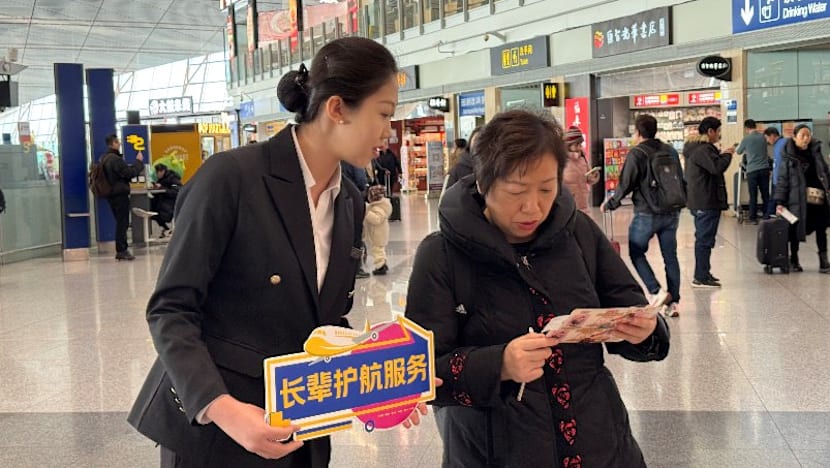
Tommy Wu, senior China economist at Commerzbank, said consumption subsidies are largely following - rather than driving - the behavioural shift.
“This is a relatively new pattern that may take time to become fully mainstream,” he said.
“Platforms are riding on the trend rather than shaping it,” he added.
“AS LONG AS WE’RE TOGETHER”
Reverse reunions are only one sign of how Chinese New Year habits in China have been evolving - and increasingly, there is no fixed formula or “correct” way to mark the holiday, families say.
Some young people choose not to travel at all while others fold family reunions into short getaways.
Last year, Xu Yumin, a Shenzhen-based public relations professional, invited her mother and aunt from northeast China to spend the new year with her - pairing family time with trips to nearby islands and cities.
This year, Xu is spending the holiday with friends in Tengchong, Yunnan instead - and only plans to reunite with her family when they visit her in Shenzhen later in spring.
Analysts said such flexibility reflects a generational shift.
“China's younger generation has fully adapted to urban life,” said Chen Bo.
“For them, returning to rural hometowns is no longer the only meaningful way to mark the festival.”
Zhao Litao agreed, noting that while locations may change, many families continue to observe core traditions - reunion dinners, gift-giving and visits to elders - just in newer settings.
For Joe Zhou and his father in Guangzhou, the changes feel more like an intimate adjustment and less like a social trend.
The pair have been spending quiet time at home - with the elder Zhou still getting used to his son's new flat and city and also missing familiar rhythms of home back in Changsha.
But there have also been special moments.
Zhou recalled his father smiling as they crossed the bridge in Haixinsha island, located in Guangzhou’s Tianhe district - gazing at the Pearl River skyline.
“He was really happy then,” Zhou said.
“As long as we’re together, that’s what matters most.”