Advertisement
Advertisement

East Asia

Chinese EV makers bet big on global expansion as domestic growth slows

From AI-powered cars to flying vehicles, companies like XPeng are betting that cutting-edge tech and global expansion will drive their next growth phase.
Chinese EV makers bet big on global expansion as domestic growth slows

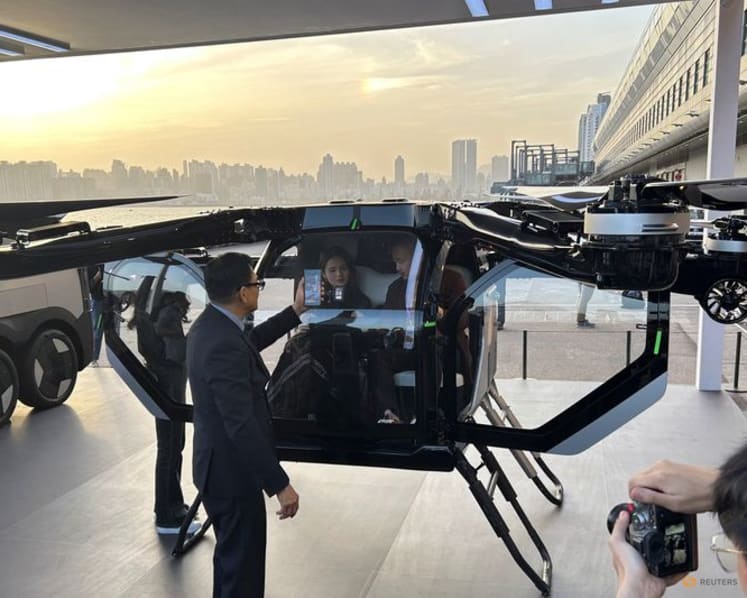
Chinese electric vehicle (EV) maker Xpeng displays a concept flying car, alongside a van designed to carry it, at a company event by the Victoria Harbour in Hong Kong, China, Apr 15, 2025. (Photo: Reuters/Brian Thevenot)

New: You can now listen to articles.

This audio is generated by an AI tool.

25 Jan 2026 09:00AM

SHENZHEN: Chinese electric vehicle makers are charging ahead with bold targets for 2026, even as signs of fatigue emerge in their home market. 

With domestic demand slowing and competition intensifying, many are turning to consumers overseas to sustain growth, aided by a recent easing of trade tensions between China and the European Union. 

Last week’s breakthrough agreement between Beijing and Brussels to introduce a price floor on Chinese-made EVs – which will replace EU-imposed tariffs of up to 35 per cent – is also offering exporters a timely reprieve.

TECH TAKES THE DRIVER’S SEAT 

At the heart of this expansion drive is technology. 

Chinese EV manufacturers are racing to differentiate themselves on the global stage through innovation, from artificial intelligence and autonomous driving to even flying cars. 
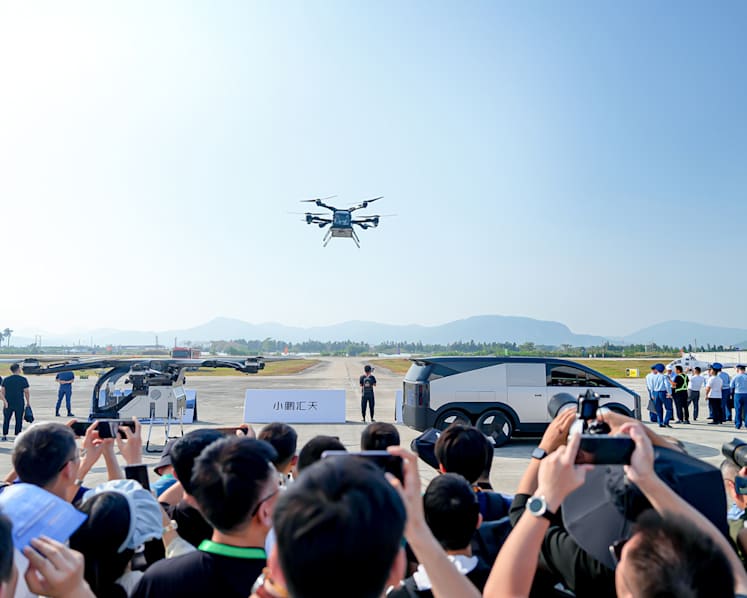
XPeng AeroHT's “Land Aircraft Carrier” makes its first public flight at the China Airshow at Zhuhai City in Guangdong province, China, Nov 12, 2024 (File Photo: XPeng AeroHT)

At Chinese carmaker Xpeng’s Aridge exhibition in Guangzhou last week, visitors were given a glimpse of what the company sees as the future of mobility.

Alongside concept vehicles were flying cars currently undergoing testing, with a potential launch from 2028. 
 
The exhibition also featured its so-called “land aircraft carrier”, a futuristic six-wheeled vehicle with a two-seater detachable aerial module stored in the back. This allows users to drive long distances, then deploy the aircraft for short-range personal flight. 
 
The vehicle is expected to retail for around 2 million yuan (US$285,000). The company aims to roll out mass production and deliveries this year. So far, it has received around 7,000 pre-orders, including 600 from Gulf companies. 
 

ACCELERATING OVERSEAS PUSH 

 
On the ground, XPeng is rolling out a new AI-powered sedan across 36 countries, building on strong export-driven growth last year. 
 
It had a stellar year in 2025 – global sales more than doubled from the year before, growing nearly five times faster than market leader BYD. 
 
Europe has emerged as one of XPeng’s best-performing regions, supported by local production in Austria that helps it skirt around EU tariffs. 
Gary Ng, a senior economist at investment bank Natixis, said Chinese EVs remain well positioned despite regulatory uncertainties in Europe. 
 
“Because Chinese EVs have been rather cost-effective and have good battery technology, they will still be quite competitive in the EU market,” he told CNA. 
 
“Even though the growth rate may not be as (quick) as a few years ago, it's still possible to see a growth rate of around at least 20 per cent in 2026.” 
 

SPEED BUMPS IN DOMESTIC MARKET

 
Globally, Chinese EV makers are reshaping the industry. Last year, Chinese brands dominated global EV sales, with BYD overtaking American EV maker Tesla for the top spot for the first time. 
 
The picture at home, however, is less rosy. BYD’s domestic sales growth slowed to 7.7 per cent – its weakest pace in five years – as manufacturers struggle to stand out in an increasingly saturated domestic market. 
 
A prolonged price war that began in 2023 has squeezed margins, prompting Chinese authorities to warn against excessive competition. 
 
Industry forecasts point to further challenges ahead. The China Association of Automobile Manufacturers expects the overall market to grow just one per cent this year. 
 
New energy vehicle sales are tipped to grow 15 per cent, a slowdown from last year when sales surged 28 per cent. 
For consumers, price alone is no longer the deciding factor. Buyers interviewed by CNA highlighted safety, practicality and reliability as key considerations. 
 
“What I care about first is safety, because I once read a report about a case of a battery-powered vehicle catching fire. The second is comfort, because we buy a car mainly for convenience in travel and energy conservation,” said one car owner. 
 
Another said: “Battery life (is important). Here in Shenzhen, it's relatively (warm). But if I drive it to a colder place, I would consider the car’s power consumption, as well as whether it's convenient to charge it or not.”  
 

REVVING UP TECH PROWESS 

 
As consumer priorities evolve, automakers must rethink their strategies, say market watchers. 
 
“Because of geopolitics, (it is important to) localise the production to bypass the tariffs, and at the same time ensure the supply chain is smooth,” said Ng. 
 
“Batteries … will continue to be one of the core parts of EV performance. Also, how to integrate the whole system with AI to offer a better experience,” he added. 
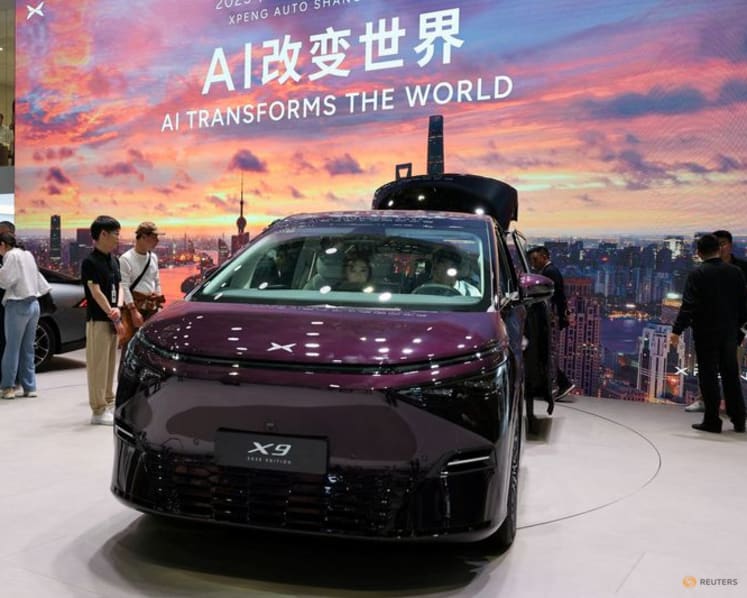
People look at an Xpeng X9 minivan at the Chinese electric vehicle (EV) maker's booth during a media day for the Auto Shanghai show in Shanghai, China, Apr 23, 2025. (File Photo: Reuters/Go Nakamura)
That shift is already underway – AI and robotics have become central to Chinese EV investment plans. 
 
Xiaomi has pledged to invest at least US$28.6 billion in research and development over the next five years, while Geely has unveiled its latest intelligent driving system. 
 
XPeng is investing heavily in its in-house Turing AI chip, saying it is three times more powerful than Nvidia’s products. Its chairman and CEO He Xiaopeng said he believes custom-designed chips will define the next phase of competition. 
 
“The world's leading AI companies will likely customise their own chips in the future, because proprietary chips can achieve next-generation performance using current-generation technology. It’s not merely cost-related but fundamentally tied to capability,” he said. 
 
As competition intensifies globally, industry leaders say that China’s biggest export success story in EVs will ultimately be decided beyond its borders. 
 
Wei Jianjun, chairman of Great Wall Motors, one of China’s largest sport utility vehicle producers, noted: “As a major automotive nation, in our progress towards developing to become an automotive power, we must start to look outwards to the world.”
Source: CNA/dn(lt)
Advertisement

Also worth reading

Advertisement