‘Food should have no borders’: China-Japan spat hits Beijing’s Japanese restaurants as cancellations surge
Analysts warned the dispute sparked by Japanese Prime Minister Sanae Takaichi’s remarks on Taiwan could persist, leaving ordinary people to navigate the resulting uncertainty.
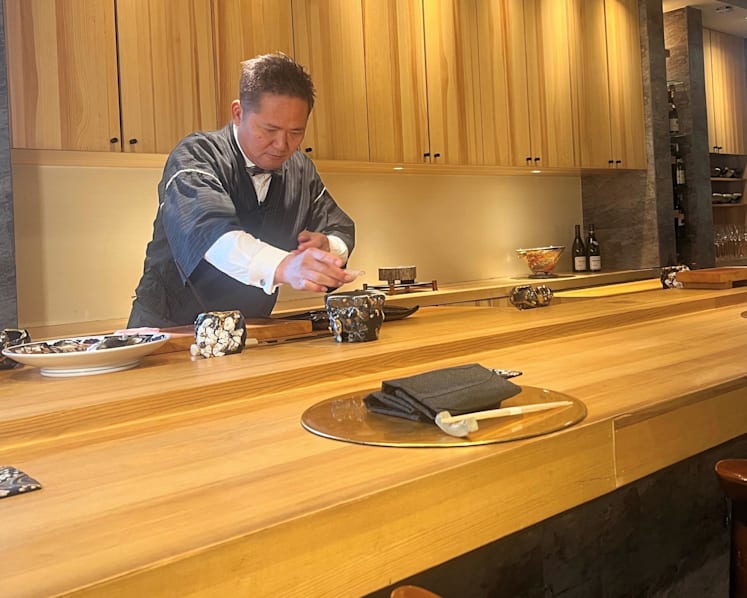
Kazuyuki Tanioka, owner of Japanese cuisine Toya restaurant in Beijing, said the latest China-Japan spat has hit his business harder than the COVID-19 pandemic. (Photo: CNA/Tan Si Hui)

This audio is generated by an AI tool.




BEIJING: Diners once had to book weeks in advance to secure a table at Toya, a popular Japanese restaurant in Beijing.
But business has taken a sharp turn, with more than 60 reservations cancelled since mid-November, said owner Kazuyuki Tanioka, who has served omakase menus in the Chinese capital for over a decade.
“With China and Japan not on good terms, many Chinese don’t want to eat Japanese food,” the 52-year-old Japanese national told CNA.
The slump comes amid the latest diplomatic row between China and Japan.





Tensions flared following Japanese Prime Minister Sanae Takaichi’s Nov 7 remarks in parliament that a Chinese attack on Taiwan could amount to a "survival-threatening situation" and potentially trigger a military response from Tokyo.
STRAIN ON DAILY LIFE
Backlash from Beijing has been swift, ranging from travel advisories to reported curbs on seafood imports.
The spat between the two Asian neighbours has begun to cast a shadow over daily life for some in China.
For Tanioka, the fallout has hit his business harder than the COVID-19 pandemic.
He had just welcomed China’s lifting of its two-year ban on Japanese seafood imports in early November, before reports emerged that they could be suspended again.
His restaurant had already switched to Chinese and European seafood, but with fewer diners – and high rent and staff salaries to cover – the changes may not be enough.
“We may close our restaurant next year,” he said somberly.
“We can’t control the relationships between countries. But I believe that food and friendship should have no borders.”
Some of Tanioka’s Japanese friends are also considering leaving China, and he is thinking of doing the same – potentially opening a restaurant in Tokyo, even if it means being apart from his Chinese wife.
Some Japanese food outlets in Beijing told CNA that bookings have plunged by as much as 70 to 80 per cent since the diplomatic feud began about a month ago.
Others, however, said they have not observed any significant impact on business.
Several restaurateurs said they had learnt from previous periods of tension and diversified their seafood supplies, sourcing from countries such as Spain and Canada to reduce reliance on Japanese imports.
ESCALATING POLITICAL RIFT
Beijing – which views self-ruled Taiwan as an inalienable part of its territory under the one-China principle – has demanded a retraction from Japan's premier.
On Monday (Dec 1), Chinese foreign ministry spokesperson Lin Jian urged Japan to “learn the lessons of history, do soul searching, take seriously what it has heard from the Chinese side, simply retract the erroneous remarks as it should and take practical steps to honour its political commitments to China”.
But with neither side showing signs of backing down, analysts warned that the dispute could persist, leaving ordinary people to deal with the rising uncertainty.
The spat has also led to the postponement of Japanese film releases in China, the abrupt cancellation of concerts by Japanese musicians and the suspension of official exchanges.
A frequent traveller to Japan, Yan Jun, faced a dilemma when China advised its citizens to avoid visiting Japan. Chinese airlines proceeded to cut hundreds of Japan-bound flights this month.
“If you are really tight on time and have many urgent matters to handle, then it’s best to simplify your travel plans as much as possible,” said Yan, who added that she is still continuing with her trip to Japan.
“I have many friends, including those who have returned from Japan and those currently there. They have all told me personally that it is still safe.”
Analysts said China’s response is consistent with its usual playbook.
Chinese netizens and state media have strongly criticised Japan, though offline reactions have not reached the intensity seen in 2012, when anti-Japan protests swept many Chinese cities over disputed islands in the East China Sea.
Chong Ja Ian, an associate professor of political science at the National University of Singapore, said there have been periodic spats between Beijing and Tokyo over the years.
The economic conditions in China and Japan today differ greatly from the past, especially with China’s growth slowing, he added.
Their military balance has also shifted significantly, with China now far more capable than before, said Chong. “There are multiple calculations and also domestic concerns.”