China probes three major brokers in crackdown on 'illegal' cross-border trade
The Chinese regulator says it will impose penalties on Hong Kong-registered brokers Longbridge and Futu, which owns online platform MooMoo, as well as New Zealand-registered Tiger Brokers.
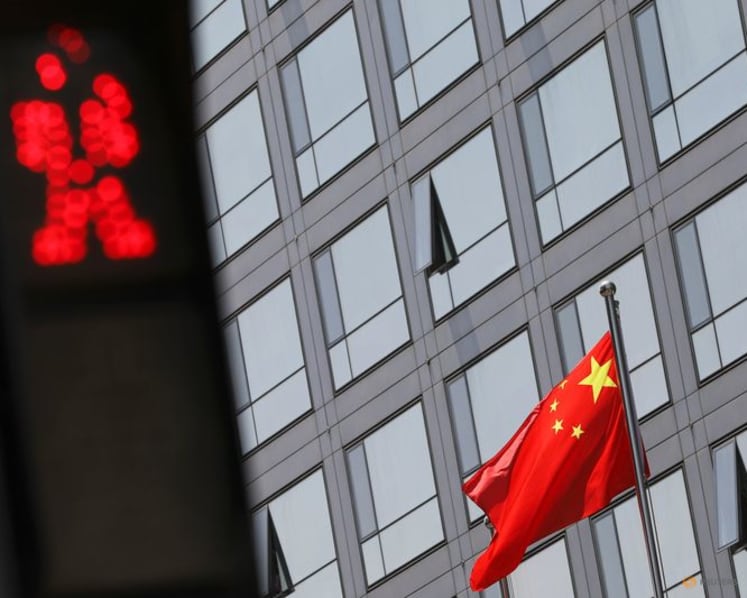
A Chinese national flag flutters outside the China Securities Regulatory Commission (CSRC) building in Beijing, China. (File photo: REUTERS/Tingshu Wang)
BEIJING: China's market regulator announced a sweeping investigation on Friday (May 22) against three major brokers running cross-border trading, as it launched a two-year crackdown on investment leaving the country.
China does not allow private individuals to directly invest in overseas markets, requiring them to trade assets only through approved third-party channels.
However, regulations differ in the semi-autonomous city Hong Kong, and some brokers have been able to legally operate there, attracting investors from mainland China to open trading accounts in the Chinese finance hub.
Authorities have sought to regulate the loophole in recent years, and in 2022, barred private Chinese investors from opening accounts with such brokers.





The China Securities Regulatory Commission (CSRC) said on Friday it will probe and impose penalties on Hong Kong-registered brokers Futu and Longbridge, as well as New Zealand-registered Tiger Brokers.
Regulators said the brokers had conducted securities-related business in China "without obtaining the necessary approvals or licences", violating China's securities law.
The CSRC said in a separate statement on Friday that it will join forces with seven other bodies, including the Ministry of Public Security and the People's Bank of China, to carry out a two-year campaign targeting illegal cross-border securities activities.
The campaign aims to "completely eradicate the illegal cross-border operations of overseas securities, futures and fund management institutions", it said.
Futu, which owns online brokerage Moomoo, said in a filing that Chinese authorities have proposed a fine of about 1.85 billion yuan (US$271 million).
Futu "has already ceased opening accounts for applicants with mainland Chinese identities ... has consistently engaged in active dialogue with regulatory authorities and complied with their rectification requirements", it said in a statement.
Chinese investors accounted for about 13 per cent of the group's total client base, it added.
UP Fintech, a US-listed brokerage firm that owns Tiger Brokers, said CSRC fined the company 308.1 million yuan and confiscated 103.1 million yuan of illegal income.
The firm "accepts the penalty with sincerity", it added.
The two brokers' CEOs were also fined.

Chinese authorities' aim "is to gain full control of capital outflows, and to block any loopholes of these illegal activities", Kelvin Lam, a China-focused economist at Pantheon Macroeconomics, told AFP.
"What China is trying to do at the moment is to make sure no overseas branches of these companies ... take funds out of Chinese investors and help them to invest overseas," Lam said.
Hong Kong cross-border brokers have operated in a regulatory grey zone until now, he said, but authorities are seeking to fully stem the flow of Chinese investment out of the country.
"Rather than worrying the fact of capital leaving China illegally, the aim of Chinese authorities is to seek full control of the situation rather than anything else," Lam said.