Japan says ready to act as yen hits 40-year low
The yen sank past 161.96 per dollar for the first time since 1986 in London trade on Monday.
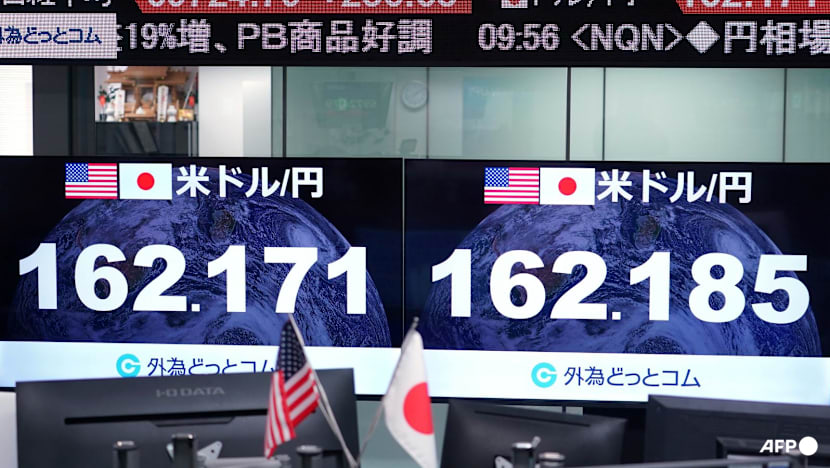
Electronic boards display the foreign exchange rate of the Japanese yen against the US dollar at a foreign exchange brokerage in Tokyo on Jun 30, 2026. (Photo: AFP/Kazuhiro Nogi)
TOKYO: Japan's finance minister said on Tuesday (Jun 30) that authorities were ready to take "appropriate action" after the yen hit a 40-year low against the dollar.
The currency has been sliding for years and has come under renewed pressure because of the Middle East war and the gap in US and Japanese interest rates.
Satsuki Katayama said Japan "will take appropriate action at any time as necessary", local media reported.
The comment was intended to signal to markets that Japan was prepared to intervene to support the currency after spending more than US$70 billion doing so last month.





The yen sank past 161.96 per dollar in London trade on Monday for the first time since 1986.
It hit 162.40 in Asian trade on Tuesday before recovering to 162.17.
A weak yen makes imports more expensive for resource-poor Japan, notably for dollar-traded oil.
Prime Minister Sanae Takaichi's government has been shielding consumers with heavy fuel and energy subsidies.
But the weak yen has also helped fuel a boom in tourism, since it makes shopping, accommodation and food cheaper for foreign tourists.
The Bank of Japan this month raised interest rates to a 31-year high but there are expectations that the US Federal Reserve could lift borrowing costs itself this year, meaning that the gap will remain.
Further hikes by the BoJ could also meet resistance from Takaichi's government, which is anxious not to snuff out growth with high borrowing costs.
INTERVENTION ALONE WON'T REVERSE YEN'S SLIDE: ANALYST
Speaking to CNA's Asia First, Jesper Koll, expert director at financial services company Monex Group in Tokyo, said any government intervention will likely have only a limited impact because it would not address the underlying drivers of the yen's weakness.
"You cannot attack the symptom, which is a weaker yen, when the underlying issue is the policy mix in Japan," he said.
He said negative real interest rates, the BOJ being "very, very slow to hike interest rates" and the government's expansionary fiscal policy are likely to keep the currency under pressure.
"Until the fundamentals (change) – interest rate differentials, Japanese fiscal spending – the yen is going to continue to be a pretty safe one-way bet towards further depreciation," Koll said.
He noted that while the weak yen has hurt consumers' purchasing power through higher import costs, it has also boosted corporate Japan by lifting exporters' overseas earnings.
"The dirty secret is that the weak yen is great for Japanese corporations," Koll said, arguing that a weaker yen translates into sizeable profit for many Japanese exporters.