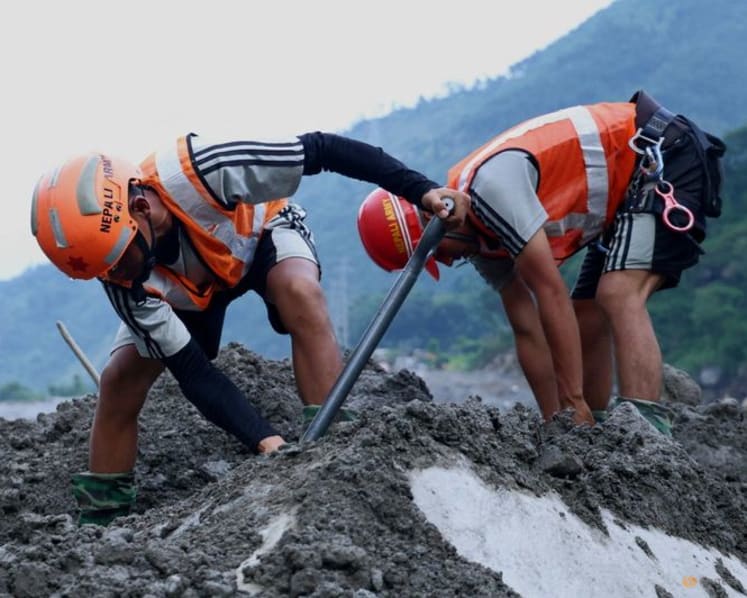
China punishes 10 people over Nepal-Tibet disaster ‘rumours’ amid misinformation crackdown
Cyberspace authorities have vowed to crack down on “false disaster information” that could mislead members of the public and “disrupt online order”.
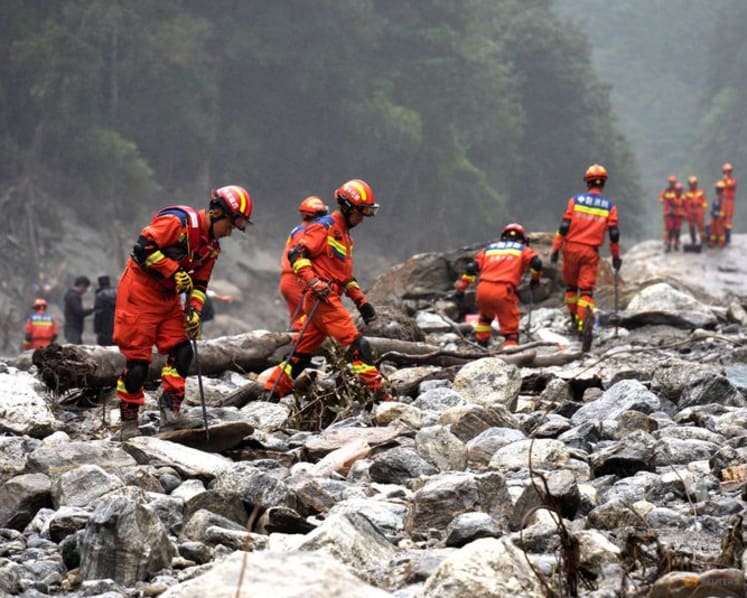
Firefighters conduct search and rescue operations along a river, after a mudslide in Gyirong county, Shigatse, Tibet Autonomous Region, China, Aug 29, 2026. (Photo: cnsphoto via Reuters)

This audio is generated by an AI tool.
BEIJING: China has punished 10 people for allegedly spreading what authorities have described as “online rumours” about the Nepal-Tibet disaster, as Beijing steps up efforts to counter misinformation surrounding the catastrophe.
The Chinese embassy in Nepal has also publicly rejected what it called “fake news” about the disaster’s cause and whether Beijing had provided sufficient warning.
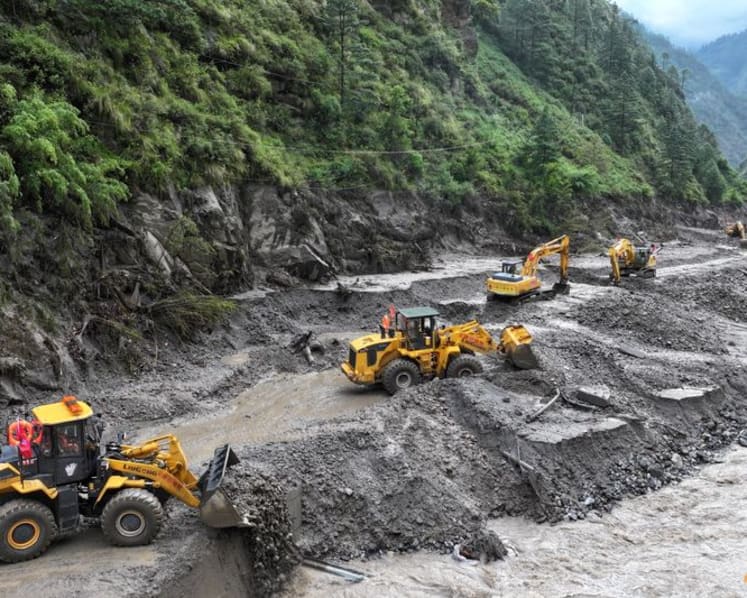
A tsunami-like flood crashed through the Himalayan region on Aug 26, devastating communities on both sides of the border. As of Monday (Aug 31), the death toll in Nepal and Tibet had passed 900, with around 4,800 people missing.
On Monday, the cybersecurity protection bureau under China’s Ministry of Public Security publicised 10 cases as it vowed to crack down on people fabricating “false disaster information” that could mislead members of the public and “disrupt online order”.





The cases largely involved social media posts about casualties in Tibet, including claims that thousands had died or that more people were missing than officially reported, the bureau said.
China has so far put the death toll in Tibet at 16, with 546 people missing.
All 10 people have received “administrative penalties”, the bureau said, without specifying the exact punishment meted out in each case or identifying the social media platforms on which the claims were made.

Under Chinese law, people who intentionally spread rumours or falsely report dangers, epidemics, disasters and police alerts, disrupting public order, can be detained for up to 10 days and fined up to 1,000 yuan (US$149).
Those found fabricating information on “false dangers”, epidemics, disasters or police and spreading them through social media networks may be jailed for up to three years. If “serious consequences” are caused, offenders face up to seven years’ jail.
EMBASSY REJECTS “FAKE NEWS”
Beijing’s efforts to counter misinformation have extended beyond casualty figures.
In a post last Thursday on social media platform X, the Chinese embassy in Nepal singled out two claims circulating online as “fake news”.
One alleged that China had failed to issue an early warning to Nepal, resulting in significant casualties on the Nepali side. The other claimed that the collapse of a geological disaster dam on the Chinese side of the border had caused major losses in Nepal.
The embassy rejected the claims, stressing that the disaster had “caused significant casualties” and left people missing on “both the Nepali and Chinese sides of the Gyirong-Rasuwagadhi border region”.
“Accusation helps nothing. Cooperation saves lives,” it wrote.
The embassy also posted a separate statement on Saturday evening, which it said was in response to comments in Nepali media and on online platforms “accusing China of failing to warn Nepal of the mudslide disaster”.
It cited findings by Chinese and international experts, showing that "risk points" in the Himalayan region are "highly dispersed", and that routine ground surveys on high-altitude areas cannot be as comprehensive as those in low-altitude areas.
"Chinese expert teams have always made every effort, within the limits of existing technology, to conduct monitoring, assessment and analysis, and have shared important information with the Nepali side in a timely manner," said the embassy.
Shortly before that, the embassy had shared and reproduced parts of a commentary by a Chinese expert published in Online Khabar, a Nepali news platform.
“Two countries are burying their dead together. This is the truth of Langtang Lirung,” Huang Yunsong, professor and associate dean at Sichuan University’s School of International Studies, said.
“Everything else - every rumour, every unverified claim, every attempt to turn grief into a geopolitical weapon - is noise the dead and the missing cannot afford.”
CHINA STEPS UP AID TO NEPAL
China has meanwhile stepped up emergency assistance to Nepal as rescue operations continue.
On Sunday, China’s ambassador to Nepal Zhang Maoming handed over US$2 million in emergency flood relief assistance from the Chinese government to the Nepali government.

The Red Cross Society of China also donated a separate US$200,000 to the Prime Minister Disaster Relief Fund of Nepal, according to a post on the Chinese embassy’s Facebook page.
State broadcaster CCTV reported on Sunday that the first batch of Chinese relief supplies had arrived in Kathmandu, along with four Chinese tunnel rescue experts.
The shipment comprised 13,200 emergency relief items, including tents, blankets, sleeping bags and first aid kits.
The supplies will be distributed to the front lines of the disaster areas to help meet the basic living and emergency medical needs of those affected, CCTV reported.