South Korea's birthrate, the world's lowest, rises again amid signs of easing demographic crisis
South Korea's total fertility rate, the average number of babies a woman is expected to have during her reproductive life, stood at 0.80 in 2025, up from 0.75 in 2024, according to preliminary data from the Ministry of Data and Statistics.
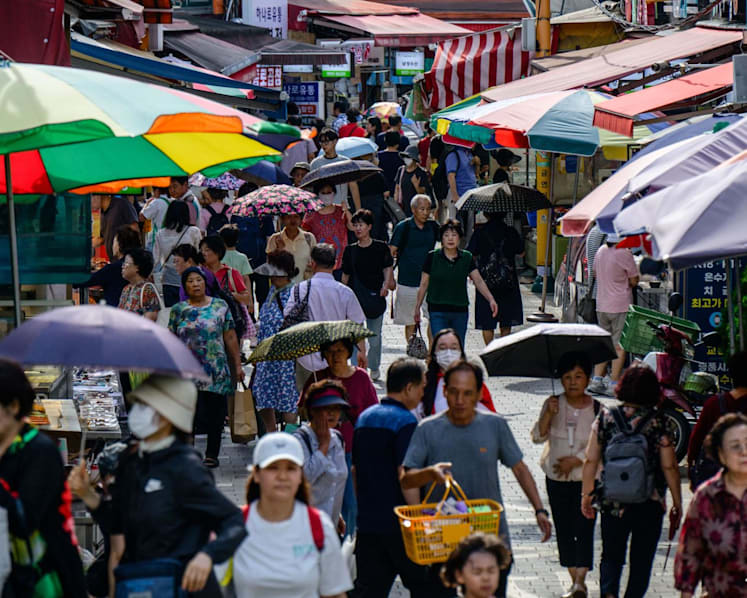
People walk past stalls at a street market in Seoul on Sep 3, 2025. (File photo: AFP/Anthony Wallace)
SEOUL: South Korea's birthrate rose for a second straight year in 2025, government data showed on Wednesday (Feb 25), in a further sign that a country facing a demographic crisis for nearly a decade may be starting to turn a corner.
South Korea's total fertility rate, the average number of babies a woman is expected to have during her reproductive life, stood at 0.80 in 2025, up from 0.75 in 2024, according to preliminary data from the Ministry of Data and Statistics.
New births began rebounding in 2024 on a post-pandemic boost and government policies, after eight consecutive years of declines that saw South Korea register the world's lowest birthrate at 0.72 in 2023, a period marked by skyrocketing house prices and higher economic participation by women.
There were 5.0 new births per 1,000 people in 2025, up from 4.7 in 2024. That compared with 5.6 in China last year, 4.6 in Taiwan last year and 5.7 in Japan in 2024, where the trend remains downwards.





The pace of the rebound is faster than the government's optimistic-case projection of 0.75 in 2025 and 0.80 in 2026, which forecasts the total fertility rate to break above 1.0 per woman in 2031.
Marriages, a leading indicator of new births with a time lag of one to two years, rose 8.1 per cent in 2025, after a record 14.8 per cent jump in 2024.
"The biggest part is that marriages are increasing a lot accumulatively," Park Hyun-jung, a ministry official, told a briefing. She also noted an increase in the number of people in their 30s, when most people get married and have babies, and changes in social attitudes.
The sharpest rise in new births was in the capital, with Seoul's fertility rate at 0.63, up 8.9 per cent from 0.58 in 2024, though still the lowest across the country.
Shin Kyung-ah, a sociology professor at Hallym University, said the data needed more scrutiny because of statistical effects such as population composition changes behind the rise.
"Still, it is meaningful as an indicator suggesting positive changes, which will, at least indirectly, also help make people become more positive about having a baby," Shin said.
In a biennial government survey in 2024, 52.5 per cent of South Koreans expressed positive views about marriage, up from 50.1 per cent in 2022. The average number of children people ideally wanted to have stood at 1.89.
Last year, new births rose 6.8 per cent to 254,457, the biggest percentage rise since 2007, while deaths rose 1.3 per cent to 363,389, resulting in the population naturally shrinking for the sixth consecutive year.
Related:
ECONOMIC SHOCK
President Lee Jae Myung's administration plans a five-year policy road map this year to respond to demographic changes, amid concerns about an economic shock from an ageing population.
It also plans to expand policy support rolled out in recent years for childbirth, and to introduce measures to attract skilled foreign workers to offset a shrinking workforce.
"The government will further strengthen support for young people in their 20s and early 30s, low-income earners and the unemployed," the Presidential Committee on Ageing Society and Population Policy said last month, citing evidence policy efforts were bearing fruit.
South Korea's potential economic growth rate, currently estimated at around an annual rate of 2 per cent, fell by six percentage points in the last three decades, more sharply than in most major economies, and is expected to fall to 0.6 per cent by 2045-2049, according to the central bank.
Credit ratings agencies warn that South Korea's public finances are facing strains because of growing social welfare expenditure. The country's public pension fund, the world's third-largest with US$1 trillion in assets, is projected to run out by 2071.
President Lee has called for regional cooperation on demographic changes and proposed at last year's summit of the Asia-Pacific Economic Cooperation grouping to hold the group's first population policy forum in South Korea this year.
During his visits to China and Japan in January, Lee also made separate agreements with President Xi Jinping and Prime Minister Sanae Takaichi to seek collaboration on ageing populations.
South Korea's population of 51.8 million is expected to shrink by almost a third to 36.2 million by 2072, according to the latest government projection in 2022.