







Army units to get homeland security training at new institute
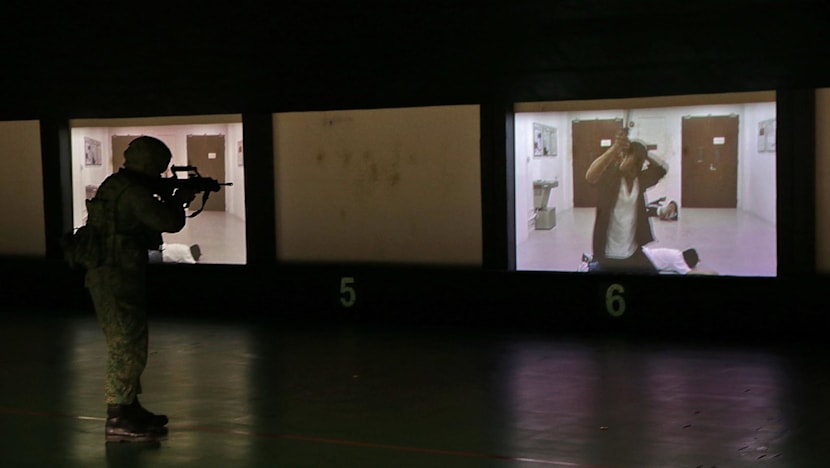
To better prepare soldiers for patrols with personnel from the Home Affairs Ministry, army servicemen will also undergo “judgemental video simulation” training at Pasir Laba Camp, which enacts situations that soldiers may have to confront when they are deployed in a public setting. Photo: Wee Teck Hian/TODAY


SINGAPORE — Servicemen from army combat and combat support units have to undergo training in homeland security operations at the new Island Defence Training Institute (IDTI), save for those already involved in this area, said the Ministry of Defence on Monday (July 31).
Defence Minister Ng Eng Hen recently announced that the institute would train about 18,000 soldiers from both active and operationally ready National Service (NS) units yearly in such operations from last month.
Operationally ready national servicemen (NSmen) will also have their roles enlarged to include homeland security operational duties. Selected army NS units will carry out such operations during in-camp training along with their present operational duties. Each year, up to 15,000 more servicemen will be trained in other island defence roles, such as sector defence and in protecting key installations.
The IDTI comprises the Homeland Security and Island Defence training centres at Clementi Camp, as well as the Security and Policing Leadership and Security and Policing Vocational schools at Mowbray Camp near Choa Chu Kang. The longer-term plan is to move the IDTI to Maju Camp, although details have not been confirmed.





Speaking to reporters last week ahead of the institute’s inauguration on Monday, Senior Lieutenant Colonel (SLTC) Vincent Soh, commander of IDTI, said that so far, 4,000 troops from active units have been trained since March, and operationally ready NSmen will be trained “very soon”.
Servicemen undergo training which spans seven days. The first two days will see troopers picking up knowledge in areas such as search-and-arrest techniques, and using less lethal weapons like retractable batons, as well as skills to “de-escalate and neutralise” hostile situations during operations, including joint deterrence patrols.
The rest of the days will focus on equipping troopers with skills to protect designated critical structures and carry out cordon-and-search operations. The syllabus, which includes lectures, offers various scenarios that allow participants to exercise their judgment and skills. Soldiers would be assessed on the second, fourth and final day of training, Major Muhammad Azmie, company trainer at the Homeland Security Training Centre, said.
For NSmen, they will go through a three-day refresher course when they report for in-camp training to keep their skills up-to-speed in areas such as rules of engagement.
To better prepare soldiers for patrols with personnel from the Home Affairs Ministry, army servicemen will also undergo “judgmental video simulation” training at Pasir Laba Camp near Tuas, to run through situations that they may confront in a public setting. They will also undergo “judgmental video” live firing at a complex in camp to improve their confidence in operating in a public space.
One example of a simulated scenario involves an “active shooter” and hostage-taker in a mall during a joint patrol between the Singapore Armed Forces (SAF) and the police. They then try to de-escalate the situation with verbal commands. Another scenario takes troopers to a vehicular checkpoint, where they work with a police officer to examine a vehicle, and a shooting may take place.
SLTC Soh said that the scenarios focus a lot on soft targets and are based on prevailing threats and operations which soldiers are expected to undertake. “You see a vehicle ramming (into individuals) and things like that (in attacks overseas). So that’s why … there’s a checkpoint (scenario), where we train our soldiers (to deal with) a vehicle that’s non-compliant and how you take it down.” It takes about a month to develop a new scenario for training.
The Security and Policing Leadership and Security and Policing Vocational schools — formerly the Military Police Training School — will focus on military security and policing duties.
The Security and Policing Vocational School, for instance, will focus on competency training for various units, such as policing and security operations for military policemen. It will also devise new skillsets needed for homeland security operations, such as using non-lethal and less lethal weapons.
On the need to train soldiers, Associate Professor Kumar Ramakrishna from the S Rajaratnam School of International Studies (RSIS) said that it is not unusual for countries to rope in their militaries for counterterrorism operations. Assoc Prof Kumar, who is coordinator of RSIS’ national security studies programme, added: “This new initiative … demonstrates to me that it’s being taken very seriously — the need for counter-terrorism to be seen as part of the repertoire of SAF servicemen, not just in conventional warfare but unconventional war.”
Dr Graham Ong-Webb, an RSIS research fellow, said that he would not be surprised if Singapore was one of the few countries globally to have made such a move. Besides standardising training for soldiers, this initiative would also help mobilise the army unit closest to an attack.
“It’s down to minutes in terms of preventing further death and destruction … If we train everybody, basically we’ve cast the net far and wide across Singapore,” Dr Ong-Webb added.




