







Asean keeping at regional integration, even as global mood goes the other way: PM Lee
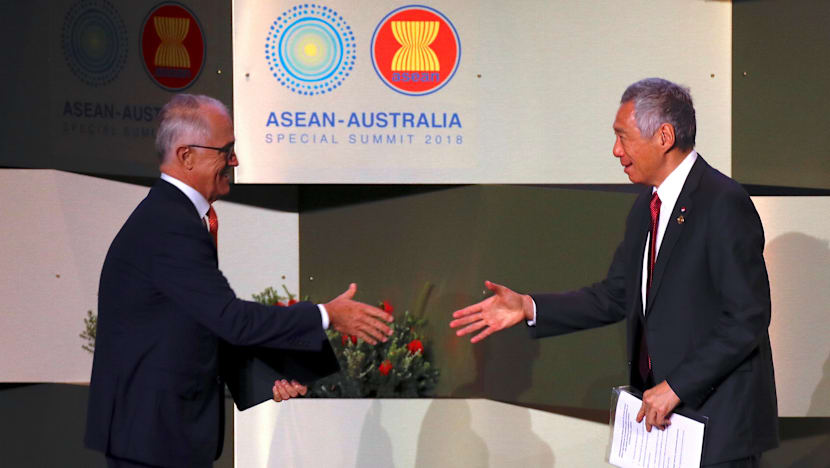
Australian Prime Minister Malcolm Turnbull shakes hands with Singapore's Prime Minister Lee Hsien Loong during the ASEAN-Australia Special Summit in Sydney on Friday (March 16). Photo: Reuters


SYDNEY — Even as other economies may be turning inwards, the Association of South-east Asian Nations (Asean) is keeping at its work of regional economic integration, and the grouping will be an important driver of the region’s prosperity, Prime Minister Lee Hsien Loong said on Friday (March 16).
“Asean continues to work towards regional economic integration. The global mood may be moving in the other direction, but within Asean, in South-east Asia, we’re trying our best to strive forward, to deepen integration, to deepen interdependence, to work together, to trade, to open up markets, to co-prosper together,” Mr Lee said at the opening of a conference at the Asean-Australia Business Summit in Sydney.
Mr Lee is on a four-day visit to the Australian city, where he will attend a series of bilateral and regional meetings, including a special summit between Asean leaders and Australia this weekend.
Australian Prime Minister Malcolm Turnbull, who also addressed the 500-strong audience at the opening of the Small and Medium Enterprise (SME) Conference on Friday, said protectionism was a “dead end” and that countries should embrace free trade and not retreat from it.





“You don’t grow stronger by closing the door to other markets. Protectionism is a dead end … We must face the world, not turn from it. Embrace free trade, not retreat from it, and do so on the basis of strong and transparent rules, fair and open competition and non-discriminatory legislation,” he said.
On the digital front, Mr Turnbull announced that Asean and Australia will work together to develop, adopt and use international standards that promote digital trade. These will be up-to-date and harmonised standards that make it easier for businesses to operate across borders.
Such standards will remove barriers to regional markets for businesses and create new jobs and growth opportunities.
The Australian leader said: “We’ll show the world what can be achieved when nations work together.”
Acknowledging that the pace and scale of digital change was moving along much faster than legislators, policymakers and regulators can keep up with, Mr Turnbull said digital trade standards will underpin the benefits of new technologies, from big data to artificial intelligence, and “harness the opportunities they bring to our region”.
Calling the new initiative a “very good first step in developing interoperable digital standards”, Mr Lee said it will pave the way for trade and cut business costs, particularly for SMEs.
Asean’s digital economy, though in its infancy, is fast gaining ground, replete with innovative start-ups, venture-capital platforms and business opportunities. Last year, for instance, start-ups in South-east Asia — including Singapore-based ride-hailing company Grab and Indonesia’s Go-Jek — drew a record US$8 billion (S$10.5 billion) from investors, Mr Lee pointed out.
This year, during Singapore’s chairmanship of Asean, the regional grouping is pursuing an agreement on e-commerce which will streamline the varying regulatory systems of its member states, making electronic transactions safer and more convenient.
On the economic front, Mr Lee noted Asean’s slew of initiatives over the years. These included lowering entry barriers and pruning transaction costs for businesses since the Asean Economic Community was formed in 2015.
“These initiatives are important and useful to businesses seeking to enter or grow their presence in Asean markets and beyond,” he said.
Stressing Asean’s strong economic fundamentals and good growth prospects, Mr Lee said the market — comprising more than 600 million people — is expected to become the fourth-biggest globally by 2030.
“Incomes are also growing in Asean countries. By 2020 … Asean’s annual consumer spending could reach US$2.3 trillion,” Mr Lee said.
Apart from a growing middle class, the region is enjoying a “demographic dividend”, with more than 60 per cent of Asean’s population under 35 years old. This means a “steady workforce and a growing consumer market in the coming years,” said Mr Lee.
Describing SMEs as an engine of growth, especially in rapidly developing economies such as Asean’s, Mr Lee said they were a source of jobs, forming at least half of employment in Asean countries. They also make up one-third to half the gross domestic product of Asean members, and up to a third of exports.
“But more importantly … SMEs are engines of innovation. They embody the spirit of enterprise,” said Mr Lee. “Many begin life as start-ups, before scaling up into market leaders.”
Often, successful SMEs venture beyond borders, braving challenges in search of new markets and opportunities. That is why many governments and Asean, at the regional level, have taken steps to develop their SMEs, said Mr Lee.
He added: “I am confident that SMEs have a promising outlook in Australia, as in Asean, and the combined efforts of businesses, industries, governments and partners will allow us to better seize the growing opportunities in our region, and make this a productive, prosperous and successful environment for businesses and for our peoples.”




