







Better access for S’pore firms to China’s legal, shipping, construction sectors under expanded free-trade deal
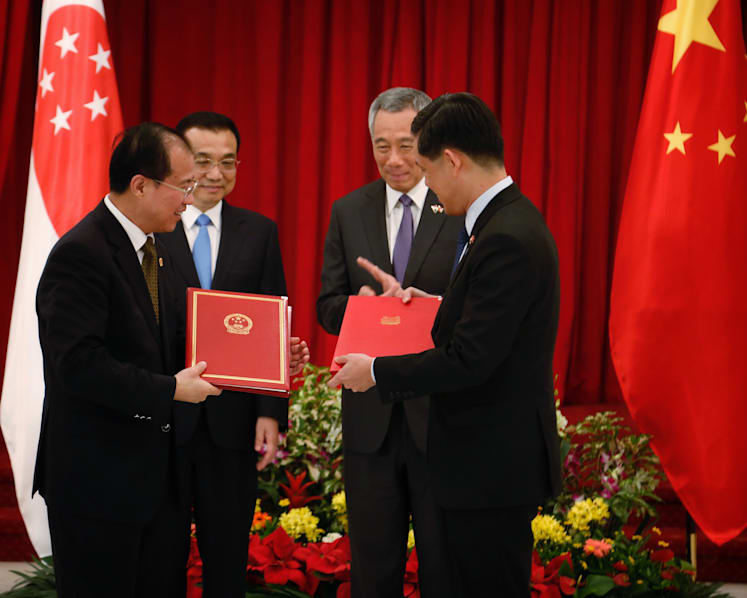
Exchange of the MOU between China’s International Trade Representative and Vice Minister of Commerce Fu Ziying, (L) and Minister for Trade & Industry Chan Chun Sing (R), while Prime Minister Lee Hsien Loong and Chinese Premier Li Keqiang look on, Nov 12, 2018.


SINGAPORE — Singapore firms are set to have greater access to China’s legal, maritime and construction sectors, and improved market access for goods entering China, under an enhanced free-trade deal three years in the making.
The upgraded China-Singapore Free-Trade Agreement was signed on Monday (Nov 12) by Trade and Industry Minister Chan Chun Sing and Chinese vice-minister of commerce Fu Ziying. It was witnessed by Prime Minister Lee Hsien Loong and visiting Chinese Premier Li Keqiang.
The two sides also exchanged several bilateral agreements, including one to elevate the China-Singapore Guangzhou Knowledge City to a state-level bilateral co-operation project, and a memorandum of understanding to develop a New International Land-Sea Trade Corridor under the Chongqing Connectivity Initiative, a trade route linking Western China with South-east Asia and the rest of the world.
The expanded China-Singapore Free-Trade Agreement will come into effect after ratification by both sides.





No expected date for this was provided, though Mr Chan said he looked forward to its “swift ratification”.
This will give Singapore firms improved access to the legal, maritime and construction sectors in China. For instance, Singapore law firms with offices in the Shanghai Free Trade Zone will be allowed to forge commercial associations with Chinese law firms in the zone, offering Chinese domestic and global legal services to clients across China.
Singapore construction firms in the Shanghai Free Trade Zone, Suzhou Industrial Park, Tianjin Eco-City, and the Chongqing Connectivity Initiative can also take on joint construction projects in the respective Chinese cities.
The latest agreement will also enhance market access for goods entering China, with more Singapore petrochemical exports to China qualifying for preferential treatment.
Besides that, traders will no longer have to submit hardcopy certificates of origin to China, with both sides transmitting documents via a new Electronic Origin Data Exchange System.
On its end, Singapore will liberalise the air transport, courier and environment sectors for Chinese firms. Those in courier services, for instance, will be able to deliver documents and parcels — excluding letters weighing 500g or less, as well as postcards — in Singapore.
Negotiations on the upgraded free-trade deal began in November 2015, with eight rounds of talks held in Singapore and Beijing.
The agreement has been in force since January 2009, and is the first comprehensive bilateral free-trade deal that China reached with an Asian country.
Since it was inked, trade between the two sides has risen by 4.6 per cent, and investments have expanded by 12.2 per cent yearly on average. Last year, total trade between Singapore and China amounted to S$137.1 billion.
As for the China-Singapore Guangzhou Knowledge City that was raised to state-level status, it will feature a “demonstrated zone for enhanced co-operation”, paving the way for tie-ups in areas such as technology innovation, intellectual property rights and talent development, Singapore’s Trade and Industry Ministry (MTI) said.
As part of this zone, there will be a 200ha demonstration area, envisaged as a new precinct for living, working, learning and play. Urban solutions giant Ascendas-Singbridge Group and the Sino-Singapore Guangzhou Knowledge City’s administrative committee will draw up its masterplan.
Guiding the development of the Knowledge City will be a joint working committee co-chaired by representatives at the ministerial level, and a joint implementation committee co-led by vice-ministerial representatives, the MTI said.
Separately, the MOU to develop the New International Land-Sea Trade Corridor, previously known as the Southern Transport Corridor, will pave the way for trade through stronger data, digital and financial flows, and standardised logistics practices and customs co-operation.
The multi-modal economic route will connect Chongqing in southwest China with Qinzhou in the south by rail, and Qinzhou to Singapore and beyond by sea.




