







Budget 2026: Singapore to set up National AI Council, chaired by PM Wong
The National AI Council will “provide strategic direction and drive Singapore's AI agenda”, said Prime Minister Lawrence Wong.


This audio is generated by an AI tool.


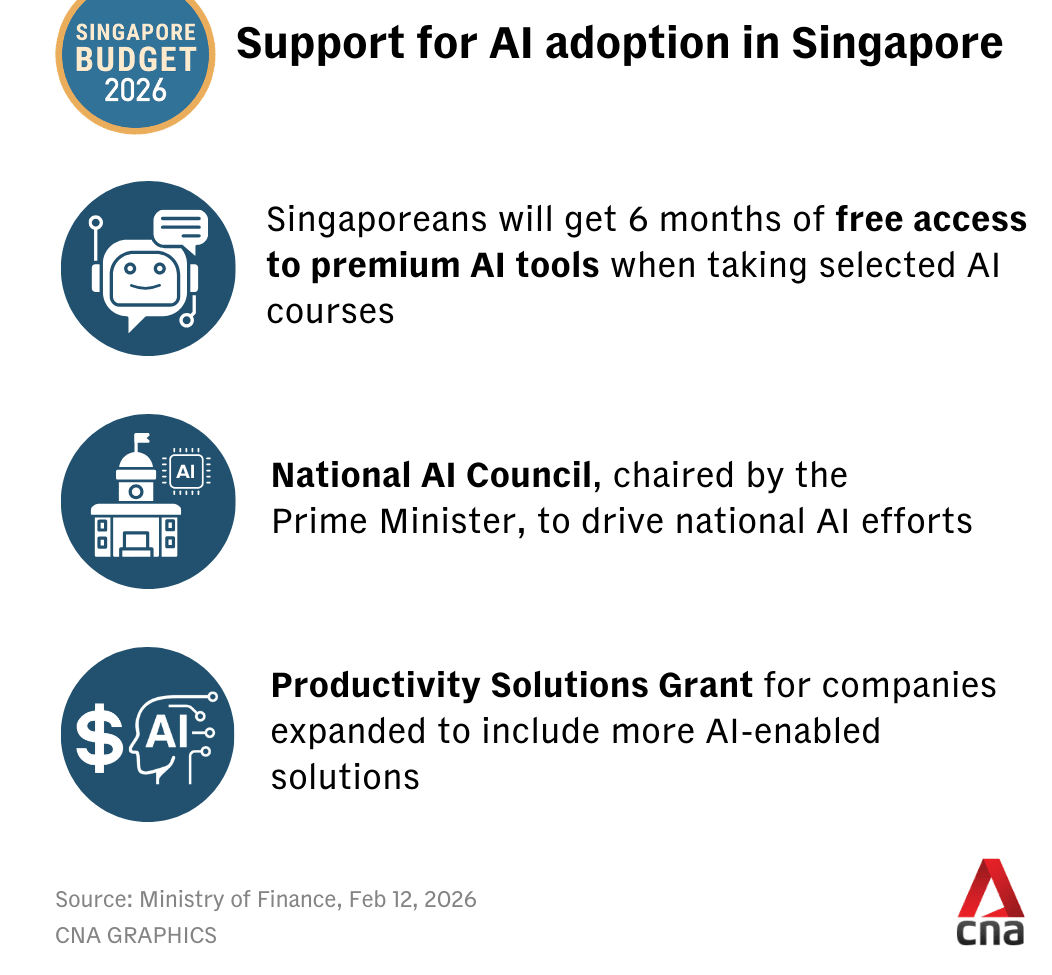
SINGAPORE: A new National Artificial Intelligence (AI) Council will be established and chaired by Prime Minister Lawrence Wong to coordinate and drive Singapore’s AI strategy.
The council will oversee the development and execution of “AI missions”, said Mr Wong on Thursday (Feb 12) in the Budget 2026 statement.
“These missions will drive AI-led transformation in key sectors of our economy, and push the boundaries of what is possible for Singapore and for the world,” said Mr Wong, who is also the finance minister.
The missions will focus on four sectors: advanced manufacturing, connectivity, finance and healthcare.
“For example, in advanced manufacturing, we aim to accelerate innovation and build best-in-class factories that can compete globally,” he said.
“In connectivity and logistics, AI can help to automate airport and seaport operations, move goods more efficiently and strengthen Singapore’s position as a leading global hub.”
He said the AI missions are not “abstract aspirations” but come with clear objectives and tangible outcomes.
But delivering these objectives will “require us to work differently”, he said.
“Within the government, we will better align our R&D (research and development), regulatory and investment promotion efforts, so that agencies act in concert and pull in the same direction.”
This will require a coordinated national effort, he said, and the establishment of the National AI Council will “provide strategic direction and to drive Singapore's AI agenda”.
The council will comprise:
- Deputy Prime Minister and Minister for Trade and Industry Gan Kim Yong
- Coordinating Minister for Social Policies and Minister for Health Ong Ye Kung
- Minister for Digital Development and Information Josephine Teo
- Minister for Manpower and Minister-in-charge of Energy and Science and Technology Tan See Leng
- Minister for National Development and Deputy Chairman of the Monetary Authority of Singapore Chee Hong Tat
- Acting Minister for Transport and Senior Minister of State for Finance Jeffrey Siow
The council will also tap expertise from the private sector. The finance ministry said more details would be released later.


FEAR OF AI CANNOT BE THE RESPONSE
While the potential of AI to raise productivity, unlock new discoveries and transform lives is immense, this promise also comes with deep concerns, such as job displacement, misinformation and the ethical use of powerful technologies.
These anxieties are real and must be confronted squarely, said Mr Wong.
“But fear cannot be Singapore’s response,” he said. “If we allow uncertainty to paralyse us, we will fall behind in a world that is moving rapidly ahead.”
He said how AI is developed and used in Singapore will be defined, with clear rules set to ensure it is applied responsibly and safely.
“And we will ensure that its benefits are shared widely across society,” he said.
He added that AI can help Singapore overcome structural constraints such as limited natural resources, a rapidly ageing population and a tight labour market.
However, Singapore’s advantage does not lie in building the largest frontier models, but in deploying AI effectively, responsibly and at speed.
“Singapore can be a trusted hub where companies and researchers come together to develop, test and deploy impactful AI solutions, and do so faster and more coherently than many larger countries,” he said.
He noted that companies such as Google and Microsoft have set up AI centres of excellence in Singapore, creating a growing number of jobs for Singaporeans.
But to fully realise AI’s potential, Singapore needs to move beyond individual pilots and isolated experiments.
“We must organise at a national level, and move with speed and scale,” he said.
NEW AI PARK
To bring more companies on board with AI transformation, a new Champions of AI programme will be launched to support firms with the ambition to use AI to comprehensively transform their businesses.
Support will be tailored to each company and will include enterprise transformation and workforce training.
“As these companies succeed, they will set benchmarks for their industries and inspire others to follow,” said Mr Wong.
Support for all enterprises, especially small- and medium-sized enterprises, will be strengthened.
The Enterprise Innovation Scheme will be expanded to include AI expenditures as a qualifying activity for the assessment years of 2027 and 2028, capped at S$50,000 (US$39,600) per year.
The scheme currently provides businesses with 400 per cent tax deductions on qualifying expenditures in activities such as research and development, innovation and capability development.
The Productivity Solutions Grant, which helps companies adopt digital solutions, will also be expanded to cover a wider range of digital and AI-enabled solutions.
A new AI park will be established at one-north. It will build on a pilot initiative called Lorong AI, a dedicated co-working space for the AI community at Cross Street.
“This will be a new cluster to catalyse ideas, forge collaborations, and translate AI initiatives into practical solutions for businesses and public services,” said Mr Wong.
"SINGAPORE IS WELL POSITIONED TO LEAD"
Major AI firms say that Singapore's AI plans are timely.
Mr Oliver Jay, managing director, international at Open AI, said that the economic gain from AI lies in closing the "capability overhang", which is the gap between what AI can do and how it typically is used.
"Closing that gap requires better tooling, training, and governance so businesses can safely deploy higher-value use cases," said Mr Jay.
He added that Singapore is in a good position to lead, ranking high for per-capita ChatGPT adoption, which is Open AI's AI chatbot.
"We look forward to partnering closely with the government, the upcoming National AI Council, and industry players to translate capability into measurable economic impact," he said.
Ms Eileen Chua, managing director of business software and AI firm SAP Singapore, said her company’s research shows that Singapore firms invested an average of S$18.9 million in AI over the past year, generating an average return of 16 per cent.
That figure is expected to rise to 29 per cent within the next two years.
"This illustrates that AI is already moving beyond concept into business impact," she said. "Government support that enables clear objectives, regulated sandboxes and coordinated industry missions will help enterprises accelerate that transition from early returns to sustained value."




