







Bukit Panjang residents well-prepared for first full-day LRT closure
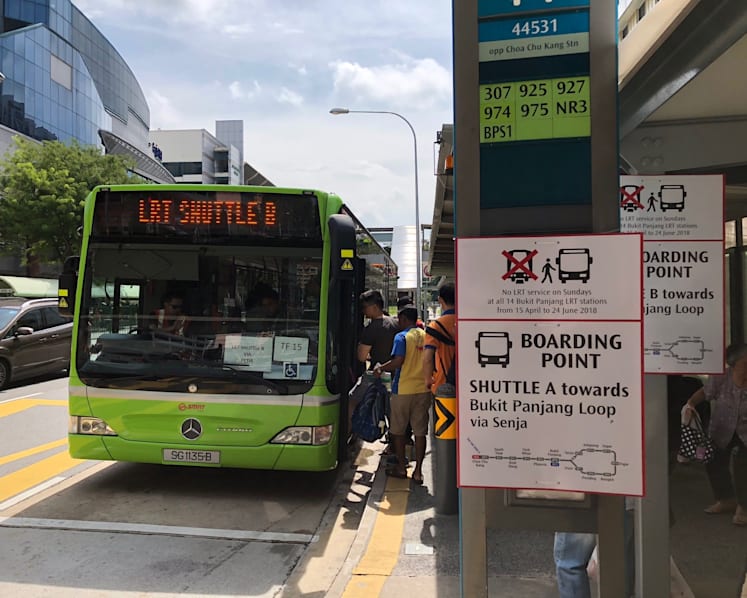
Commuters are seen boarding shuttle buses plying along the Bukit Panjang Light Rail Transit system on Sunday (April 15), the first of 11 full-day closures of the line.


SINGAPORE — In a departure from her Sunday routine, Bukit Panjang resident Chia Xi Zhen set off half an hour earlier than usual as she braced for a longer commute to her Jurong workplace.
Madam Chia, 52, was one of many residents of the town who budgeted more time for their travels on Sunday (April 15), the first of 11 full-day closures of the Bukit Panjang Light Rail Transit (LRT) system.
The full-day shutdowns, which will take place on Sundays until June 24, will give engineers more time to replace the ageing system’s track switch components, doors, propulsion systems and sections of the power rails.
Unsure about alternative transport arrangements, Mdm Chia left home at 10.15am on Sunday. After seeking directions from crowd marshals stationed near Bukit Panjang station, she took a shuttle bus to the Chua Chu Kang MRT Station, where she boarded an MRT train to Jurong East. This added 10 minutes to her journey.





Saying that commuting by road was more unpredictable than taking the LRT — since accidents could hold up traffic — Madam Chia said: “You still have to leave home early.”
Most of the residents approached by TODAY on Sunday were aware of the closures and said the impact on their commutes was minimal, given the availability of shuttle buses to ferry them between stations.
The buses arrived at intervals of eight to 10 minutes, while those serving the stretch between Chua Chu Kang and Bukit Panjang LRT stops arrived every four to five minutes.
Responding to TODAY’s queries, rail operator SMRT said up to 25 shuttle buses, and more than 60 staff members — comprising its employees and crowd marshals — would be deployed along the network throughout the day.
When TODAY rode on a shuttle bus between Fajar and Bukit Panjang LRT Stations around 9am, traffic was smooth although it was standing room only on the single-deck bus. The journey took slightly more than 10 minutes.
Besides those commuting to work, most residents were heading out to the shops or the market, or to visit relatives and friends.
A banker, who gave his name only as Mr Ken, said that he would make alternative travel plans for the weekends to come.
On Sundays, the 30-year-old usually takes the LRT from Segar to Chua Chu Kang, before switching to the North-South and East-West Lines to reach his workplace in Tiong Bahru.
During the full-day closures, he plans to take two buses to get to work.
Another resident Guna Seenakram, 43, had to set off for his Sunday activities five to 10 minutes earlier but said the overhaul of the LRT system was necessary.
“As long as the (alternative transport) runs smoothly, there’s no problem. I still can understand that they need to do maintenance,” said the private-hire bus driver.
Agreeing, Mdm Chia — who has been caught in multiple delays on the LRT — said: “If in the future, there are no longer such issues with the LRT, it’s a good thing for us residents.”
Last month, Land Transport Authority chief executive Ngien Hoon Ping signed a four-year S$344 million renewal contract for the Bukit Panjang LRT with its original supplier Bombardier.
SMRT also signed a contract with Bombardier for it to provide long-term service support for the renewed system for 10 years. It declined to reveal the value of the service support contract, which will see Bombardier providing speedier technical support and training for Bukit Panjang LRT’s maintenance staff.
Speaking in Parliament last month, Minister for Transport Khaw Boon Wan said the Bukit Panjang LRT, launched in 1999, was “reaching the end of its useful life”. In September last year, he had derided the system as an “afterthought” built under “political pressure”, resulting in a design that made for uncomfortable rides.




