







BYD cements lead as Singapore's top-selling car brand as EV sales surge to 45% of new registrations
The Chinese automaker registered over 11,000 vehicles in 2025, outpacing Toyota and BMW as electric vehicles comprised nearly half of all new car sales.
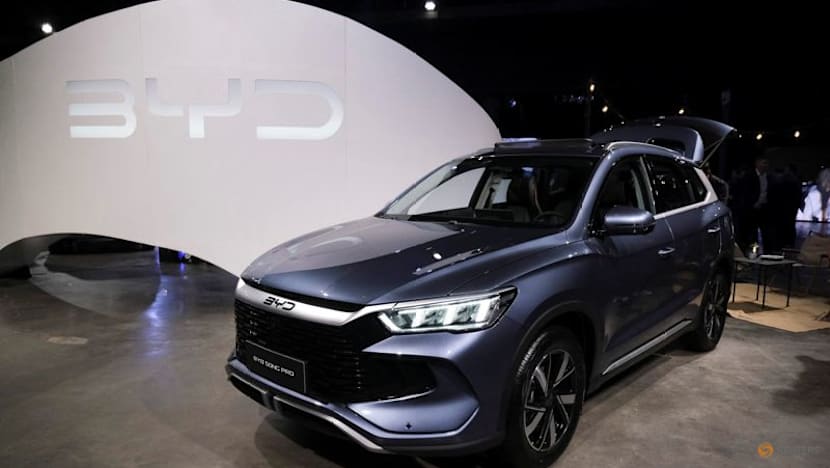
A BYD Song Pro electric vehicle is displayed during the launch event of Chinese electric vehicle (EV) maker BYD in Buenos Aires, Argentina, October 8, 2025. REUTERS/Alessia Maccioni

This audio is generated by an AI tool.


SINGAPORE: Chinese automaker BYD has solidified its position as Singapore’s best-selling car brand in 2025, capturing more than one-fifth of all new vehicle registrations as the nation's electric vehicle adoption reached record levels.
A total of 11,184 new BYD cars were registered last year, representing 21.2 per cent of the 52,678 cars registered.
Industry experts attributed BYD's success to competitive pricing and an extensive model line-up that caters to diverse consumer segments across the mass market.
Japanese carmaker Toyota secured second place with 7,466 new registrations, while German luxury manufacturer BMW was third with 5,091 vehicles.
Across all brands, a record 23,684 EVs were registered last year, or 45 per cent of all new cars.
This represents a substantial increase from 2024, when EVs accounted for 34 per cent of new registrations.
The total EV population on Singapore's roads reached 49,262 vehicles by year-end 2025, constituting 7.4 per cent of the overall car population – nearly double the 4 per cent share recorded in 2024.

ATTRACTIVE PRICES, AGGRESSIVE MARKETING
Associate Professor Walter Theseira, a transport economist from the Singapore University of Social Sciences, said BYD's market leadership comes as no surprise.
“For some time now, EVs from Chinese car makers have pulled ahead of mass market cars from the traditional Korean or Japanese mainstays in value for money and features,” he said.
“BYD also now offers cars across the entire mass market … so there really is a BYD for almost every popular car type in Singapore.”
The brand's luxury line, Denza, has enabled it to capture higher-end market segments, while BYD's established global presence has instilled greater consumer confidence compared to smaller Chinese automotive brands, Assoc Prof Theseira noted.
It was reported earlier this month that BYD had overtaken Tesla as the world's leading EV manufacturer. The American brand had sold 1.64 million EVs in 2025, while BYD sold 2.26 million.
In Singapore, Tesla remains the only other EV brand in the top 10, with 3,476 new registrations last year.
Mr Benjamin Loo, chief operating officer at car dealership CarTimes Group, said that BYD has stayed on top due to its aggressive international marketing strategy.
“Even in Singapore, they have four appointed dealers on top of the (official) brand distributor to ensure that they are able to cast a wide net,” he said.
Mr Loo suggested that the spike in EV registrations may also reflect consumers rushing to secure vehicles before government incentives decrease. The EV adoption rebate fell from a maximum of S$40,000 in 2025 to S$30,000 this year.
“This results in additional urgency for consumers to buy quickly,” he said.

CAN BYD RETAIN ITS CROWN?
Assoc Prof Theseira believes BYD's market dominance will likely persist, though the broader competitive landscape will be shaped by developments beyond Singapore's borders.
“All of this will be decided overseas, since whether a brand succeeds or not in Singapore has no real effect on its global profitability,” he said.
Key questions remain about whether Japanese and Korean manufacturers can regain competitiveness by launching more affordable EVs with compelling features, and whether other Chinese brands will achieve breakthrough success in the local market.
Mr Loo echoed this outlook, noting that emerging Chinese EV brands are entering Singapore but face an uphill battle.
“Other Chinese brands are starting to come into the market, but they would need some time to catch up to BYD and the current lead they have in both full product line-up and brand awareness,” said Mr Loo.




